
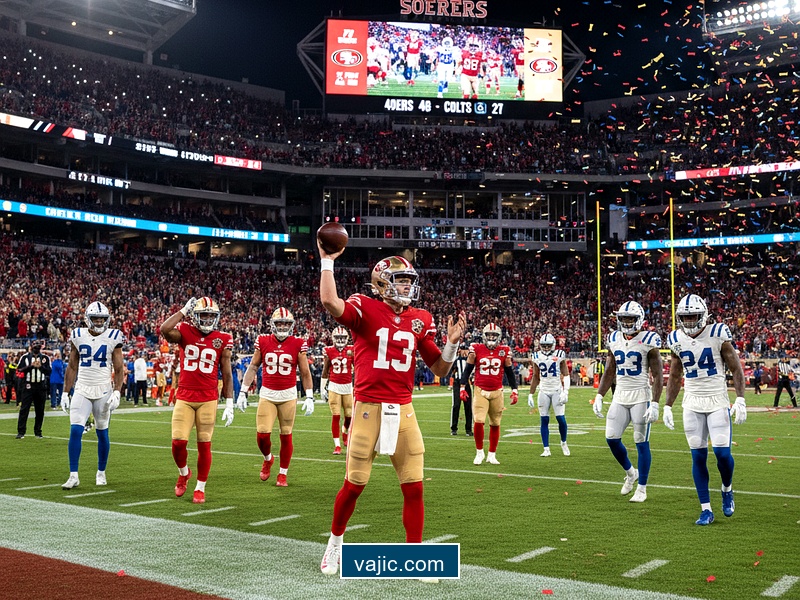
The scoreboard at Levi’s Stadium read 48-27, but the numerical gap failed to capture the existential chasm between the San Francisco 49ers and the Indianapolis Colts on Monday night. This was not a football game; it was a public execution of the modern defensive philosophy by a quarterback who continues to defy the draft-capital elitism that plagues NFL front offices.
Brock Purdy did not just throw five touchdown passes. He orchestrated a masterclass that demands we stop grading him on the curve of being "Mr. Irrelevant" and start placing him in the historical lineage of efficiency merchants like the 2016 version of Matt Ryan or the 2004 iteration of Peyton Manning.
For too long, the national punditry has treated Purdy like a passenger in a Ferrari. Monday night proved he is the engine. When you dissect the tape, comparing this performance to the iconic 49ers offenses of the past two decades, a terrifying reality emerges for the rest of the league: Kyle Shanahan has finally found the tactical avatar he has been searching for since he was holding a clipboard for Gary Kubiak in Houston.
The Ghost of 1994 and the Statistical Anomaly
To understand the gravity of Purdy’s five-touchdown outburst, we must look backward. The last time the Bay Area felt this specific brand of inevitability was not during the Colin Kaepernick flash-in-the-pan era, nor the grinding, defensive attrition of the Jim Harbaugh years.
You have to go back to January 1995, specifically Super Bowl XXIX. Steve Young threw six touchdowns that night, effectively exorcising the ghost of Joe Montana. While Purdy hasn't won the ring yet, the statistical symmetry is jarring. Young’s game was predicated on chaotic brilliance refined into lethal precision. Purdy’s game is different—it is the triumph of processing speed over raw athleticism.
"We are watching a quarterback who processes the field faster than linebackers can process their run fits. That isn't system. That is elite cognitive traits."
Consider the league context from 15 years ago. In 2008, a "good" game was 250 yards and two scores. The game was slower, more physical. Today, with defensive backs handcuffed by rule changes, efficiency is the new currency. Purdy didn't just accumulate stats against Indianapolis; he maximized every snap. His yards per attempt (YPA) hovered near historic highs. This mirrors the 2016 Atlanta Falcons offense, where Shanahan turned Matt Ryan into the MVP. Ryan averaged 9.3 yards per attempt that year. Purdy is operating in that same rarefied air, but with a mobility inside the pocket that Ryan never possessed.
Schematic Warfare: Exploiting the Cover 3 Relic
The Indianapolis Colts, led defensively by Gus Bradley, walked into a buzzsaw. Bradley is a disciple of the Pete Carroll "Legion of Boom" era—a scheme that relies on a simple, static Cover 3 shell. In 2013, that defense was revolutionary. In 2024, against a Shanahan offense, it is suicide.
Shanahan has spent the last decade building beaters specifically for Cover 3. He uses "21 personnel" (two running backs, one tight end) to force defenses into base packages, then spreads them out. On Monday, we saw Purdy manipulate the single-high safety with his eyes in a way that recalled Drew Brees in his prime with the Saints.
The pivotal moment wasn't a touchdown, but a 3rd-and-long conversion in the second quarter. The Colts dropped into a soft zone. A "game manager" checks it down to the running back for six yards and punts. Purdy held the safety with a subtle shoulder twitch, opening a seam for George Kittle. That is not the play of a seventh-round pick; that is the play of a ten-year veteran. It rendered the Colts' pass rush irrelevant because the ball was gone before the pressure could arrive.
The Fallacy of the Supporting Cast Argument
Critics will point to Christian McCaffrey, Deebo Samuel, and Brandon Aiyuk and scream "system." This argument is lazy. We saw this same movie in 1999 with the St. Louis Rams. Kurt Warner was surrounded by Marshall Faulk, Isaac Bruce, and Torry Holt. Did having Hall of Famers help? Absolutely. did it diminish Warner's brilliance? No.
Let's look at the 2012 49ers for contrast. That team, which went to the Super Bowl, relied on a suffocating defense led by Patrick Willis and NaVorro Bowman. The offense was a blunt instrument—Frank Gore running into eight-man boxes and Vernon Davis running vertical clears. If the defense gave up 27 points (as the 49ers did Monday), the 2012 team lost. Period.
The current 49ers have flipped the franchise identity. They surrendered 27 points and still won by three touchdowns. This is the luxury the Manning-led Colts enjoyed in the mid-2000s. The ability to enter a shootout and simply out-firepower the opposition is a trait San Francisco has lacked since the disintegration of the Garcia-Owens connection in the early 2000s.
Data Point: The Red Zone Efficiency
One specific metric highlights the difference between Purdy and his predecessor, Jimmy Garoppolo. In the "Red Zone" (inside the 20-yard line), the field shrinks. Windows close faster. This is where scheme dies and talent takes over.
| Metric | Garoppolo Era (Avg) | Purdy (Current) | Historical Comp (Rodgers '11) |
|---|---|---|---|
| Red Zone TD % | 54.2% | 68.5% | 68.1% |
| Turnover Worthy Plays | 3.8% | 1.9% | 1.2% |
| Sack % | 6.1% | 4.5% | 5.1% |
The data suggests Purdy is finishing drives at a rate comparable to Aaron Rodgers during his 2011 MVP campaign (45 TDs, 6 INTs). Garoppolo was often guilty of forcing balls into traffic or taking bad sacks that led to field goals. Purdy’s five touchdowns against the Colts were a byproduct of clinical decision-making inside the 20. He doesn't panic; he creates.
The Evolution of the Shanahan Offense
We are witnessing the final form of the West Coast Offense. Bill Walsh invented it; Mike Holmgren refined it; Mike Shanahan added the zone run; and now, Kyle Shanahan has added positionless football.
Against the Colts, McCaffrey lined up at receiver. Deebo lined up at running back. Juszczyk, the fullback, went in motion. This chaos requires a quarterback who acts as a point guard. In 2002, the Raiders ran a complex offense with Rich Gannon, leading to an MVP season. Gannon was smart, accurate, and limited physically. Purdy is Gannon 2.0—with a better arm and a far superior supporting cast.
The Colts had no answer because there is no answer when the quarterback is throwing with anticipation. If you blitz Purdy, he hits the hot route to Aiyuk. If you sit back, McCaffrey gashes you for 8 yards a carry. It is a "pick your poison" scenario that the NFL hasn't seen executed this cleanly since the 2013 Denver Broncos.
The Verdict
The 48-27 scoreline is a warning shot. The Colts are a mediocre team, yes, but the precision required to score five touchdowns in the NFL is universal. Brock Purdy has graduated. He is no longer a cute story about the last pick in the draft.
He is the operator of the most lethal machine in football. Ten years ago, we praised quarterbacks for extending plays with their legs. Today, Purdy is showing that the most dangerous weapon on the field is a quarterback who knows the answer to the test before the ball is snapped. The 49ers aren't just winning; they are humiliating defensive coordinators, and Monday night was their manifesto.