
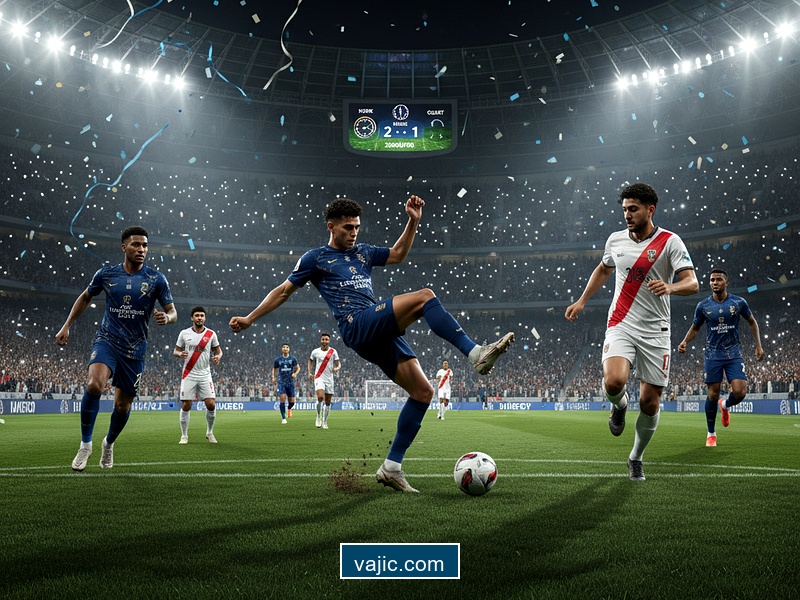
The Asian Football Confederation’s confirmation that Jeddah will host the 2026 AFC Champions League Elite™ Finals is not merely a logistical update; it is the final piece of a geopolitical and tactical puzzle that has been assembling itself since the Saudi Pro League’s privatization began. By selecting King Abdullah Sports City and Prince Abdullah Al Faisal Stadium as the battlegrounds for the "Final 8," the AFC has fundamentally altered the managerial calculus for the continent's top coaches.
For twenty years, I have covered the fragmented, travel-heavy slog that was the old Champions League. It was a tournament decided by logistics, jet lag, and humidity as much as tactical acumen. The shift to a centralized "Final 8" format on Saudi soil changes the sport from a marathon of attrition to a sprint of precision. For the managers sitting in the dugouts of Riyadh and Jeddah—specifically the likes of Jorge Jesus and Stefano Pioli—the assignment has shifted. The question is no longer about managing fatigue; it is about mastering the pressure of a home-soil coronation.
The Death of the "Travel Buffer"
To understand the magnitude of this venue decision, one must look at the historical tactical theory of Asian football. Historically, East Asian powerhouses like Ulsan HD or Urawa Red Diamonds relied on the "Travel Buffer." They knew that technical West Asian sides would struggle with the seven-hour flights, the distinct climate shifts, and the unfamiliar turf of Japan or Korea. The two-legged final was often a game of survival.
Jeddah 2026 erases that variable. By centralizing the Quarter-finals, Semi-finals, and Final in a single city, the AFC has adopted a "World Cup" style knockout format. This demands a distinct managerial philosophy: Tournament Periodization.
"In a league format, you manage for consistency. In a Final 8, you manage for chaos. The managers who succeed in Jeddah won't be the ones with the best system, but the ones with the best 'Plan B' when the system fails in the 80th minute."
This format heavily favors the "Galactico" model constructed by the Public Investment Fund (PIF). Clubs like Al-Hilal have built squads not just for the starting XI, but with international-quality depth that European sides would envy. In a condensed tournament where teams play three high-intensity games in roughly ten days, the manager who can rotate without a drop in quality wins. This is where the sustainability of the Saudi project shines—it is built for depth, whereas the J-League and K-League models are built for cohesion.
The "Jewel" as a Tactical Weapon
We cannot ignore the venues themselves. King Abdullah Sports City, colloquially known as "The Jewel," is not a neutral ground. Having attended matches there since its opening in 2014, I can attest that it possesses unique acoustic properties that rival Istanbul’s Vodafone Park or Dortmund’s Westfalenstadion. The stands are steep, trapping noise and creating a vertical wall of sound.
From a tactical perspective, the pitch at The Jewel is known for being fast and immaculate. This directly benefits managers like Jorge Jesus at Al-Hilal, whose philosophy relies on a high defensive line and rapid ball circulation. A slower, bumpier pitch often found in older West Asian venues acts as a leveler, slowing down superior technical teams. The pristine surface of the Finals venue removes that equalizer. It invites pure football, which, given the current disparity in talent acquisition, hands a massive advantage to the Saudi clubs.
Analyzing the "Project" Philosophy
The skepticism regarding the Saudi project often centers on the phrase "sustainable growth." Critics argue that buying aging stars is a short-term dopamine hit. However, the venue selection for 2026 suggests a maturing of the "Project."
We are seeing a shift from recruitment to infrastructure dominance. The managerial philosophy required to win in 2026 is not about counter-attacking or defensive rigidity—styles often employed by underdogs. The mandate for managers like Jesus or whoever occupies the Al-Nassr hot seat in two years is Dominant Proactivity. The expectation is not just to win, but to control. This is the "Pep Guardiola effect" transplanted to the Middle East.
| Feature | Old Format (Home/Away) | New Format (Jeddah Final 8) |
|---|---|---|
| Primary Stressor | Logistics & Travel Fatigue | Recovery Speed & Squad Depth |
| Managerial Focus | Conservative Away Tactics | Explosive "Cup Final" Mentality |
| Advantage | Defensive Organization | Individual Brilliance & Bench Impact |
The Ultimatum for the Manager
This announcement places a definitive expiration date on excuses. For the managers of the Saudi "Big Four," the 2026 Finals are a trap. If a Saudi club fails to lift the trophy in their own backyard, given the unprecedented investment and the removal of travel disadvantages, it will be viewed as a catastrophic tactical failure.
This creates a volatile environment. We are likely to see managers becoming more risk-averse in the league to preserve energy for the continental stage. The philosophy will shift toward "European" squad management—sacrificing domestic points to ensure peak physical condition for the Asian nights. It is a luxury only the deepest squads can afford.
The Verdict
Is the result of this venue selection sustainable for the growth of Asian football? That is the uncomfortable question. The centralization of power—financial, tactical, and now logistical—in Saudi Arabia risks turning the AFC Champions League Elite into a procession rather than a competition. However, from a sheer sporting perspective, it forces the rest of Asia to evolve.
The Japanese and Korean clubs can no longer rely on system superiority to beat financial superiority. They must find a way to replicate the intensity of a centralized tournament environment. For the Saudi managers, the philosophy is clear: You have been given the players, the wages, and now the venue. The era of "building" is over. The era of delivery has begun.
Jeddah 2026 will not just be a tournament; it will be a referendum on the billion-dollar philosophy of the Saudi Pro League. If they lose at home, the project hasn't failed, but the philosophy behind it will need to be burned to the ground and rebuilt.