
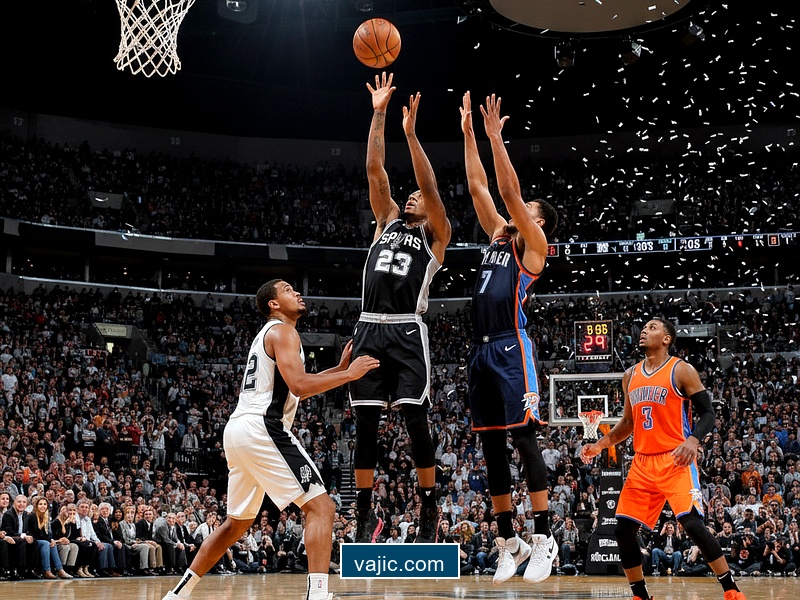
The betting lines from MGM and the breathless promos from ESPN will tell you this is about "The Next Great Rivalry." They aren't wrong, but they are focusing on the marquee rather than the machinery. What happened in Vegas during the preseason, and what we are about to witness twice during Christmas week, is not merely a clash of marketed stars. It is a collision of two distinct basketball philosophies, personified by two biomechanical anomalies who are actively rewriting the geometry of the court.
I have spent two decades watching big men plod through the paint, banging bodies in a phone booth. Watching Victor Wembanyama and Chet Holmgren is different. It requires a recalibration of the scout’s eye. We are no longer looking for leverage and mass; we are analyzing suspension systems, torque, and catch radiuses that defy Euclidean logic. The Spurs and the Thunder aren't just playing games; they are presenting the league with a new physics problem.
The Biomechanics of the Modern "Big"
To understand why this rivalry matters, you have to look past the box score and study the movement patterns. During the Vegas exhibition, a sequence occurred that I’ve replayed a dozen times. Holmgren drove right, executed a euro-step that requires the hip fluidity of a 6-foot-2 guard, and finished at the rim. On the ensuing possession, Wembanyama caught the ball at the three-point line, took one dribble, and dunked.
From a scouting perspective, we are witnessing the death of the "stiff" center. Holmgren’s movement economy is elite. Watch his feet when he sets a drag screen. He doesn't just plant; he flips his hips instantly to dive or pop. This is "ground force production" applied horizontally rather than vertically. He moves like a wing who was stretched on a rack.
"The terrified look in a driver's eyes when they turn the corner and realize the lane is occupied by a 7-foot-4 wingspan is the new currency of NBA defense. It's not about the block; it's about the shot that never leaves the hand."
Wembanyama, conversely, operates with a verticality that renders traditional defensive rotations obsolete. In standard pick-and-roll coverage, a defender "tags" the roller. With Wembanyama, the "tag" is useless because his catch radius is three feet higher than any rotational defender can reach. We call this "vertical spacing." It exerts pressure on the rim without the player even touching the ball, forcing defenses to contract in ways that leave shooters wide open.
Schematic Warfare: Daigneault’s Precision vs. Popovich’s Laboratory
While the media focuses on the players, the coaching chess match is where the game will be won. Oklahoma City Head Coach Mark Daigneault has implemented a "0.5 offense"—catch, shoot, or drive in half a second. The Thunder’s system relies on five-out spacing where Holmgren acts as the fulcrum. His ability to handle the ball in transition allows OKC to invert the floor.
Watch for the "Ghost Screen." This is where Holmgren sprints to set a screen but slips into open space before making contact. Because of his shooting gravity, both defenders often panic and jump to him, leaving the ball handler—usually Shai Gilgeous-Alexander—with a runway to the rim. It is a terrifying predicament for defenses: help off the unicorn and give up a three, or stay home and surrender a layup.
San Antonio remains in the experimental phase. Gregg Popovich is treating this season as a laboratory. The experiment of playing Jeremy Sochan at point guard is less about winning now and more about developing a squad of positionless interchangeability. However, the Spurs must figure out their entry angles. Too often, they miss Wembanyama on the seal. The "unseen" work here is the post-entry pass. It is a lost art. If the Spurs cannot deliver the ball over the top of a fronting defense, Wembanyama’s height becomes a theoretical advantage rather than a practical one.
Tale of the Tape: The Unseen Metrics
When evaluating these two franchises, we must look at the specific attributes that define their current trajectories. The following breakdown highlights the contrast in their team-building ethos.
| Attribute | Oklahoma City Thunder | San Antonio Spurs |
|---|---|---|
| Rebuilding Stage | Acceleration Phase (Contender) | Foundation Phase (Discovery) |
| Defensive Philosophy | Switch-heavy, aggressive nail help | Drop coverage, funnel to Wemby |
| Offensive Fulcrum | Gilgeous-Alexander (Drive & Kick) | System-based motion |
| X-Factor | Lu Dort (Point of Attack Defense) | Devin Vassell (Shot Creation) |
The Psychological Component: Body Language and "The Dog"
Skill is essential, but temperament dictates ceilings. In Vegas, I watched the interactions during dead balls closely. Holmgren has a nastiness to him. He initiates contact. When he gets bumped, he doesn't complain to the refs; he lowers his shoulder on the next possession. He plays with the chip of a guy who was told he was too skinny his whole life.
Wembanyama is more stoic, almost Tim Duncan-esque in his emotional regulation. But don't mistake silence for softness. His recovery blocks—where he is beaten off the dribble but recovers to swat the ball from behind—are demoralizing. That requires a relentless motor. The question for the Spurs is who will be the "enforcer." Every unicorn needs a bodyguard. In the 90s, Robinson had Avery Johnson and later Mario Elie. Who protects Victor? Sochan seems eager for the role, engaging in skirmishes and getting under skins. Watch his interactions with OKC’s Lu Dort. That specific subplot—the grinders doing the dirty work while the aliens battle in the clouds—is where the real rivalry heat will generate.
Christmas Day and the League's New Pivot
The NBA schedule makers placing this matchup on Christmas Day is a signal fire. For a decade, the league’s marketing rested on the shoulders of LeBron James and Stephen Curry. That era is sunsetting. The league is desperate for the next binary opposition—Magic vs. Bird, Shaq vs. Kobe. They are betting the house that Spurs-Thunder is it.
Historically, the Spurs and Thunder have bad blood dating back to the 2012 Western Conference Finals and the 2014 rematch. That was tactical brilliance: The beautiful game of the Spurs against the raw athleticism of Durant and Westbrook. We are seeing a remix of that track. But this time, the athleticism is fused with high IQ. The Thunder are further along the timeline. They have accumulated a war chest of draft picks and a roster that makes sense today.
The Spurs are playing the long game, willing to lose battles now to win the war in 2027. But make no mistake, when these two teams meet, the developmental timelines pause. Wembanyama knows Holmgren is the only other human on earth who understands his specific burden. Holmgren knows Wembanyama is the only obstacle between him and recognition as the prototype of the future.
Forget the promo codes. Forget the highlight reels. Watch the footwork. Watch the spacing. This is the first chapter of a decade-long dissertation on how basketball is played above the rim.