
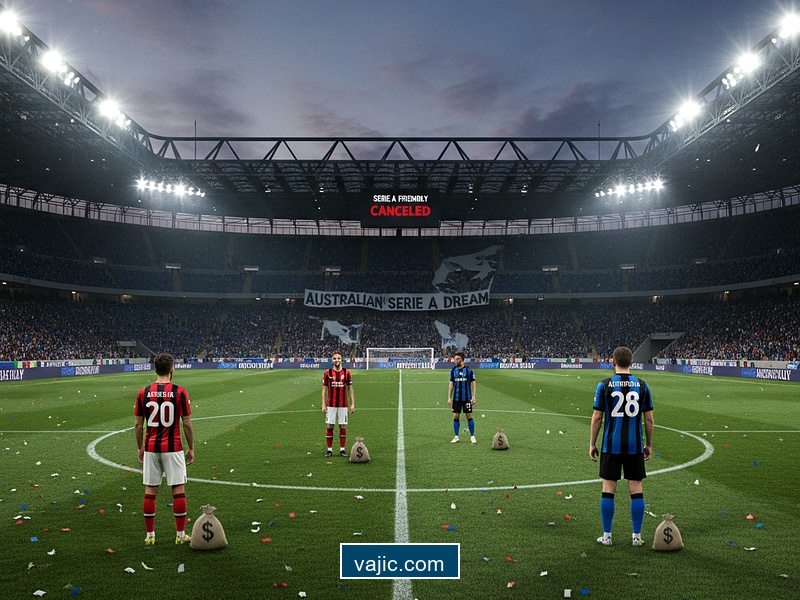
The news that the proposed Serie A exhibition match in Australia has collapsed under the weight of "financial concerns" is not merely a scheduling hiccup. It is a damning indictment of the current philosophy governing Italian football. We are witnessing the collision of aggressive American capitalism with the chaotic reality of Calcio, and the wreckage is landing on the shores of Perth.
To understand why this cancellation matters, we must look beyond the logistics of a 90-minute friendly that will no longer happen. We must analyze the "Manager" in the truest sense of the modern game: not the man in the tracksuit on the touchline, but the private equity architects in the boardroom. This was not a failure of football; it was a failure of the "Project." The cancellation exposes the fragility of the strategy adopted by ownership groups like RedBird Capital (AC Milan) and The Friedkin Group (AS Roma), who seem intent on forcing a global expansion that the product—and the balance sheets—cannot yet support.
The Philosophy of "Content" Over Calcio
The philosophy driving these postseason tours is rooted in a fundamental misunderstanding of what made Serie A the world’s greatest league in the 1990s. The current managerial directive is "Calcio as Content." The objective is to transform historic sporting institutions into media companies. Under this doctrine, a match is not a competition; it is inventory to be monetized.
The strategic focus here is the desperate pursuit of the Premier League’s revenue model. The English top flight generates over €4 billion annually in domestic and international TV rights. Serie A struggles to scrape together €1 billion. The gap is existential. The proposed solution by the league’s governance, led by Luigi De Siervo, and the American owners, is to export the brand aggressively. They look at the NFL playing in London or the Premier League Summer Series in the USA and attempt to replicate the behavior without replicating the infrastructure.
"You cannot build a skyscraper on a swamp. You cannot demand global blockbuster fees for a product that is still struggling with solvency and stadium infrastructure at home."
The "Project" fails because it puts the cart miles before the horse. The Premier League tours are victory laps; Serie A’s proposed tours are begging bowls. The financial concerns in Australia likely stemmed from a local promoter realizing that, unlike Manchester United or Liverpool, the brand equity of current Italian sides—despite their heritage—does not guarantee a sold-out Optus Stadium at premium prices. The math simply didn't work.
Tactical Analysis of the Boardroom Failure
Let’s dissect the tactical setup of this failed venture. The strategy relies on the "Flywheel Effect"—a concept beloved by Gerry Cardinale at Milan. The theory is that sports success feeds media presence, which feeds commercial revenue, which feeds transfer budget. However, this philosophy ignores the human element: the players.
Scheduling a high-intensity friendly on the other side of the planet, immediately following a grueling domestic season and right before the European Championships and Copa America, is tactically suicidal. It treats players like assets to be sweated rather than athletes to be protected. This is the "Moneyball" approach stripped of its intellect and replaced with pure greed.
The cancellation is, ironically, a tactical victory for the actual football managers—the coaches. It saves them from risking their stars’ ACLs on a cricket pitch in Western Australia for a paycheck that might not clear. It reveals a disconnect between the Sporting Project (winning trophies) and the Commercial Project (brand expansion). When these two philosophies clash in Italy, chaos usually ensues. In this case, the chaotic disorganization of the event saved the league from further embarrassment.
Historical Context: The Ghost of Cragnotti
To understand the unsustainability of this current model, we must look at history. In the late 1990s and early 2000s, Serie A was the "NBA of Football." It was driven by the patronage of industrial tycoons: The Agnellis, Morattis, Berlusconis, Cragnottis, and Tanzis. They spent with reckless abandon. It was financially doped, but the product was undeniable.
The current "American Project" is the inverse. The spending is austere, governed by Financial Fair Play and settlement agreements, yet the commercial ambition is delusional. We have moved from the "Seven Sisters" burning Lira to impress the locals, to Hedge Funds trying to extract Euros to please limited partners.
| Era | Ownership Profile | Primary Motivation | Outcome |
|---|---|---|---|
| 1990-2010 | Italian Industrial Families | Prestige & Political Influence | Sporting Dominance, Financial Ruin |
| 2011-2017 | Transitional / Asian Speculation | Brand Association | Instability, Management Turnover |
| 2018-Present | US Private Equity / Consortia | Asset Appreciation & Media Rights | Austerity, Failed Global Expansion |
The collapse of the Australia match is a symptom of trying to operate in the third column of this table while expecting the results of the first. You cannot strip-mine the assets (selling Sandro Tonali, for instance) to balance the books and then expect the world to pay a premium to watch your team play an exhibition.
Is This Sustainable?
If we judge the "Project" by this result, the answer is a resounding no. The sustainability of the modern Serie A model relies on a fallacy: that the brand "Italy" is enough to cover the cracks of the system.
The league is currently cannibalizing itself. We see this in the scheduling of the Supercoppa Italiana in Saudi Arabia. While that event secures guaranteed cash, it alienates the core domestic fanbase—the Curva—who are the actual custodians of the atmosphere that makes Serie A marketable. By chasing the Australian dollar or the Saudi Riyal, the ownership risks diluting the only unique selling point they have left: passion.
Furthermore, the "Project" ignores the logistical reality of modern football. The calendar is saturated. FIFA’s expanded Club World Cup and UEFA’s new Champions League format leave zero room for these speculative commercial ventures. The managers and players are at a breaking point. Trying to squeeze a trans-hemispheric flight into this calendar isn't just bad management; it is negligence.
The Verdict
The cancellation of the Australia match should serve as a wake-up call, though it likely won't. The "Managers" in the boardroom are playing a spreadsheet game, not a football game. They view this cancellation as a line-item error, a revenue projection missed.
They are wrong. This is a structural failure. It proves that you cannot force globalization. The Premier League didn't conquer the world by scheduling friendlies in Perth; they did it by creating a high-octane, television-friendly product in renovated stadiums with the best talent in the world, week in and week out.
Serie A’s ownership groups are trying to skip the hard work. They want the global tour without building the stadium. They want the massive TV rights without fixing the slow, tactical pacing of the game that turns off casual international viewers. The philosophy of "Brand First, Football Second" has hit a wall. Until the focus returns to the sustainability of the domestic product—crumbling concrete, racist incidents, and bureaucratic incompetence included—these global expeditions will continue to look less like imperial conquests and more like a circus act that couldn't afford the tent.