
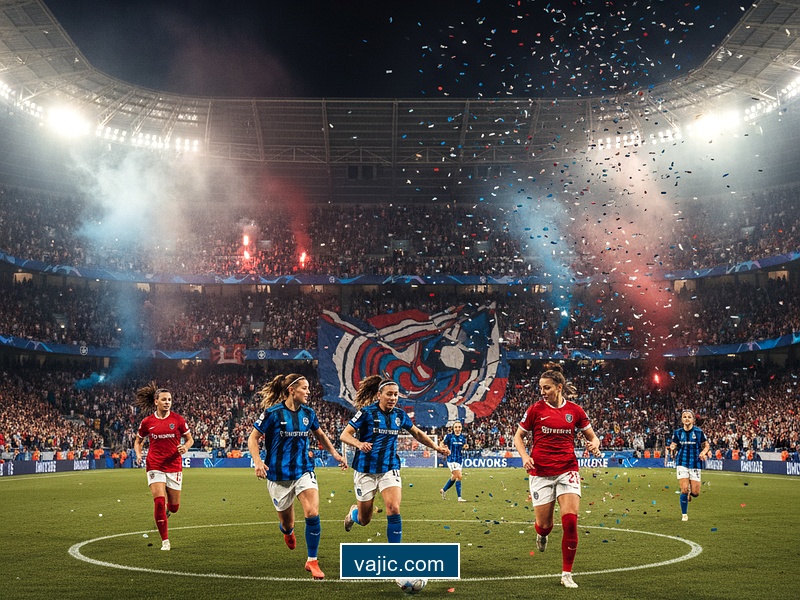
If you are looking at the 2025/26 Women's Champions League fixture list and circling dates based on star power, you are watching the sport wrong. Put down the fan scarf and pick up the wide-angle lens. The era of the solitary genius dragging a team to a European final is dead. It has been suffocated by the hive mind.
Having spent two decades analyzing the minutiae of elite football, the upcoming campaign represents a definitive shift in scouting methodology. We are no longer looking for the player who can run the fastest or shoot the hardest. We are looking for the player who knows where to stand when the ball is sixty yards away. The fixture list released by UEFA isn't just a schedule; it is a gauntlet that will expose the teams relying on athleticism over cognitive processing.
The "Rest Defense" litmus Test
The defining tactical battleground for the 2025/26 season will not be in the final third, but in the transition. specifically, the concept of Restfeld or "rest defense." This is the structure a team maintains while they are in possession, preparing for the inevitable turnover.
Watch the body language of the center-backs from the heavy hitters—Barcelona, Lyon, Chelsea—when their team is attacking a low block. The amateur eye watches the winger dribbling. The scout watches the weak-side defender. Are their hips open to the field? Are they scanning the blind side of the opposing striker? Or are they ball-watching?
In previous seasons, we saw English sides, particularly Arsenal and Manchester City, suffer in Europe because their rest defense was reactive rather than proactive. They relied on recovery pace—sprinting back after losing the ball. In 2025/26, that is suicide. The modern European elite press with such ferocity that if your center-backs aren't positioned to kill the counter-attack before the pass is even made, the goal is already conceded. The top teams effectively defend while they attack.
"The difference between a good player and a world-class player is what they do in the two seconds after they lose possession. But the difference between a champion and a runner-up is what they did in the five seconds before they lost it."
Scanning: The Metric That Matters
Let’s talk about "scanning frequency." This is the most critical unmeasured stat in women's football right now. When analyzing the midfield engines of the top contenders, look for the 'head swivel.' Top-tier midfielders like Aitana Bonmatí or Keira Walsh don't just look; they take mental snapshots of the field at a rate of 0.6 to 0.8 scans per second.
This creates what we call "cognitive time." By the time the ball arrives at their feet, they have already played the pass in their head. This season, watch the underdogs—perhaps the qualifiers from the Nordic leagues or the emerging Italian sides. You will spot the difference instantly. Their midfielders will receive the ball, then look up. That half-second delay is where the high press eats them alive.
The fixture density of the 2025/26 format demands high cognitive load management. Players who don't scan effectively suffer from faster mental fatigue, leading to technical breakdowns in the 75th minute. That is where these group stage matches will be decided.
The Evolution of the Pressing Trap
Reviewing the confirmed entrants and the path through the qualifying rounds, we are seeing a shift in defensive shapes. The generic 4-4-2 block is being dismantled by dynamic pressing traps. We used to see pressing as "running at the goalkeeper." That is wasted energy.
The sophisticated approach we will see this season involves "shadow cover." Watch how Wolfsburg or Bayern Munich forwards press. They don't run in straight lines. They make curved runs (arcing runs) to block the passing lane to the center-back while closing down the goalkeeper. They are defending two players at once.
This forces the opposition to play into specific "kill zones"—usually the touchline or a crowded central pocket—where the defense collapses like a bear trap. If a team in the 2025/26 group stage tries to play out from the back without players comfortable receiving under heavy duress (facing their own goal), they will be liquidated.
Off-Ball Gravity and the Third-Man Run
The most expensive commodity in football is space. The best teams manipulate it; the average teams occupy it. When scouting the forward lines for this Champions League campaign, ignore the goal highlights. Look at the movement that creates the space for the goalscorer.
This is "gravity." A striker who demands double coverage creates numerical superiority elsewhere. We are seeing a resurgence of the "third-man run" in the women's game. Player A passes to Player B, who sets it for the onrushing Player C. Player C is the dangerous one, but Player C is only open because Player A dragged a defender out of position with a decoy sprint.
It is distinctively different from the "Hero Ball" of the early 2010s, where Marta or Lotta Schelin would isolate defenders 1v1. Defenses are too organized now. The low block is too compact. The only way to break the 2025 defensive structure is through rapid, synchronized movement that disrupts the defensive chain's spacing.
The Physicality Myth
There is a lazy narrative in sports journalism that the gap in the women's game is closing due to "physicality." This is false. The physical gap closed five years ago. The current gap is tactical education.
| Attribute | 2015 Era Focus | 2025/26 Era Focus |
|---|---|---|
| Defending | Individual tackling & recovery speed | Zonal structure & Rest defense positioning |
| Midfield | Ball carrying & Dribbling | Scanning & One-touch progression |
| Pressing | Intensity (running hard) | Triggers (running smart) |
| Wide Play | Crossing from the byline | Inverted runs into half-spaces |
The teams that will struggle in the 2025/26 fixtures are those that rely on athleticism to solve tactical problems. You cannot outrun a bad system. We saw this with the stagnation of certain NWSL-influenced styles when transposed to the European stage. The chaotic, transition-heavy game is being systematically dismantled by teams that value control and La Pausa—the ability to slow the game down to provoke a defender into stepping out of line.
The Unseen Fatigue
Finally, a word on the schedule itself. The expansion of the calendar creates "cumulative cognitive load." By the time we reach the quarter-finals in March 2026, the teams left standing will be the ones with the deepest tactical literacy, not just the deepest benches.
When a player is tired, the first thing to go isn't their legs; it's their scanning. They stop checking their shoulders. They stop adjusting their hip orientation. They revert to instinct rather than system. The manager who can rotate their squad without diluting the tactical IQ on the pitch is the one who will lift the trophy.
So, as you review the 2025/26 fixtures, look beyond the crests. Look for the teams that move like a single organism. Look for the center-backs standing on the halfway line while their team takes a corner. Look for the midfielder checking her shoulder three times before the ball arrives. That is where the trophy is won. Everything else is just noise.