
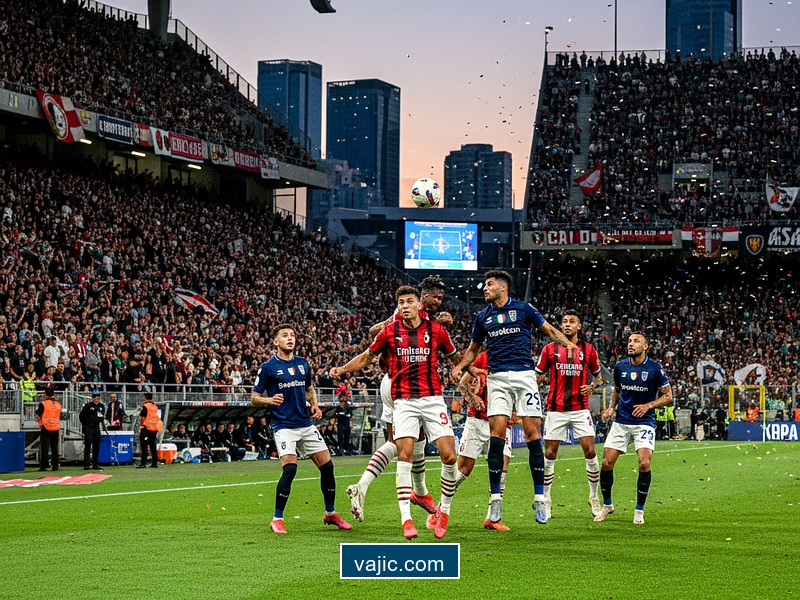
Sometimes, the best move in football is the one you don’t make. The news that Serie A has scrapped plans for a post-season exhibition between AC Milan and Como in Perth, Australia, will be mourned by the accountants at Casa Milan and the marketing executives at RedBird Capital. They will see a hole in the balance sheet, a missed opportunity to expand the brand in the Asia-Pacific region, and a failure to leverage the burgeoning glamour of Como’s celebrity ownership.
However, for Paulo Fonseca, this cancellation is not a failure of logistics; it is a divine intervention. In a sport that increasingly treats players like battery hens and managers like short-order cooks, the elimination of a 26-hour flight to play a meaningless friendly is a rare victory for the integrity of the "Project" over the demands of the ledger.
The Cost of Frequent Flyer Miles
Modern football management is less about tactical innovation and more about crisis management amidst exhaustion. When we analyze why teams collapse in the spring, we often look at muscle injuries or tactical staleness. We rarely quantify the cognitive load of commercial obligations. For a manager like Fonseca, whose system requires absolute mental sharpness and synchronized movement, fatigue is the enemy of structure.
Fonseca arrived at Milanello with a mandate to evolve the team from Stefano Pioli’s chaos-ball—a style predicated on individual duels and heavy transition—into a dominant, possession-based machine. That transition does not happen on an Airbus A380 over the Indian Ocean. It happens on the grass at Carnago, through repetitive drilling of pressing triggers and defensive spacing.
The High Line: Bravery or Suicide?
To understand why this reprieve matters, one must dissect the fragility of Fonseca’s tactical philosophy. The Portuguese technician operates on a razor-thin margin of error. His insistence on an aggressively high defensive line is not merely a preference; it is the foundational dogma of his approach. He demands that his center-backs, often Fikayo Tomori and Matteo Gabbia or Malick Thiaw, defend 50 yards from their own goal to compress the pitch.
"Fonseca’s football is an act of faith. It asks defenders to abandon the safety of the penalty box in exchange for territorial dominance—a transaction that looks brilliant when it works and calamitous when it fails."
This system differs radically from the Catenaccio DNA still lingering in the Italian subconscious. Even Arrigo Sacchi, the godfather of the high press, emphasized the collective shape over individual recovery pace. Fonseca, conversely, often leaves his defenders in isolated one-on-one situations, relying on the "offside trap" not as a tactic, but as a lifestyle. When legs are heavy and minds are foggy from travel, the timing of that step-up lags by a fraction of a second. In Serie A, against strikers like Lautaro Martinez or Dusan Vlahovic, that fraction is the difference between a clean sheet and a humiliation.
The RedBird Algorithm vs. The Eye Test
The cancellation of the Como fixture also forces us to confront the schism at the heart of AC Milan’s ownership. Gerry Cardinale’s RedBird Capital operates on a Moneyball-adjacent philosophy: buy undervalued assets with high ceilings (Christian Pulisic, Tijjani Reijnders, Youssouf Fofana), develop them, and win through efficiency. It is a corporate strategy that views the club as a content producer.
The proposed match against Como was the perfect embodiment of this. Como 1907, backed by the enormous wealth of the Hartono brothers and fronted by Cesc Fàbregas and Thierry Henry, is the trendiest project in Italy. A match in Perth would have been a festival of "vibes" and marketing synergy. But strictly from a footballing perspective, does playing a friendly against a Serie A rival on the other side of the world advance the tactical coherence of the squad?
Absolutely not. It exposes the tension between the commercial drive to be a global entertainment company and the sporting necessity of being a coherent football team. By removing this distraction, the focus returns to the pitch, where the algorithm has yet to solve the Rafael Leão conundrum.
The Leão Paradox and Structural Integrity
No analysis of Fonseca’s tenure is valid without addressing the left flank. The sustainability of Milan’s project hinges on reconciling the genius of Rafael Leão with the demands of modern pressing structures. Under Pioli, Leão was granted a distinct license to drift; under Fonseca, the demand for defensive contribution has increased, creating visible friction.
This is where the "Project" faces its sustainability test. A high-pressing system requires 11 active participants. If one player creates a disconnect, the passing lanes open up, and that high defensive line is exposed. We have seen moments this season where Milan’s midfield pivot—often Reijnders and Fofana—is left chasing shadows because the initial press was bypassed too easily. The result is a team that creates high xG (Expected Goals) but concedes chances of terrifying quality.
Fixing this requires tactical drilling, video sessions, and rest. It requires convincing Leão that tracking back is not a punishment, but a prerequisite for the team’s survival. You cannot coach this mentality in an airport lounge in Western Australia.
Como: The Romantic Counterpoint
Briefly, we must look at the other side of this cancelled ticket. Cesc Fàbregas is attempting something equally ambitious at Como. He is trying to import a pure Spanish positional play style—La Pausa, rapid triangles, playing through the third man—into the rigorous tactical chessboard of Italy. Like Fonseca, Fàbregas needs time. Como’s survival in the top flight won’t be dictated by their commercial appeal, but by their ability to execute complex passing patterns under duress.
For Fàbregas, a rookie manager, the scrapping of this tour is arguably even more beneficial. It prevents his squad, a mix of veterans (like Sergi Roberto) and hungry talent (like Nico Paz), from being paraded as show ponies when they need to be training as racehorses.
The Verdict: Sustainable or Ephemeral?
So, is Fonseca’s project sustainable? The skepticism is warranted. Serie A is a league that historically punishes dogmatism. From Zdeněk Zeman’s Foggia to Luis Enrique’s Roma, coaches who prioritize aesthetics over structural solidity often face a brutal reckoning. Milan’s current trajectory suggests a team capable of beating Real Madrid on a Tuesday and losing to Cagliari on a Saturday. That volatility is the hallmark of a team that understands the idea of the philosophy but lacks the muscle memory to execute it consistently.
The cancellation of the Perth friendly is a small administrative footnote, but it symbolizes a momentary reprieve from the relentless grind of modern football commerce. It grants Fonseca the one resource money cannot buy: time. If he uses it to tighten the gap between his center-backs and his pivot, to synchronize the press, and to bridge the gap between Leão and the rest of the squad, this non-event might be more valuable than any trophy lifted in a pre-season tournament.
Football is played on grass, not on spreadsheets. For once, the grass won.