
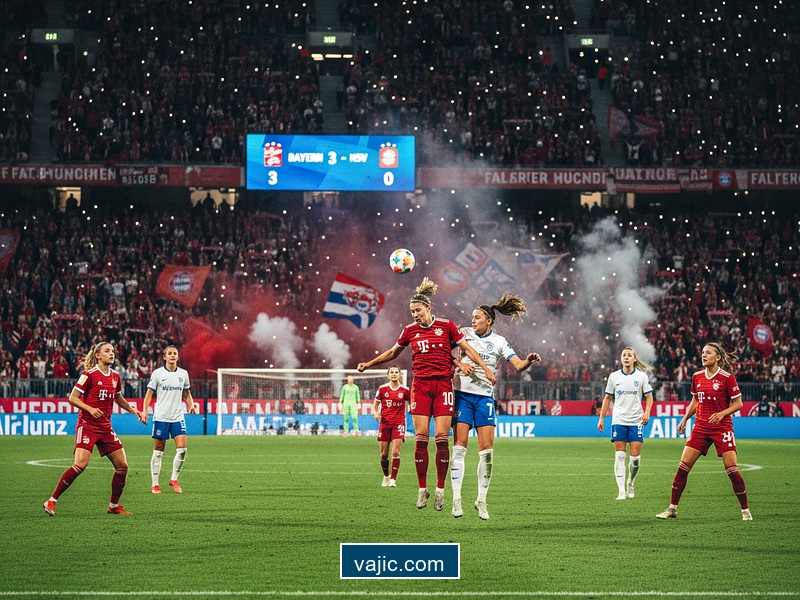
The table at Christmas rarely lies, but it often whispers uncomfortable truths about the state of competition. As the Frauen-Bundesliga enters its winter hibernation, Bayern Munich sits atop the pile, looking down with a distinct air of imperiousness. While the headline news is straightforward—Bayern first, Wolfsburg chasing, HSV and Jena languishing in the relegation zone—the subtext is far more profound.
We are witnessing a historical pivot. For the last decade, the German game was defined by the Wolfsburg-Bayern duopoly, a tit-for-tat exchange of shields and cups. But this season’s Bayern side, managed with surgical precision by Alexander Straus, has stopped resembling a contemporary rival and started mimicking a ghost from the past. They are beginning to look, feel, and suffocate opponents like the legendary 1. FFC Frankfurt side of the mid-2000s.
The Resurrection of Hegemony
To understand the gravity of Bayern’s current position, one must look back twenty years. In 2005, the Frauen-Bundesliga was the playground of 1. FFC Frankfurt. That team did not just beat you; they dismantled your spirit before kickoff. With a spine of Birgit Prinz, Renate Lingor, and Kerstin Garefrekes, they possessed an aura of invincibility that transcended tactics.
Current analysis often focuses on xG (expected goals) and possession stats, but the true marker of a dynasty is psychological inevitability. Bayern Munich has achieved this. When they step onto the pitch against mid-table sides like Hoffenheim or Freiburg, the result feels pre-ordained. This is the exact atmospheric pressure Frankfurt applied between 2001 and 2008.
"We are seeing a shift from competitive duality to singular dominance. Bayern isn't just winning matches; they are effectively ending the era where the league title was a question mark."
The parallels between the key protagonists are striking. In Pernille Harder, Bayern possesses the modern answer to Birgit Prinz. While their styles differ—Prinz was a battering ram of athleticism, whereas Harder is a Raumdeuter (space interpreter) of the highest order—their influence is identical. They are the 'Cheat Codes.' In the mid-2000s, if Frankfurt needed a goal, Prinz simply decided to score one. Harder operates with that same autonomy today. She provides the individual brilliance that breaks low blocks, a luxury that Wolfsburg, for all their grit, currently lacks.
Tactical Evolution: 2005 vs. 2025
While the dominance feels the same, the mechanics have evolved. It is crucial to dissect how the "super-club" model has shifted tactically over two decades.
| Metric | 1. FFC Frankfurt (c. 2005) | Bayern Munich (2024/25) |
|---|---|---|
| Formation | Rigid 4-4-2 / 4-3-3 | Fluid 4-2-3-1 / 3-box-3 |
| Primary Playmaker | Renate Lingor (Deep Lying) | Georgia Stanway (Box-to-Box Engine) |
| Defensive Style | Man-marking, Physicality | Zonal Pressing, Interception |
| Full-Back Role | Defensive containment | Inverted playmaking (e.g., Gwinn) |
The Frankfurt dynasty relied on physical superiority and direct verticality. They ran over teams. Straus’s Bayern, conversely, kills teams with a thousand cuts. The integration of Giulia Gwinn as an inverted option and the relentless engine of Georgia Stanway offers a tactical flexibility that the legends of the past never required. Frankfurt won because they were better players; Bayern wins because they are better players and a more sophisticated system.
The Tragedy of Hamburg (HSV)
At the other end of the spectrum lies the relegation battle, featuring Carl Zeiss Jena and, more poignantly, HSV. The presence of Hamburg in the relegation zone is a melancholic reminder of the sport's volatile economics. Newer fans might view HSV as a plucky promoted side struggling to adapt, but history paints a darker picture.
In 2011, HSV was a top-four side. They had players like Almuth Schult (before she became a Wolfsburg icon) and were competing in the DFB-Pokal final. Then came the dark summer of 2012. The club’s management, facing financial headwinds on the men's side, effectively liquidated the women's Bundesliga team. They voluntarily relegated themselves to the regional leagues to save money.
It has taken them over a decade to crawl back to the top flight. To see them sitting in the relegation zone at Christmas is not just a sporting failure; it is a scar on the league's history. It highlights the brutality of the "elevator team" existence. Unlike the mid-2000s, where the gap between bottom and middle was bridgeable with hard work, the financial stratification of 2025 makes survival a near-impossible task for clubs without massive institutional backing.
Jena’s struggles are equally predictable but less tragic. They represent the fading legacy of the East, much like Turbine Potsdam (who are a shadow of their former selves). The center of gravity in German football has shifted ruthlessly to the West and South—to Munich, Wolfsburg, and Frankfurt.
Wolfsburg: The Fading Giant?
We cannot discuss Bayern’s ascent without addressing Wolfsburg’s stagnation. For a decade, the Wölfinnen were the standard-bearers. They were the machine that broke the Frankfurt dynasty. However, watching them this season, one gets the sense they are entering their twilight.
Alexandra Popp remains a talismanic figure, but relying on her aerial dominance is becoming an archaic strategy in a league that increasingly favors technical floor play. It feels reminiscent of the decline of Turbine Potsdam around 2012. Potsdam held on to their "fitness-first" philosophy under Bernd Schröder for too long while the game grew more technical. Wolfsburg is at risk of holding onto their "power-first" philosophy while Bayern embraces total football.
The Verdict
The Christmas table is provisional, but the trends are permanent. Bayern Munich has successfully weaponized their financial might and tactical acumen to recreate the dominance of the early 2000s Frankfurt era. They have built a squad where the bench players would walk into the starting XI of 10 other Bundesliga teams.
For the neutral, this is concerning. The Frauen-Bundesliga thrived in recent years on the tension of the title race. If Bayern turns this into a procession, the league loses its primary selling point. But for the purist, there is an undeniable beauty in watching a team that has solved the puzzle.
HSV and Jena will likely fight until May, but the writing is on the wall. The gap between the professional elite and the rest has widened into a canyon. As we head into the second half of the season, we aren't just watching a title race; we are watching the coronation of a new dynasty that remembers the history of German women's football and has decided to repeat it, ruthlessly.