
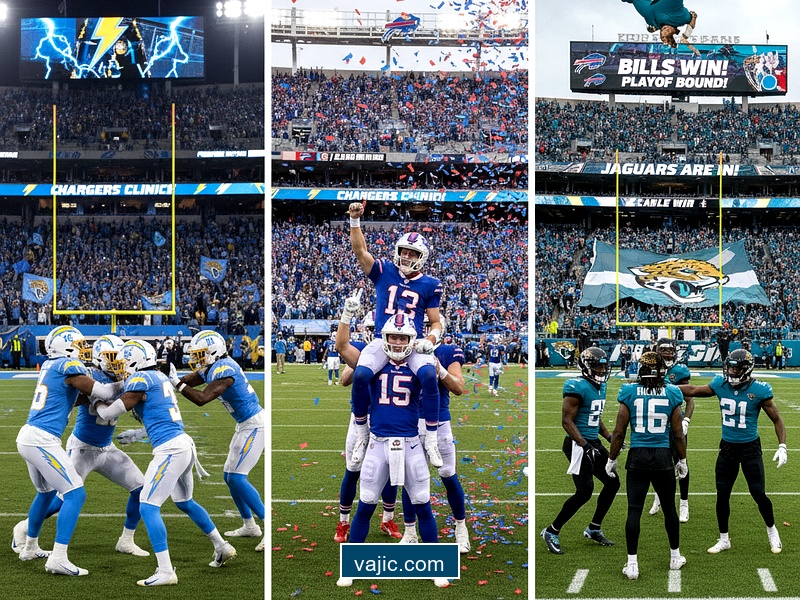
There is a distinct irony in the Buffalo Bills securing their ticket to the 2025 NFL postseason while sitting on their couches, watching the Indianapolis Colts self-destruct against the San Francisco 49ers. For a franchise historically defined by heartache and chaotic theater, this backdoor entry feels almost too clinical. Yet, it is the perfect metaphor for what Sean McDermott has constructed in Western New York: a program so structurally sound that it no longer relies on serendipity or "Music City Miracles" to survive. It simply waits for the math to catch up to its competence.
While the Jacksonville Jaguars and Los Angeles Chargers also punched their tickets through the Colts' failure, their narratives differ wildly. The Chargers are in the honeymoon phase of the Jim Harbaugh resurrection; the Jaguars are surviving the volatility of the Doug Pederson era. Buffalo, however, is providing a masterclass in organizational sustainability. We are witnessing the vindication of a philosophy that was heavily scrutinized entering this season—a "soft rebuild" that was supposed to close their championship window.
The Myth of the "Gap Year"
To understand the magnitude of this clinch, one must ignore the standings for a moment and look at the ledger. General Manager Brandon Beane and Head Coach Sean McDermott treated the 2024 offseason as a financial exorcism. They absorbed over $30 million in dead cap space to trade Stefon Diggs. They allowed stalwarts of the "Process"—Jordan Poyer, Micah Hyde, and Tre’Davious White—to walk out the door. In modern NFL economics, this is signaling a punt. It is a concession that the credit card bill has come due.
Most franchises crumble during these transitions. The New England Patriots post-Brady and the New Orleans Saints post-Brees are cautionary tales of teams refusing to take their medicine, resulting in prolonged mediocrity. McDermott, however, bet on culture over continuity. His philosophy posits that the "system" is robust enough to elevate replacement-level talent, provided the quarterback remains elite.
The Bills didn't just clinch a playoff spot; they clinched an argument. They proved that their window is not tied to a specific roster iteration, but to the architectural stability of the program itself.
Tactical Evolution: The Death of "Hero Ball"
For years, the criticism of the McDermott era was a perceived ceiling. The offense was accused of being too reliant on Josh Allen’s cape, and the defense was criticized for wilting against elite quarterbacks in January. This season has seen a deliberate, philosophical pivot that directly contradicts those narratives.
Under Offensive Coordinator Joe Brady, who has fully integrated McDermott’s desire for complementary football, the Bills have weaponized efficiency over volume. In previous seasons, Allen was asked to be the entire offense. This year, the philosophy has shifted to "everybody eats." By utilizing a diverse run game centered on James Cook and Ray Davis, and spreading targets among a collection of WR2s and WR3s like Khalil Shakir and Keon Coleman, McDermott has inoculated his team against the volatility of a diva receiver.
This is not just a tactical shift; it is a psychological one. It forces defenses to defend the blade of grass, not just the superstar. The result is an offense that is perhaps less explosive on the highlight reel but significantly harder to dismantle schematically. They have traded variance for consistency.
The Defensive Chameleon
The true genius of this playoff berth, however, lies on the defensive side of the ball. The promotion of Bobby Babich to Defensive Coordinator was met with intrigue, but the execution has been pure McDermott. This unit has survived a litany of injuries—specifically to Matt Milano, the heartbeat of their linebacker corps—without suffering a systemic collapse.
McDermott’s philosophy relies on a "next man up" mentality that actually works, largely because the scheme demands discipline over athleticism. The heavy usage of nickel packages and the reliance on zone integrity means that players like Terrel Bernard and Dorian Williams don't need to be Hall of Famers; they just need to be in the right gap. While other AFC contenders panic-buy talent at the trade deadline to fix holes, Buffalo simply coaches up the next guy on the depth chart.
This clinch via the Colts' loss highlights the difference between Buffalo and the conference's second tier. The Colts, fighting for their lives, couldn't execute against the 49ers. Buffalo, even in a "down year," has accumulated enough equity to profit from other teams' failures. That is the definition of a floor that is higher than most teams' ceilings.
Contrasting the Projects: Harbaugh and Pederson
It is instructive to compare Buffalo’s situation with the other beneficiaries of the Colts’ loss. The Los Angeles Chargers are clinching because Jim Harbaugh is a shock-to-the-system specialist. He arrives, bullies the culture into submission, runs the ball, and wins immediately. It is impressive, but it is effectively Year One of a new regime.
The Jacksonville Jaguars are the inverse—a team with talent that often feels less than the sum of its parts, relying on Trevor Lawrence to mask structural deficiencies. Their clinch feels like survival.
Buffalo represents the third, most difficult state of being in the NFL: sustained excellence amidst attrition. They are the only team in this trio that actively dismantled its core leadership group and got better in terms of win probability. This suggests that the "McDermott Culture"—often mocked for its clichés and wrestling analogies—is a tangible asset. It is a framework that prevents the bottom from falling out.
The Sustainability Verdict
Is this sustainable? Critics point to the postseason failures against Kansas City as proof that McDermott’s conservative nature is a fatal flaw. However, looking at the long-term health of the franchise, this playoff berth is arguably his finest coaching job. He has navigated the salary cap hell that usually kills contenders and kept the team atop the AFC East.
As the Bills prepare for the 2025 postseason, they do so with cleaner books for the future and a quarterback who has learned to play within the structure. The narrative that the Bills missed their chance in 2021 or 2023 is false. By clinching this spot during a roster reset, they have opened a second window.
The Colts' loss to the 49ers was the mathematical trigger, but the work was done in the meeting rooms back in March. When Beane and McDermott decided to tear down the roster to build it back up, they gambled their jobs on the belief that their philosophy was superior to individual talent. The standings today declare that gamble a victory. The "Project" isn't over; it has simply evolved into something far more dangerous: a machine that doesn't need to be perfect to be present.