
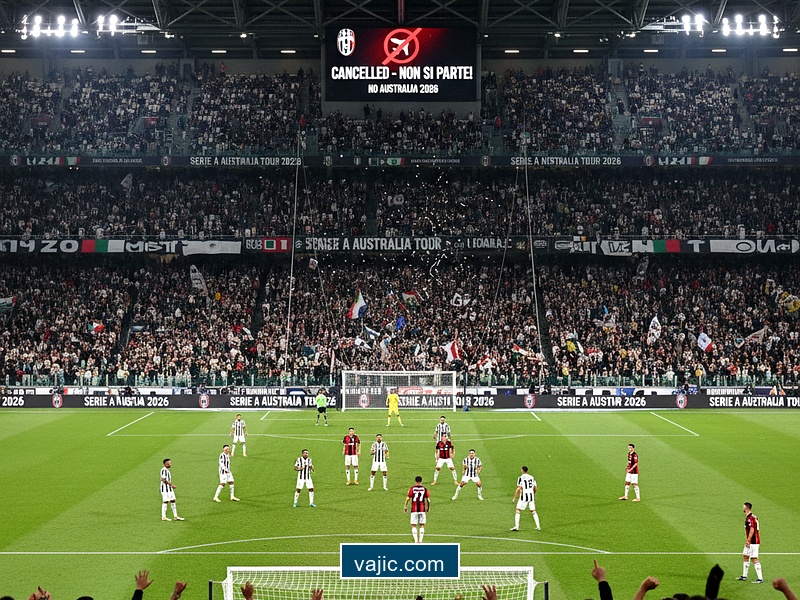
The news that Serie A’s ambitious—or perhaps delusional—plan to stage a competitive league match in Australia has collapsed isn't just a logistical hiccup. It is a tactical defeat for the current administration’s philosophy, a repudiation of the "football as pure product" ideology that has infected the upper echelons of Italian football management. For those of us who have covered the slow, agonizing decline of the peninsula’s footballing hegemony over the last two decades, the cancellation of this proposed 2026 excursion is not a missed opportunity. It is a moment of clarity.
We must strip away the marketing jargon about "brand expansion" and "global footprints" to analyze the manager of this project: the Lega Serie A administration. Their strategy, much like a desperate coach throwing center-backs up front in the 89th minute, has been defined by panic rather than process. The attempt to force AC Milan, Inter, or Juventus to play a Scudetto-deciding 90 minutes in Perth was never about the sport. It was a Hail Mary pass to close a revenue gap that no amount of frequent flyer miles can fix.
The Flawed Tactics of Forced Globalization
To understand why this Australian venture was doomed, one must look at the tactical setup of the league’s hierarchy. Under the guidance of Lorenzo Casini and Luigi De Siervo, Serie A has adopted a philosophy of imitation without foundation. They look at the Premier League’s global dominance and assume the solution is to physically export the product, ignoring that England’s dominance was built on twenty years of stadium infrastructure, equitable TV rights distribution, and a high-octane domestic product.
The Premier League didn't win the world by playing Arsenal vs. Chelsea in Sydney. They won by making the product so compelling on television that Sydney came to them.
The tactical error here is fundamental. Serie A’s leadership is trying to bypass the midfield build-up—fixing crumbling stadiums, resolving the ultra culture issues, and modernizing domestic TV production—to go straight for the goal of international revenue. The "Perth Project" was reminiscent of Richard Scudamore’s failed "39th Game" proposal for the Premier League in 2008. But where Scudamore was negotiating from a position of supreme strength, Serie A attempts these maneuvers from a position of financial fragility.
The Sustainability of the 'Export' Philosophy
Let us analyze the sustainability of this model. The physical toll of a 26-hour flight to Western Australia for a competitive fixture is physiologically ruinous. In an era where FIFPRO is threatening legal action over fixture congestion and managers like Carlo Ancelotti and Pep Guardiola are openly criticizing the expanding calendar, the idea of inserting a trans-hemispheric round trip into the middle of a domestic season is managerial malpractice.
If we look at the tactical periodization theories used by top coaches, recovery is as vital as the training stimulus. A trip to Perth would have effectively destroyed a team’s performance metrics for the subsequent three weeks due to circadian rhythm disruption. A league that claims to value the integrity of its competition cannot simultaneously sabotage the physical condition of its star assets for a quick cash injection.
Furthermore, the removal of the Decreto Crescita (Growth Decree) tax break has already tightened the belts of Italian clubs. The financial incentive offered by Australian promoters would have been a drop in the ocean compared to the systemic revenue issues facing the league. You cannot plug a hull breach with a boomerang.
Regulatory Walls and The Integrity of the Round-Robin
The collapse of this deal also highlights a misunderstanding of the regulatory pitch. FIFA has historically held a defensive line against domestic leagues playing official matches in foreign territories. While the ongoing litigation involving Relevent Sports in the United States has cracked the door open slightly, the governing body remains hostile to the idea. The Asian Football Confederation (AFC) would likely have pressed high against this move, viewing it as a European encroachment on their territory.
But beyond the courtroom tactics, there is the philosophy of the Round Robin format. The sanctity of a league season rests on the concept of home and away. Playing a "home" game in Perth neutralizes the tactical advantage of the San Siro or the Stadio Olimpico. It turns a competitive fixture into a sterile exhibition. In a league often decided by narrow margins—recall the two points separating Milan and Inter in 2022—altering the neutrality of the venue is a corruption of the sporting meritocracy.
The Disconnect with the Curva
The "Manager’s Philosophy" in the Lega offices fails to account for the unique sociology of Calcio. Unlike American sports franchises, which are mobile businesses, Italian clubs are civic institutions. They are anchored to the soil of their cities. The relationship between the team and the Curva (the hardcore fans) is not merely consumer-provider; it is tribal.
When the Supercoppa Italiana was moved to Saudi Arabia, the grumbling was audible but tolerated because it was a cup competition—a one-off event. Moving a Serie A league match crosses a red line. It tells the season ticket holder in Turin or Naples that their loyalty is secondary to a casual fan in the Southern Hemisphere. This disconnect creates a toxic atmosphere that eventually bleeds onto the pitch. Players feed off the energy of their home support; strip that away, and you are left with a training ground exercise played at half-speed.
The Economic Reality Check
Why did they try this? Desperation. Serie A’s domestic TV rights deal with DAZN and Sky, valued at roughly €900 million per season, pales in comparison to the Premier League’s £6.7 billion domestic harvest. The leadership sees "markets" instead of "supporters." They look at the 2026 timeline and see dollar signs, failing to realize that the product is diluted the further it travels from its source.
The "Project" should not be about exporting matches. It should be about importing value. This means solving the bureaucracy that prevents Milan and Inter from building a modern stadium. It means improving the camera angles and lighting in provincial grounds to look better on 4K screens. It means aggressive marketing of the tactical sophistication that makes Serie A the most intellectual league in the world.
The cancellation of the Australia match is a mercy killing for a bad idea. It forces the league’s administrators to stop looking for shortcuts and start doing the hard work of rebuilding the league’s value from the inside out. The philosophy of "sell everything that isn't nailed down" has hit a wall. Now, perhaps, they can get back to coaching the actual game.