
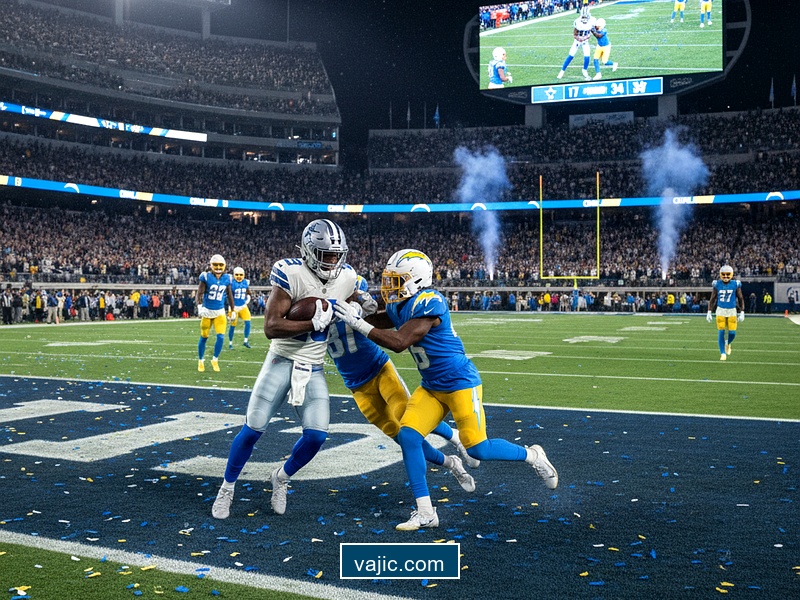
The scoreboard read 34-17, but the spiritual distance between the Los Angeles Chargers and the Dallas Cowboys on Sunday afternoon was measured in lightyears, not points. While the box score pundits will obsess over the "Zero to 100" metrics and Dak Prescott’s fourth-quarter incompletions, they are missing the forest for the trees. Sunday wasn’t just a loss for Dallas; it was a philosophical indictment. It was the collision of two distinct team-building ideologies: one rooted in the glamour of the star, the other in the brutality of the trenches.
Jim Harbaugh has been back in the NFL long enough now that we can stop calling it an experiment. What we witnessed at SoFi Stadium was the maturation of a project that feels less like a football team and more like a rolling construction crew. The Chargers winning four consecutive games isn't a fluke of the schedule; it is the mathematical inevitability of the Harbaugh doctrine.
The Bo Schembechler Ghost in the Machine
To understand why Los Angeles is surging while Dallas is spinning its wheels, you have to ignore the modern obsession with "explosive play rate" and look at the architectural blueprints. Mike McCarthy’s "Texas Coast" offense is designed like a Ferrari—sleek, expensive, and heavily reliant on perfect conditions. It requires elite timing, pristine protection, and receivers winning isolation routes.
Harbaugh, conversely, builds tanks. His philosophy is a direct lineage of the Bo Schembechler "Team, The Team, The Team" mantra he absorbed at Michigan, modernized during his Stanford resurrection, and perfected with the San Francisco 49ers from 2011 to 2014. The 34-17 drubbing wasn't about Justin Herbert out-dueling Prescott; it was about the Chargers’ offensive line erasing the Cowboys’ will to compete.
When the Chargers hire a coach, they aren't just hiring a play-caller; they are buying a culture of violence. Harbaugh’s teams historically improve in December. Why? Because finesse fades when legs get heavy. The "spread and shred" concepts that look pretty in September often wither against a disciplined pass rush in Week 16. The Chargers’ gap-scheme runs—Power O, Counter, Duo—are designed to inflict pain. By the fourth quarter, the Cowboys’ defensive front wasn't just tired; they were business-decision weary.
The Sustainability of Bully Ball
Critics often label Harbaugh’s style as archaic, a relic of a bygone era before analytics took over. They are wrong. This is the most sustainable model in football. Look at the data from his San Francisco tenure. In 2011, they rushed for over 2,000 yards. In 2012, over 2,400. They didn't rely on a quarterback playing at an MVP level every week to win.
Against Dallas, we saw the Chargers utilize heavy personnel groupings—12 personnel (1 RB, 2 TEs) and even 13 personnel. This forces defenses to stay in their base packages, limiting their ability to disguise coverages or utilize exotic blitzes. The Cowboys, dealing with documented pass-rush struggles and personnel changes along the defensive line, were mechanically dismantled. They were forced to play phone booth football against a team that lives in the phone booth.
"The team that stays healthy is often just the team that dictates the physical terms of the engagement."
Dallas, plagued by injuries and rotation issues, looked like a team trying to survive the game. The Chargers looked like they were using the game as a conditioning drill. This is the hallmark of the Harbaugh "Project." It creates a roster that is antifragile; the harder the game gets, the stronger they seem to become.
Herbert: From Savior to CEO
The most fascinating evolution in this Chargers surge is the utilization of Justin Herbert. For years, the previous regime asked Herbert to be Superman. He had to throw 45 times a game, scramble for his life, and create miracles on 3rd-and-12. That is not a system; that is a lottery ticket.
Under this staff, Herbert has been repurposed. He is no longer the entire offense; he is the executioner of the offense. By establishing a run game that averaged nearly 5 yards per carry against Dallas, the Chargers created third-and-manageable situations. This is where the efficiency metrics skyrocket. Herbert didn't need to force balls into tight windows because the play-action game—set up by those bruising runs—created passing lanes the size of the 405 freeway.
This mirrors what Harbaugh did with Alex Smith in 2011. He took a quarterback viewed as "damaged goods" or "inconsistent" and gave him a structural floor so high that failure became difficult. Herbert is infinitely more talented than Smith, which is why this Chargers team has a ceiling that could rival the current AFC elitists.
The Dallas Delusion
Flipping the lens to the visitors, this loss highlights the fundamental flaw in the Jerry Jones/Mike McCarthy era. The Cowboys are built on the fallacy of talent aggregation over systemic cohesion. They collect stars—CeeDee Lamb, Micah Parsons—but lack the connective tissue that binds a championship roster.
When the Cowboys fall behind, as they did 34-17, they panic. Their offense becomes one-dimensional. The "Texas Coast" system has no answer for a physical beatdown other than to drop back and pray. The stats from the "Zero to 100" breakdown show a team that lost the time of possession battle and failed on critical downs. But the tape shows a team that got bullied.
The personnel changes mentioned in the post-game report are excuses, not reasons. Every NFL team is banged up in late December. The difference is that the Chargers’ system is designed to plug in a backup guard and tell him, "Block down, kick out." It is simple, violent, and repeatable. The Cowboys’ system requires their replacements to win one-on-one matchups against superior athletes. That is a losing proposition.
A Warning for the Playoffs
The Chargers’ "dangerous" tag for the playoffs is earned not because they are flashy, but because they travel well. A style of play predicated on defensive suffocation and offensive line dominance works in Kansas City in January. It works in Buffalo. It works in Baltimore.
Dallas, meanwhile, looks like a team designed to beat bad teams by 20 points and lose to physical teams by 10. They are the classic "flat-track bullies" of the NFL. When the track gets muddy, the engine stalls.
This 34-17 result wasn't just another notch in the win column for Los Angeles. It was a validation of a philosophy that prioritizes the collective over the individual. While Dallas spends the offseason wondering which checks to write to keep their superstars happy, the Chargers will be in the weight room, comfortable in the knowledge that they have finally built a machine capable of crushing the glamour teams of the league.