
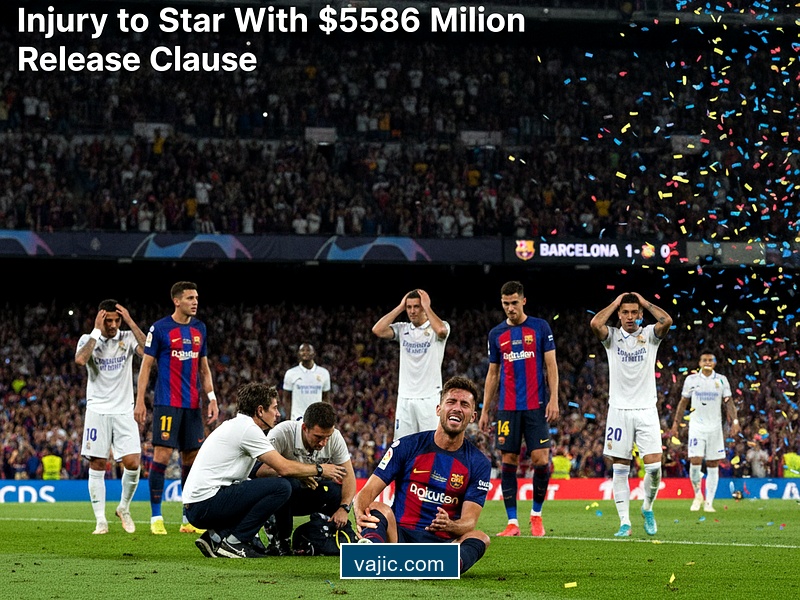
The snap of a patellar tendon is a sound that haunts training grounds. It is a distinct, visceral pop that signals not just a season ending, but a career altering its trajectory. When Marc-André ter Stegen collapsed, clutching his right knee, the immediate reaction from the Camp Nou faithful was emotional. Mine was purely analytical. I wasn’t looking at the agony on his face; I was looking at the sudden, violent collapse of Barcelona’s vertical structure.
Reports confirm Barcelona is activating the emergency mechanism within La Liga’s rigid financial framework to sign a replacement. The headline numbers are staggering—a star with a $586 million release clause is now a spectator—but the real story isn't the money. It is the specific, irreplaceable biomechanics of the German goalkeeper and how Article 77 of La Liga’s regulations is a trap disguised as a lifeline.
The False Security of Article 77
To understand the desperation, one must first dissect the bureaucratic loophole. La Liga’s Article 77 allows a club to sign a replacement outside the transfer window if a player suffers an injury exceeding four months. The caveat? The club can only use 80% of the injured player’s salary cap space, and the new arrival must be a free agent or currently playing in Spain.
This rule is often cited as a mercy clause. In reality, it is a scouting nightmare. It forces elite clubs to shop in the bargain bin for premium parts. You are looking for a Champions League-level operator in a pool of retirees and journeymen. The focus has shifted to names like Wojciech Szczęsny or Keylor Navas, but this conversation misses the point. You cannot replace a system player with a shot-stopper. The discrepancy lies in the hips, the eyes, and the feet.
"Goalkeeping at Barcelona is not about saving goals; it is about preventing the opponent from believing they can press."
Scouting the Void: The 'Unseen' Ter Stegen
Having watched Ter Stegen from the press box for a decade, his value isn't in his hands. It is in his La Pausa—the ability to put his foot on the ball and wait. Watch the game tape from Barcelona’s last ten matches. When an opponent triggers a high press, Ter Stegen does not clear the ball immediately. He waits for the striker to commit to a pressing angle. By baiting the press, he opens a passing lane to the pivot or the inverted full-back.
This is the "unseen" work. It requires a specific physiological profile: open hips to disguise the passing angle and the composure to keep the heart rate low when a striker is sprinting at 30km/h toward you. A standard goalkeeper, the type usually available via emergency exemption, operates on survival instincts. They clear their lines. They prioritize safety. In Hansi Flick’s system, safety is a liability. If the goalkeeper clears long, possession is a 50/50 duel. If Ter Stegen plays short, possession is controlled. The injury forces Barcelona to abandon a decade of neural programming at the back.
The Biomechanics of the High Line
The most critical aspect of this crisis is the defensive line height. Under Flick, Barcelona’s center-backs push up to the halfway line. This system relies entirely on the goalkeeper acting as a sweeping libero. This requires explosive eccentric strength—the ability to decelerate and change direction instantly to intercept through balls.
Scouting potential replacements requires analyzing their "starting position." Most traditional goalkeepers anchor themselves to the six-yard box. A Barcelona keeper must live on the edge of the 18-yard box. This 12-yard difference sounds negligible, but tactically, it is an ocean. If the replacement keeper sits deep, the center-backs naturally drop five yards to compensate. The midfield then drops to maintain vertical compactness. Suddenly, the entire team is defending 10 meters deeper, inviting pressure rather than suffocating it.
The Inaki Peña Dilemma: Body Language Analysis
Why not trust the youth? Inaki Peña is the internal solution, but his body language during his previous stints suggests a player fighting the jersey rather than wearing it. In scouting terms, we look for "territorial dominance." Does the goalkeeper communicate with verbal commands or physical presence?
When a cross comes into the box, Ter Stegen usually claims the space at the highest point of his jump, knee raised—a physical deterrent to attackers. Peña, conversely, often opts to punch or stay on his line. He shrinks the playable area. His shoulders often hunch under pressure, a tell-tale sign of high cortisol levels affecting decision-making. In a cauldron like the Montjuïc or the Camp Nou, teammates feed off the goalkeeper's anxiety. If the keeper is frantic, the center-backs become erratic.
The Free Agent Trap: Szczęsny and Navas
Let’s analyze the floated replacements through a scout’s lens. Wojciech Szczęsny, recently retired but rumored to be the primary target, offers world-class shot-stopping. His reflexes are intact. However, his distribution mechanics are rigid. He is a "plant-and-drive" passer, meaning he needs a stable base to hit long diagonals. He lacks the agility to play one-touch passes under duress, a prerequisite for Barcelona’s build-up play.
Keylor Navas relies heavily on athleticism that is waning with age. His game was built on cat-like explosiveness, compensating for his lack of height. Without that twitch-fiber dominance, he becomes vulnerable on crosses. Furthermore, neither possesses the nuanced understanding of the "third-man run" initiation that Ter Stegen has mastered. Signing either is admitting that the team will no longer build from the back.
Tactical Regression is Inevitable
The "La Liga Rule" allows Barcelona to put a body in the net, but it cannot legislate tactical continuity. The injury forces Hansi Flick to alter his entire defensive schematic. We will likely see the defensive line drop deeper. The double pivot will have to collect the ball from the goalkeeper’s feet rather than receiving it in the half-spaces. This slows down the transition, allowing opposition defenses to reset.
From a scouting perspective, the next few months will be a study in damage limitation. We aren't watching to see if the new goalkeeper makes saves; any professional can block a ball. We are watching the space between the goalkeeper and the center-backs. That is where the season will be won or lost. If that space expands, Barcelona’s pressing structure collapses.
The $586 million release clause on the injured star is a number for the accountants. The number that matters to the coaching staff is the 2.5 seconds Ter Stegen usually buys them on the ball. That time is gone, and no emergency signing, regardless of their pedigree, can buy it back.