
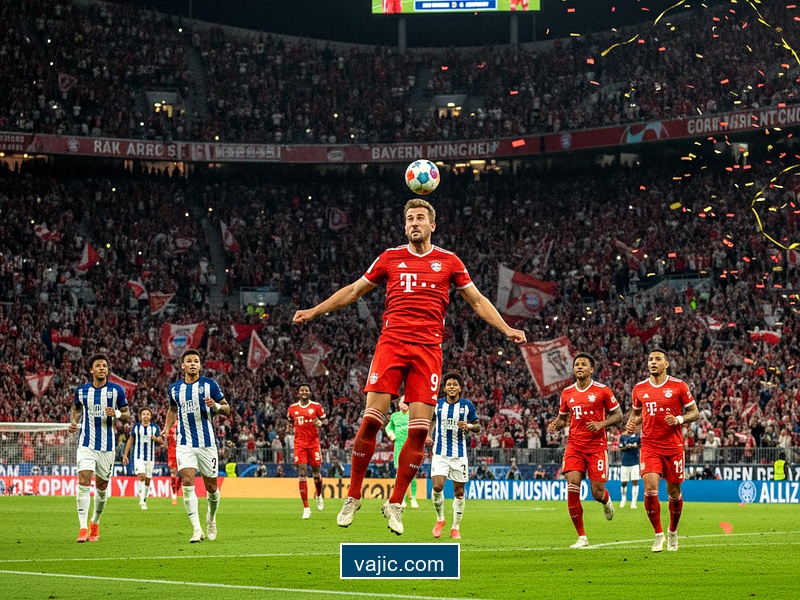
Harry Kane wants a treble. In other news, water is wet, the Bavarian winter is cold, and Bayern Munich expects to win football matches. The English captain’s New Year resolution—to secure the Bundesliga, the DFB-Pokal, and the Champions League, followed eventually by a World Cup—is hardly a revelation in terms of ambition. It is the minimum viable product for a striker of his caliber operating within the Allianz Arena.
However, to dismiss this as standard athlete rhetoric is to miss the tectonic shifts occurring beneath his feet. Kane’s wish isn't dependent on his finishing ability; we know he can find the net with his eyes closed. It depends entirely on the sustainability of the chaotic, high-octane laboratory experiment currently being conducted by Vincent Kompany.
We need to look past the number nine and scrutinize the man in the technical area. The "Project" at Bayern has shifted from Thomas Tuchel’s neurosis to Kompany’s idealism. The question isn't whether Kane can score 50 goals; it is whether Kompany’s philosophy can survive the brutality of knockout football.
The Death of Pragmatism and the Birth of Risk
To understand the current Bayern trajectory, one must first exhume the corpse of the 2023-24 season. Under Thomas Tuchel, Bayern played with a suffocating anxiety. The structure was rigid, the passing lanes were mathematical, and the joy was nonexistent. Kane scored, but he often did so in isolation, a diamond sitting in a bowl of stale oatmeal.
Vincent Kompany has not just tweaked the dial; he has ripped the console out of the wall. The skepticism surrounding his appointment—relegated with Burnley one month, handed the keys to Europe’s elite the next—was justified by traditional metrics. Yet, the tactical reality suggests the Bayern board (Max Eberl and Christoph Freund) were looking for a specific cultural reset: the reintroduction of dominance through risk.
Kompany’s system is a Guardiola inheritance but with a distinct, heavy-metal mutation. It is not merely possession; it is possession with vertical intent. The most striking alteration is the defensive line. Bayern is playing with perhaps the highest line in Europe. This is not a tactical nuance; it is a philosophy of intimidation. It tells the opponent: We do not care about your counter-attack because you will not have the ball long enough to launch it.
"This isn't just about winning; it's about winning in a way that leaves the opposition breathless. But breathless teams sometimes forget to breathe themselves."
The Tactical gamble: Can Upamecano and Kim Survive?
This is where Kane’s treble dream faces its greatest existential threat. For the philosophy to yield silverware, the center-backs—Dayot Upamecano and Kim Min-jae—are required to defend vast tracts of green space, often in one-on-one situations near the halfway line. This demands a level of concentration that borders on the inhuman.
We have seen this movie before. Pep Guardiola’s early years in Munich were plagued by Champions League exits where a single counter-attack dismantled 90 minutes of dominance (Real Madrid, 2014). Kompany is doubling down on this approach. In the Bundesliga, against bottom-half fodder, this works. The sheer talent gap allows Bayern to score four before they concede one.
But the Champions League—the third and most difficult leg of Kane’s treble wish—is not won by crushing possession metrics. It is won in moments of transition. Real Madrid, Liverpool, and Inter Milan thrive on the exact space Kompany abandons. The project relies on the gamble that Bayern’s press is so suffocating that the ball never reaches the danger zone. It is a high-wire act without a net.
Kane as the Fulcrum, Not Just the Finisher
Historically, Bayern strikers were terminators. Robert Lewandowski was the ultimate penalty-box predator. Kane is different, and Kompany has leaned into this differentiation. The "project" utilizes Kane not just as the spearhead, but as the primary playmaker in the final third.
By dropping deep, Kane vacates space for Jamal Musiala and Michael Olise (or Leroy Sané) to invert. This movement is critical. It disrupts the rigid low blocks that Bundesliga teams famously deploy against Die Roten. Under Tuchel, this movement felt scripted. Under Kompany, there is a fluidity that suggests players are being allowed to interpret space rather than memorize it.
This benefits Kane’s longevity. He isn't banging his body against center-backs for 90 minutes. He is operating in the pockets, dictating play, and arriving late. If Kane wins the treble, it will be because Kompany allowed him to be a number 10 and a number 9 simultaneously.
The England Irony: The Tuchel Connection
There is a delicious irony in Kane’s "World Cup" addendum. While chasing trophies under Kompany, his international future is now in the hands of the man Kompany replaced: Thomas Tuchel.
Kane’s proficiency at Bayern is now a direct concern for the English FA. Tuchel, known for his pragmatic tournament football, will be watching Kompany’s chaotic revolution with raised eyebrows. If Kompany burns Kane out with this high-intensity pressing system, or if the psychological toll of another trophyless season weighs on him, Tuchel inherits a damaged asset for the 2026 campaign.
Conversely, if Kompany’s school of "total football" sharpens Kane’s playmaking instincts even further, Tuchel gets a captain who is tactically more astute than ever. The synergy between the failed Bayern manager (Tuchel) and the current Bayern manager (Kompany) pivots entirely around Harry Kane.
Sustainability of the 'Mia San Mia' 2.0
Is this sustainable? That is the question plaguing the Säbener Straße. The history of Bayern Munich suggests that "projects" are only as good as the last three results. Julian Nagelsmann was a long-term project until he wasn't.
Kompany brings a charisma that Tuchel lacked. He speaks the language of the players—quite literally—and possesses an aura of Manchester City invincibility. But the Bundesliga has evolved. Bayer Leverkusen, under Xabi Alonso, shattered the illusion that Bayern has a divine right to the Meisterschale. Leipzig and Dortmund remain perennial thorns.
The sustainability of this project relies on rotation. Kompany must manage the minutes of Musiala, Kane, and the fragile fitness of his wingers. The "treble" requires depth, and while Bayern’s starting XI is world-class, the drop-off in quality—specifically in defensive midfield and full-back positions—is noticeable.
Verdict: The Thin Line Between Genius and Naivety
Harry Kane is right to aim for the treble. Bayern Munich is one of perhaps three clubs in world football where that is a realistic annual goal. But let us not pretend this is a simple equation of Kane Goals = Trophies.
We are witnessing a fascinating collision between the ruthless expectations of Bavaria and the idealistic, risky football of Vincent Kompany. If the center-backs hold their nerve, and if the midfield pivot (Joao Palhinha or Joshua Kimmich) can extinguish fires before they spread, Kane will get his wish.
But if the system fractures, if the high line is exposed by the elite pace of Europe’s best wingers, Kane will once again be the finest player on the pitch standing amidst the wreckage of a season that promised everything and delivered nothing. The treble isn't in Kane’s boots; it’s in Kompany’s whiteboard.