
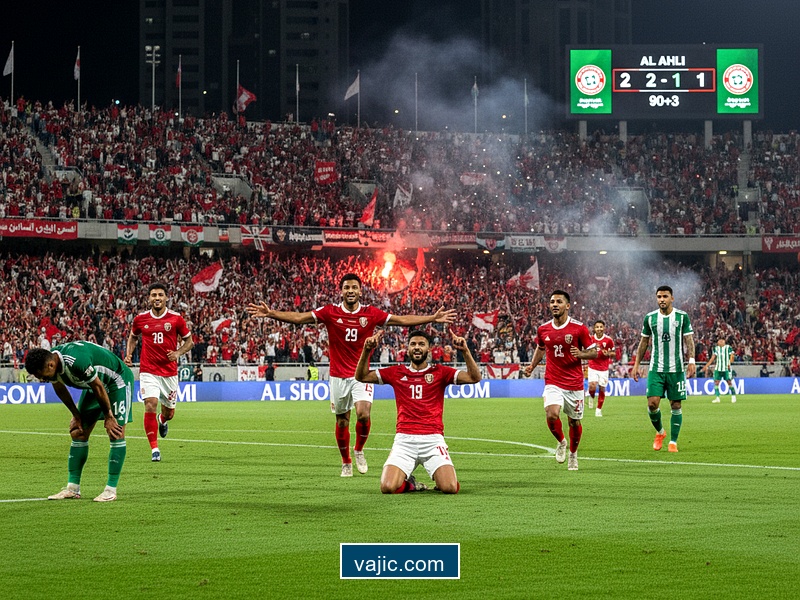
The scoreboard at the King Abdullah Sports City will tell you that Al Ahli defeated Al Shorta to secure their passage to the Asian Champions League Elite knockout stages. It will record the goals and the final 5-1 aggregate. But scoreboards are notoriously poor at capturing the truth of a football match. They record events, not processes.
To watch Al Ahli dissect the Iraqi champions was not merely to watch a victory; it was to witness a study in high-performance biomechanics and elite spatial manipulation. As a scout, when I look at a team sheets featuring the likes of Roberto Firmino, Riyad Mahrez, and Franck Kessié, I am not looking for magic. I am looking for efficiency. I am looking for the "unseen" work—the scanning frequencies, the deceleration patterns, and the creation of cognitive overload for the opposition.
What unfolded against Al Shorta was a brutal demonstration of the gap between a drilled, billion-dollar tactical system and a side relying on grit. This wasn't just about talent; it was about the geometry of the pitch.
The Biomechanics of the 'False' Movement
Most observers watch the ball; the scout watches the space the ball just left. The progression of Al Ahli hinges on the peculiar, almost ghostly movement of Roberto Firmino. Against Al Shorta’s low block, Firmino’s value wasn't in his vertical thrust, but in his retrograde motion.
Watch the footage closely. Before receiving a pass, Firmino engages in what we call a "high-frequency scan"—checking his shoulder three to four times in a ten-second window. This isn't just awareness; it is data collection. When he drops deep into the "10 space" (the zone between the opponent's midfield and defensive lines), he triggers a specific kinetic dilemma for the Al Shorta center-backs.
The biomechanical prompt is cruel: If the center-back follows Firmino, he opens a passing lane in the half-space for a winger. If he stays, Firmino turns with a low center of gravity—using his hips as a pivot point—and drives at an exposed defense.
In this match, Firmino’s "gravity"—his ability to pull defenders out of their designated zones without touching the ball—was the catalyst. He operates with a low moment of inertia, allowing him to change direction faster than the heavier, more static defenders of the Iraqi side. It is this off-ball manipulation that destroyed Al Shorta’s defensive shape long before the net rippled.
Mahrez and the Weaponization of the Pause
Riyad Mahrez offers a completely different, yet complimentary, physiological profile. In modern scouting, we talk often about "explosive power," but Mahrez is the master of "deceleration."
Against Al Shorta, Mahrez utilized the touchline to stretch the pitch horizontally. But his most dangerous action was the pause. When a winger sprints, the fullback sprints. When the winger stops dead, the fullback must engage his quadriceps and hamstrings in a violent eccentric contraction to brake. This causes momentary instability.
Mahrez creates what we call "qualitative superiority." He receives the ball, stops, and forces the defender to freeze. In that 0.5-second window, Mahrez’s body orientation is open (hips facing the field), giving him three vectors of attack: the inswinging cross, the cut-inside shot, or the slip pass. Al Shorta’s defenders were visibly suffering from cognitive fatigue by the 60th minute, their reaction times slowing simply because the mental load of tracking Mahrez’s micro-movements was too high.
The Salzburg Influence: Rest Defense
We must address the tactical fingerprint of Matthias Jaissle. Coming from the Red Bull Salzburg school of thought, Jaissle prioritizes verticality and pressing triggers. However, the unseen mechanism that allowed Al Ahli to suffocate Al Shorta was their Restfeldverteidigung—or "rest defense."
While Al Ahli attacked with five players, observe the positioning of Franck Kessié and the center-backs. They do not watch the attack; they watch the potential counter. Kessié’s movement is lateral and preventative. He closes the distance to the opponent's outlet players while his team is in possession.
This is aggressive prophylaxis. By positioning himself within 10 meters of Al Shorta’s transition targets, Kessié ensures that if possession is lost, he can engage in a duel immediately. This requires an immense anaerobic threshold, as it demands high-intensity bursts even when the team is "comfortable" on the ball. It is the engine room that allows the luxury players up top to flourish.
Al Shorta’s Structural Failure
Credit must be given to Al Shorta for reaching this stage, but the match exposed a critical deficiency common in teams transitioning from domestic dominance to continental elite competition: the inability to manage "blind-side" runs.
The Iraqi side defended in a compact 4-4-2 block, hoping to frustrate. However, their scanning was deficient. Al Ahli’s midfielders, specifically Gabri Veiga, repeatedly exploited the pockets of space behind the Al Shorta midfielders' heads. A defender can only block what he can see. Al Ahli’s passing patterns were designed to move the Al Shorta block side-to-side, forcing the defenders to constantly reset their vision.
Once the peripheral vision is overloaded, the defensive line becomes reactive rather than proactive. The goals conceded were not necessarily individual errors of technique, but failures of information processing. They simply could not calculate the vectors of Al Ahli’s third-man runs fast enough.
The Evolution of the Saudi Pro League Project
This result signifies a shift in the tectonic plates of Asian football. Historically, the AFC Champions League was a battle of attrition. Now, with the influx of elite European talent and, crucially, elite European coaching methodologies, the game model has changed.
We are seeing a fusion of South American flair (Firmino, Ibañez) with Germanic structural discipline (Jaissle). This creates a hybrid team that is comfortable in chaos but disciplined in structure. For a scout, this is terrifying to plan against. You cannot simply "park the bus" against Al Ahli because they have the technical quality to pick the lock in tight spaces (Mahrez) and the physical dominance to win second balls (Kessié/Toney).
The Verdict
Al Ahli progressing is not a surprise. The manner of the performance, however, serves as a warning shot to the East Zone giants in Japan and South Korea. This is not a team of mercenaries playing exhibition football. This is a highly tuned machine where the superstars have bought into the grunt work.
When Firmino is pressing the goalkeeper in the 80th minute, and Kessié is winning tackles in his own box despite a comfortable lead, you are watching a team with a championship threshold. Al Shorta didn't just lose a match; they were dismantled by a superior understanding of time, space, and human biomechanics. The rest of Asia should take notes: Al Ahli isn't just playing to win; they are playing to suffocate.