
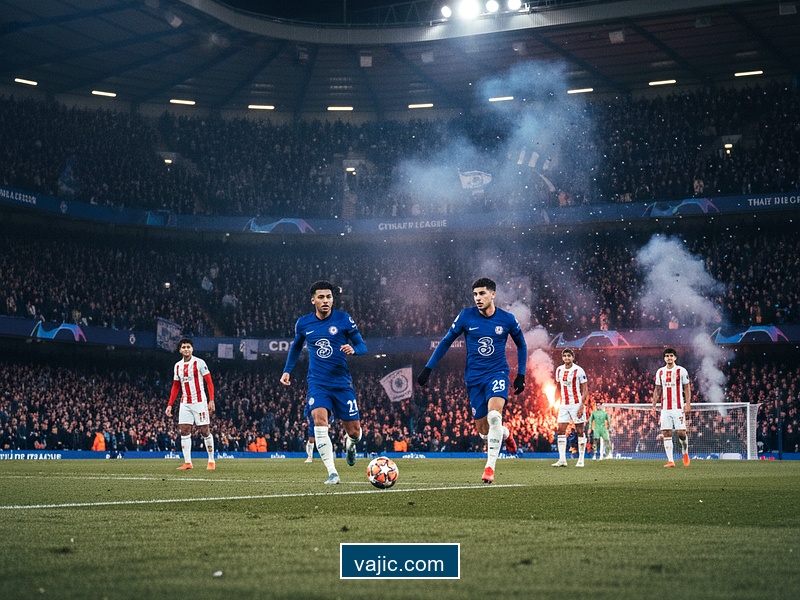
There is a specific sound that has become endemic to Stamford Bridge over the last two years. It is not the roar of triumph, nor the toxic booing of mutiny. It is a collective, frustrated intake of breath—a groan of anticipation strangled in the throat. It happens when a winger receives the ball in isolation, looks up at a destabilized defense, and then passes the ball backward to a center-half.
The New York Times suggests Chelsea’s attack is key in the Champions League and asks if the "handbrake" will be released. This question, while valid, misses the forest for the trees. The handbrake is not a malfunction; in the current iteration of the BlueCo project, the handbrake is the entire point. We are witnessing a philosophical collision between a recruitment strategy designed for chaos and a managerial ethos addicted to sterile control.
The Fetishization of 'Pausa' Over Penetration
To understand why Chelsea looks stagnant despite fielding an attack that costs more than the GDP of a small island nation, one must look at the tactical dogma infecting modern coaching. Whether under the shadow of Graham Potter, the interim chaos of Frank Lampard, or the current systematic rigidity, Chelsea has fallen victim to a misunderstood interpretation of Pep Guardiola’s Juego de Posición.
The modern manager is terrified of the transition. Losing the ball is viewed not as a part of the game, but as a systematic failure. Consequently, Chelsea’s buildup play suffers from what Italian tacticians call an obsession with la pausa—waiting for the perfect moment—without the necessary acceleration that follows.
Tactically, this manifests in the dreaded "U-Shape" circulation. The center-backs split, the pivot drops, and the ball circulates harmlessly around the perimeter of the opposition's block. Historical data paints a grim picture here. Compare this to Jose Mourinho’s 2004-2006 Chelsea. That team averaged less possession than the current crop (often hovering around 45-48% in big games) but played with a verticality that terrified Europe. They didn't pass to keep the ball; they passed to kill.
"We bought Ferraris to drive in a school zone. You cannot recruit players like Mykhailo Mudryk or Noni Madueke—athletes whose primary asset is explosive transition speed—and then ask them to play stationary, touch-tight rondo football against a low block."
The Cognitive Dissonance of the Clearlake Project
Here lies the fundamental flaw in the "Project." There is a disconnect between the Sporting Directors (Paul Winstanley and Laurence Stewart) and the tactical instructions on the grass. The recruitment model is heavily skewed toward high-ceiling, athletic individualists. These are players who thrive on instinct, space, and broken play.
However, the managerial appointments have prioritized "system managers" who treat players as coordinates on a grid. When you shackle a chaos agent like Nicolas Jackson or a vertical runner like Mudryk into a rigid system requiring 50 passes before a shot, you neutralize their greatest assets. You are asking jazz musicians to play military marches.
This is sustainable only on a spreadsheet. In reality, it breeds apathy. The "handbrake" the media refers to is actually "Rest Defense" paranoia. The full-backs invert not to create, but to ensure that if the ball is lost, the counter-attack is stifled immediately. It is defensive football masquerading as attacking dominance because it takes place in the opponent's half.
The Champions League requires Heresy, not Dogma
European competition has always punished dogmatic systems. Look at the recent history of the Champions League. While Manchester City won with a system, Real Madrid has dominated the last decade with the exact opposite: relationism. Carlo Ancelotti allows Vinícius Jr. and Rodrygo to drift, combine, and abandon their zones based on the flow of the game.
Chelsea is currently trying to out-system teams that have been playing their systems for years. In Europe, against savvy operators like Inter Milan, Bayern Munich, or even a deep-block Atletico, robotic possession is a death sentence. The handbrake needs to be released not just to score, but to disrupt the opponent's rhythm.
The "Project" ignores the intangibles of European heritage. The 2012 miracle in Munich was won on chaos, grit, and Didier Drogba’s refusal to accept logic. The 2021 triumph under Thomas Tuchel, while tactically astute, relied on the vertical transitions of Mason Mount, Kai Havertz, and Timo Werner ripping through City’s high line. Neither side played with the risk-averse lethargy we see today.
The Cole Palmer Paradox
We cannot discuss the attack without addressing the anomaly: Cole Palmer. He is the only reason the system hasn't collapsed entirely. Why? Because Palmer plays with the arrogance of a street footballer. He creates his own gravity.
Palmer effectively ignores the rigid positional instructions. He drifts from the right half-space to the center, drops deep, and attempts the "low-percentage" passes that the algorithms hate but the scoreboard loves. If the manager clamps down on Palmer’s freedom in the name of "structure," Chelsea ceases to be a Champions League threat and becomes a mid-table side with expensive kit.
Data vs. The Eye Test: The Sustainability Myth
Supporters of the current regime point to Expected Goals (xG) and possession stats to argue that results will eventually match the underlying numbers. This is a fallacy. Accumulating 2.5 xG means nothing if 2.0 of that comes from scraps at 3-0 down or low-quality volume shooting.
Elite teams generate "Big Chances"—situations where the striker is one-on-one. Chelsea’s current methodical approach allows defenses to settle into a 5-4-1 formation, meaning every shot is taken through a forest of legs. This isn't bad luck; it's bad geometry. A sustainable attack relies on speed of thought, not just speed of ball circulation.
Verdict: The Fear of Failure
Ultimately, the handbrake is psychological. The heavy contracts, the media scrutiny, and the sheer youth of the squad have created an atmosphere where making a mistake is fatal. Players take the safe option to avoid being the scapegoat on social media or being dropped for the next £50 million signing.
To conquer Europe, the manager must authorize risk. They must accept that losing the ball trying a through-pass is better than keeping it for three minutes of sterility. The owners paid for dynamite; it is time to stop using it as a doorstop. If Chelsea continues to prioritize control over chaos, they will be the best-passing team to exit in the Round of 16.