
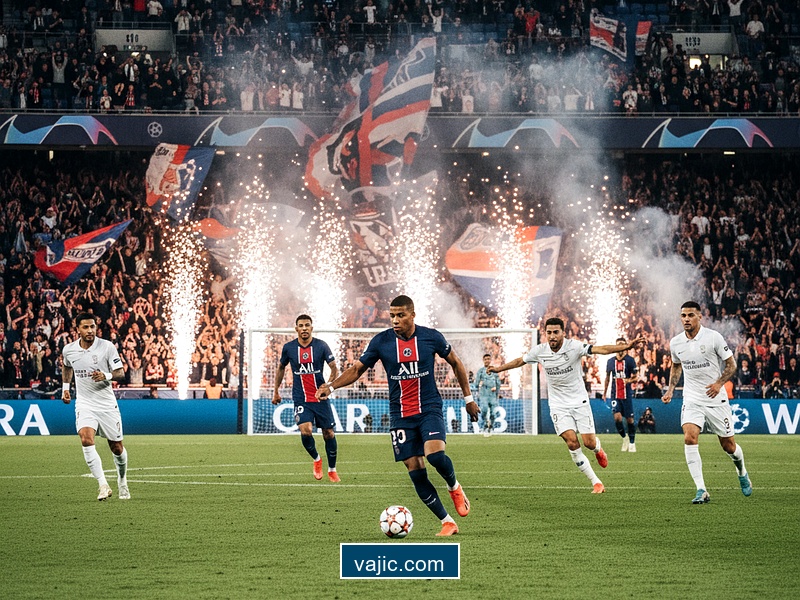
The headline from the wires states that Paris Saint-Germain has "revealed its ambitions" for the Champions League. This is, frankly, the equivalent of reporting that water is wet or that the Parc des Princes is located in Paris. PSG has worn its ambition like a neon sign for a decade, usually right before tripping over the power cord in the Round of 16.
But something feels fundamentally different in the Parisian air this season. For the first time since QSI (Qatar Sports Investments) purchased the club in 2011, the "ambition" is not tied to a marketing poster. The departure of Kylian Mbappé, following the exits of Neymar and Lionel Messi, marks the official death of PSG’s "Hollywood Era."
What we are witnessing now is not a rebuild; it is an exorcism. Luis Enrique is attempting to banish the ghosts of individual ego to summon a collective spirit we haven't seen in European football since the disciplined, machine-like efficiency of José Mourinho’s 2004-2005 Chelsea or, more poetically, the functional dominance of Arrigo Sacchi’s AC Milan.
The "Zidanes y Pavones" Fallacy
To understand the magnitude of PSG's current pivot, one must look back twenty years to the Santiago Bernabéu. In the early 2000s, Florentino Pérez engineered the "Galácticos" policy at Real Madrid. The strategy was binary: buy the biggest names on earth (Zidane, Ronaldo, Beckham, Figo) and fill the gaps with academy graduates (the Pavones). It was commercially brilliant and tactically suicidal.
Between 2003 and 2006, that Madrid team—despite having enough talent to populate an All-Star XI—won absolutely nothing of consequence. Why? because they sold the engine to buy the hood ornament. The sale of Claude Makélélé to Chelsea in 2003 remains the greatest cautionary tale in modern football history. As Zidane famously quipped, "Why put another layer of gold paint on the Bentley when you are losing the entire engine?"
For the last seven years, PSG has been re-enacting that exact failure on a loop. An obsession with the front three left the midfield porous and the defense exposed. Verratti was often left fighting a one-man guerilla war in the center circle while the front three walked back on defense.
"The current PSG project is finally acknowledging a truth that 2004 Porto taught us: The system must be the star."
Luis Enrique and the Cult of the Collective
Enter Luis Enrique. He is often remembered for the "MSN" (Messi-Suarez-Neymar) treble at Barcelona in 2015, but that revisionist history ignores his methods. Enrique is a disciplinarian who once benched Francesco Totti at Roma. He does not worship at the altar of the individual.
The "ambition" revealed by Foot Africa and other outlets is no longer about star power; it is about starvation—the hunger of young players like Bradley Barcola, Warren Zaïre-Emery, and João Neves. This shift mirrors the transition AC Milan underwent in the mid-90s. After the Dutch trio of Van Basten, Gullit, and Rijkaard moved on, many predicted a collapse. Instead, under Fabio Capello, they became a pressing monster, destroying Barcelona 4-0 in the 1994 final with a team based on tactical rigidity rather than flair.
PSG is currently building a midfield that functions much like the Chelsea trio of 2005: Makelele, Lampard, and Essien. While Vitinha is stylistically different, the function is the same: total domination of space. Vitinha’s pass completion rates and progressive carries suggest he is becoming the Metronome—the role Xavi Hernandez played for Enrique a decade ago, or Andrea Pirlo played for Ancelotti.
The African Dimension: Hakimi as the Modern Cafu
The source material highlights the African influence, and this is critical. Achraf Hakimi is no longer just a supporting act for his best friend Mbappé. He is now the tactical fulcrum of the team. In previous seasons, Hakimi’s overlapping runs were often ignored or used as decoys. Now, he is the primary outlet.
We are seeing Hakimi evolve into a figure reminiscent of Cafu during his Roma and Milan years. A right-back who is effectively a playmaker. Without the ball-dominant gravity of Messi or Neymar on the pitch, the heat map of PSG has expanded. The team breathes. The ball circulates to the flanks not because it has to, but because the space dictates it.
| Metric | PSG (2021-2023 Era) | The Historical Benchmark (Mourinho's Chelsea '05) | PSG Current Trajectory (2024/25) |
|---|---|---|---|
| Defensive Work Rate (Forwards) | Low (Walking) | High (Drogba/Duff pressing) | High (Barcola/Dembele pressing) |
| Midfield Structure | Disconnected/Overrun | The "Makelele Role" (Lockdown) | High Possession/Counter-Press (The Neves/Vitinha axis) |
| Dependency | Individual Brilliance | Tactical Discipline | Collective Fluidity |
The Danger of the "Transitional" Excuse
However, let us not be naïve. The media in Paris is unforgiving. The "ambition" to win the Champions League is a double-edged sword. When Arsène Wenger built his "Invincibles" or when Jurgen Klopp constructed his Liverpool dynasty, they were afforded time—a luxury Luis Enrique may not have.
The danger lies in the lack of a "bailout" button. In 2020, when the system failed, Neymar could conjure a moment of magic against Atalanta. In 2022, Mbappé could single-handedly terrorize Real Madrid. This current squad lacks that singular "Get Out of Jail Free" card. They are more comparable to the 2002 Bayer Leverkusen or the 2019 Ajax: beautiful, cohesive, but potentially fragile when the lights are brightest and the game descends into chaos.
Verdict: The Death of the Brand, The Birth of a Team
For twenty years, I have watched super-clubs try to buy the European Cup. It rarely works. The teams that define eras—Ajax '95, United '99, Barcelona '09, Bayern '13—were built on a shared philosophy, not a shared payroll.
PSG has finally stopped trying to be the Harlem Globetrotters of football. They have realized that the Champions League is won in the ugly, quiet moments of defensive transition, not on Instagram reels. The departure of the superstars has stripped away the glamour, leaving behind something far more dangerous: a team with nothing to lose and a point to prove.
If they win it this year, it won't be because they bought the best players. It will be because they finally had the courage to sell them.