
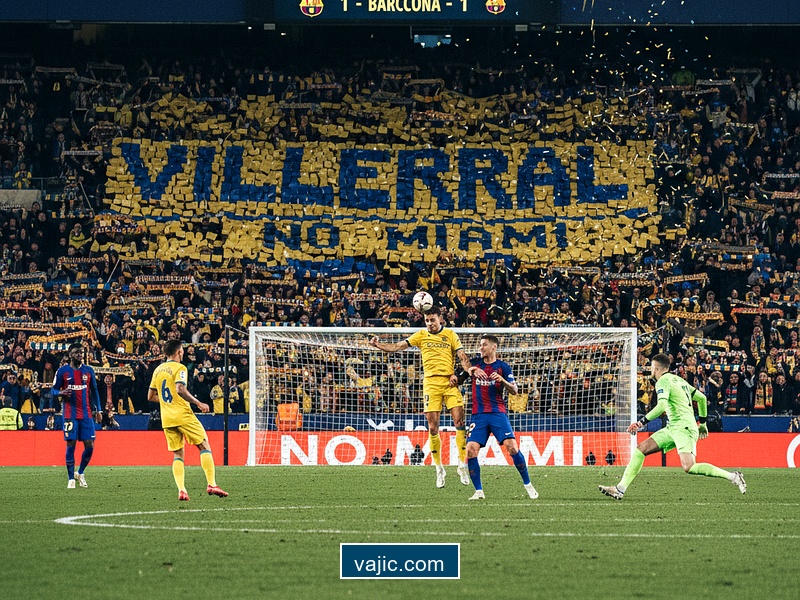
The humidity in Villarreal is distinct from the humidity in Miami, but for ninety minutes at the Estadio de la Cerámica, Barcelona played with a heat that would have melted the asphalt on Ocean Drive. The narrative entering the weekend was dominated by La Liga President Javier Tebas and his relentless, almost Ahab-like obsession with harpooning the "Great White Whale" of hosting a league match in the United States. Villarreal tried everything to stop the relentless wave of Hansi Flick’s side—fouling, pressing, offside traps—except, as the wry observation went, moving the fixture to Florida.
But let’s strip away the corporate posturing. What happened on the pitch was not just a 5-1 dismantling of a very competent Marcelino team; it was a exorcism of the slow, methodical, often ponderous possession that has haunted Catalonia since the departure of Luis Enrique.
We are witnessing a paradigm shift. For the first time in nearly a decade, we can look at this Barcelona squad and not see a pale imitation of Pep Guardiola’s 2011 masterpiece, but rather a violent, vertical reincarnation of the 2008-09 treble winners. And the scary part? Lamine Yamal is doing things at 17 that Lionel Messi was only hinting at.
The Death of the "Horizontal" Obsession
For years, the Camp Nou faithful were gaslit into believing that 1,000 passes equaled control. It was a bastardization of the Juego de Posición. Under Xavi, and briefly under Koeman, possession became a defensive mechanism—holding the ball to prevent the opponent from scoring, rather than using it to kill them.
Hansi Flick has taken a sledgehammer to that philosophy. Against Villarreal, Barcelona surrendered possession for large swathes of the first half, yet looked infinitely more dangerous. This mirrors the tactical evolution we saw between the 2011 team—which strangled opponents with suffocation—and the 2015 "MSN" (Messi, Suárez, Neymar) era, which relied on kinetic chaos.
Consider the second goal. It wasn't a 40-pass sequence. It was a direct, vertical incision. This verticality brings to mind the role of Thierry Henry in that debut Guardiola season. We often forget that before the pure "tiki-taka" took hold, Barça was a physical, counter-pressing monster. Raphinha, in his current iteration, is channeling the relentless energy of Samuel Eto’o from that era. He is not the most aesthetic player, but his movement creates the vacuum for others to operate.
"To compare the current style to the Guardiola era is lazy. This is closer to the German school of heavy metal football, finally successfully hybridized with La Masia technicality. It is not death by a thousand cuts; it is death by guillotine."
Lamine Yamal vs. The Ghost of 2007
It is professional malpractice to compare a child to Lionel Messi. And yet, watch the outside-of-the-boot assist Lamine Yamal delivered against Villarreal. It forces the conversation.
Let’s look at the timeline. In the 2006-07 season, Messi was 19. He scored that hat-trick against Real Madrid and the Getafe "Maradona" goal. He was an untamed force of dribbling nature. But Messi at 17? He was a cameo player, protected by Frank Rijkaard, feeding off scraps from Ronaldinho and Deco.
Lamine Yamal is different. He is not a passenger; he is the engine. His decision-making in the final third at La Cerámica showed a maturity that Messi developed around 2009. Messi at 17 wanted to dribble the world; Yamal at 17 understands that the pass is often more devastating than the dribble. That trivela pass wasn't just skill; it was geometry. It was the kind of vision we associated with Michael Laudrup in the Dream Team era of the early 90s.
The Statistical Anomaly
When we break down the impact, the numbers suggest Yamal is accelerating past historical benchmarks.
| Metric | Messi (Age 17/18 - 2005/06) | Lamine Yamal (Age 17 - 2024/25) |
|---|---|---|
| Role | Rotational Winger | Undisputed Starter |
| Physicality | Fragile, protected | Resilient, plays 90 mins |
| Decision Making | Individualistic | Playmaker hybrid |
| Defensive Work Rate | Low | High (Flick system requirement) |
Lewandowski: The Resurrection
Last season, Robert Lewandowski looked like a luxury sedan with 300,000 miles on the odometer. His touch was heavy, his movement sluggish. The critics—myself included—wrote him off as a bad investment of a lever-pulling administration.
Whatever Flick whispered to him during pre-season has reversed the aging process. His brace against Villarreal wasn't just about positioning; it was about sharpness. This revival parallels the 2014-15 season of Luis Suárez. After a slow start following his ban, Suárez became the sharpest point of the spear. Lewandowski is no longer dropping deep to link play unnecessarily; he is staying in the box, trusting that Yamal, Pedri, and Raphinha will find him.
He missed a penalty, yes. But even that miss felt incidental to a performance of overwhelming dominance. He hit the post, he linked play, and he bullied the Villarreal center-backs in a way we haven't seen since his Bayern Munich prime.
The Shadow of Valdés: Ter Stegen’s Knee
We cannot discuss this match without addressing the tragedy. Marc-André ter Stegen’s injury is the black cloud over the sunshine. The scream heard around the stadium evoked chilling memories of Víctor Valdés tearing his ACL against Celta Vigo in March 2014.
That injury effectively ended Valdés’s career at the top level and destabilized Barcelona’s defense for two seasons until Ter Stegen himself matured. History threatens to repeat itself. Iñaki Peña is competent, but he is not a pervasive aura of calmness. The rumor mill suggests Szczęny or Navas, but replacing a captain and a ball-playing goalkeeper mid-season is akin to changing the pilot while the plane is experiencing turbulence.
However, this tactical system might protect the backup keeper better than Xavi’s did. Flick’s high press forces turnovers high up the pitch (as seen in the Torre goal). If the ball rarely reaches the defensive third, the goalkeeper’s shot-stopping ability becomes less critical than his concentration.
The Miami Illusion
Returning to the prompt's initial jest: Villarreal didn't lose because the game wasn't in Miami. They lost because they faced a Barcelona side that has rediscovered its teeth.
Tebas wants to move games to the US to "grow the brand." It is a fundamental misunderstanding of what makes La Liga a global powerhouse. The brand is not the stadium; the brand is the brilliance. The 2009 6-2 demolition of Madrid wasn't famous because of where it was played; it was famous because Xavi and Iniesta painted a masterpiece on grass.
Sunday’s match was a reminder that the product doesn't need gimmicks. It needs quality. A 5-1 thriller with VAR controversy, incredible goals, tragic injuries, and breakout stars is the essence of Spanish football. Shipping two tired teams to a humid NFL stadium in Florida creates a spectacle, sure, but it kills the soul. The atmosphere at La Cerámica—hostile, loud, authentic—is what fuels the intensity we saw.
Barcelona is building something terrifyingly good. They have a 17-year-old genius, a system that prizes vertical violence over horizontal boredom, and a revived striker. If they can survive the loss of their goalkeeper, we aren't just looking at title contenders. We are looking at the start of a new cycle that historians will reference in 2035.