
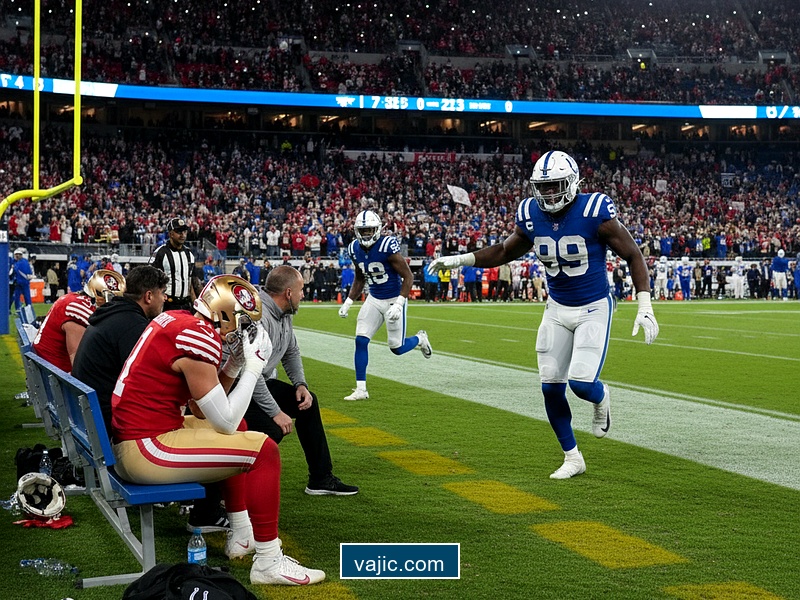
The untrained eye watches the ball. The fan watches the touchdown. The scout, sitting in a cold metal chair with a pair of Steiner binoculars, watches the hips, the hands, and the sideline demeanor. As we approach Week 16’s Monday Night Football clash between the San Francisco 49ers and the Indianapolis Colts, the headline isn't just about playoff seeding or betting lines. It is about the subtle erosion of roster integrity and the frantic attempt to patch it.
The official inactive list has dropped: Ricky Pearsall is OUT. Yetur Gross-Matos has been activated from Injured Reserve. To the casual observer, swapping a rookie receiver for a rotational defensive end is a footnote. To a coaching staff trying to execute Kyle Shanahan’s zone-beating spacing or Kris Kocurek’s aggressive defensive front, these moves represent seismic shifts in leverage and timing. Football in late December is rarely won by the stars; it is stabilized by the middle class of the roster. Tonight, San Francisco’s stability is being tested.
The Kinetic Chain of Ricky Pearsall
When a player like Pearsall is ruled out, we don't just lose a stat line. We lose a specific movement profile that the 49ers offense relies upon to manipulate safeties. Pearsall isn't just a receiver; in this system, he is a spacing tool. My evaluation of Pearsall throughout his rookie campaign has focused on his "stemming"—the ability to run directly at a defensive back's toes to eliminate their cushion before breaking laterally.
Without Pearsall, the offensive geometry changes. Shanahan’s passing concepts are predicated on high-low stretches and horizontal conflicts. Pearsall has shown an advanced ability to find the "soft spot" in zone coverage—a trait usually reserved for five-year veterans. He possesses what scouts call "throttle control," the ability to decelerate in the hole of a Cover 2 or Cover 3 shell without drifting into the linebacker's collision zone.
His absence forces a reconfiguration of the "Z" and slot roles. We aren't just looking at who catches the ball; we are looking at who clears the space. Pearsall’s unseen work—his willingness to run the "clear-out" route at 100% speed to open a dig route for Deebo Samuel or Jauan Jennings—is what will be missed. Substitutes often lack the discipline to run a decoy route with the same conviction as a primary read. If the replacement receiver rounds off his cuts or displays lazy body language because he knows he isn't getting the ball, the safety won't bite. The window for the primary target shrinks by six inches. In the NFL, six inches is the difference between a completion and an interception.
Gross-Matos and the mechanics of the "Wide-9"
On the flip side, the activation of Yetur Gross-Matos is a fascinating study in defensive line rotational theory. The 49ers, under defensive line coach Kris Kocurek, treat their defensive line like a hockey shift. They need fresh bodies to maintain the "Wide-9" alignment integrity, where ends line up well outside the offensive tackle to generate extreme angles of pressure.
Gross-Matos is an intriguing piece because of his length and bend. When scouting edge rushers returning from injury, the first thing to look for is "get-off" consistency. Does he fire off the ball on the visual cue of the snap, or is he a split-second late? But more importantly, watch his pad level on engagement. Gross-Matos has historically struggled with getting washed down on run plays when his pad level rises. However, his length allows him to "long-arm" offensive tackles—stabbing a stiff arm into the tackle's chest to keep them at bay while he surveys the backfield.
Against an Indianapolis team that utilizes a heavy RPO (Run-Pass Option) scheme and a mobile quarterback element, edge discipline is paramount. Gross-Matos won't just be asked to sack the quarterback; he will be asked to "surf" the line of scrimmage. This technique requires the defensive end to squeeze down the line unblocked, reading the mesh point between the QB and RB, without committing too early. It requires immense lower-body control and the mental discipline to ignore the instinct to crash upfield.
The Tape Study: Indianapolis in the Trenches
Analyzing the Colts' offensive front, they are a unit that thrives on displacement. They want to move you off your spot vertically. The 49ers' defensive front, conversely, relies on penetration and shooting gaps. This creates a volatile matchup of physics. If Gross-Matos and the rotation are slow to react, the Colts' massive guards will wash them out of the play.
Watch for the "double team" split. When the Colts double team a 49ers defensive tackle, does the linebacker fill the correct gap immediately? This is where the unseen game is played. If the defensive line can't hold the point of attack—a harder task with rotational pieces shuffling in and out—the linebackers are left fighting offensive linemen 300 pounds heavier than them. The return of Gross-Matos suggests the 49ers are worried about fatigue. They need bodies to bang inside and set edges outside so that Fred Warner can roam free.
Betting the Mechanics, Not the Hype
The betting markets favored the 49ers to cover, and from a scout's perspective, this aligns with the "process over results" philosophy. While the Colts have athleticism, they lack the repetitive technical consistency of the 49ers. Late in the season, games are won by the team that makes fewer "mental errors"—missed assignments, false steps, and blown coverages.
Shanahan’s teams historically tighten up fundamentally in December. Even with Pearsall out, the system provides answers. The replacement player knows exactly where to be, even if he lacks Pearsall’s fluidity. Conversely, the Colts' defense relies heavily on athleticism. Against a scheme that utilizes complex pre-snap motion and condensed splits, athleticism can be used against you. Eye discipline fails. Linebackers over-pursue the motion, leaving the backside wide open.
"The difference between a starter and a backup in Week 16 isn't usually athletic ability; it's the ability to process chaos in real-time without freezing."
The Final Scout's Take
Tonight, do not watch the ball. Watch the feet of the 49ers' backup receivers. Are they chopping their steps at the top of the route to create separation, or are they drifting? Watch Yetur Gross-Matos's hands. Is he winning the placement battle inside the offensive tackle's frame, or is he getting locked out?
The absence of Ricky Pearsall removes a layer of polish from the offense, likely forcing Brock Purdy to hold the ball a fraction of a second longer. This increases the variance of the game. However, the reinforcement of the defensive front with Gross-Matos provides the antidote: pressure. If the 49ers can disrupt the Colts' timing with a fresh defensive line rotation, the lack of offensive spacing becomes a manageable problem.
The smart money covers the spread not because San Francisco is flashier, but because their "B-Game" is built on a foundation of leverage and technique that Indianapolis has yet to master. In the attrition warfare of Week 16, technique travels.