
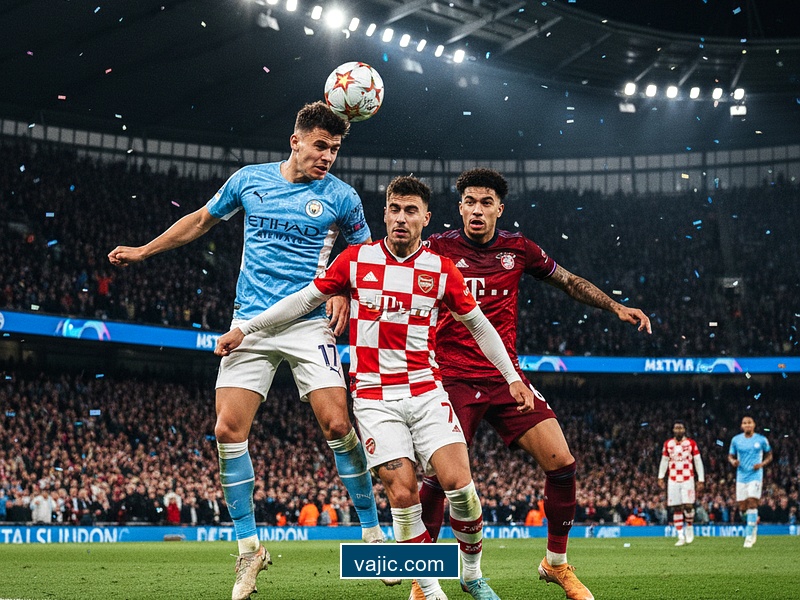
The latest Champions League power rankings from CBS Sports offer a snapshot of the current hierarchy, placing Manchester City, Arsenal, and Bayern Munich at the summit. To the casual observer, this is simply a list of wealthy clubs performing well. To the analyst who has watched the tactical tectonic plates shift over the last two decades, this is something far more significant. It is a family tree.
We are not looking at three distinct sporting projects. We are looking at one ideology refracted through three different lenses. The dominance of these three clubs represents the absolute victory of the Juego de Posición school of thought, with Pep Guardiola as the headmaster, Mikel Arteta as the honor student, and Vincent Kompany as the radical post-grad.
Analyzing the ninety minutes of their recent fixtures is a waste of ink. The scorelines are secondary to the systems. The real story here is the sustainability of the "Project" manager and why the rest of Europe is desperately trying to reverse-engineer the blueprints from Manchester.
The City State: Perpetual Beta Testing
Manchester City’s presence at the top is the least surprising, yet the most misunderstood. Pundits often lazy-label City’s dominance as a product of infinite wealth. While the balance sheet helps, money does not buy the spatial geometry we see on the pitch. Manchester United has spent over £1 billion to look like a mid-table tribute act; City spends to refine a machine that is already humming.
Guardiola’s genius lies in his refusal to let the cement dry. The City project is sustainable because it is in a state of perpetual beta testing. In 2021, he utilized the "False 9" to suffocate opponents with an extra midfielder. By 2023, he inverted the pyramid, utilizing Erling Haaland as a pure battering ram while turning center-backs like John Stones into holding midfielders. This season, we see yet another evolution: the use of Rico Lewis and Josko Gvardiol as internal playmakers, effectively creating a 3-2-2-3 shape that makes counter-attacks mathematically improbable for the opposition.
This is not just football; it is industrial design. The reason City remains the benchmark is that the players are interchangeable parts in a holistic system. If Rodri sits, the machine stutters, but it does not break. The "Project" here is total indoctrination. A player does not join City to play their game; they join to play Pep’s game. As long as Guardiola remains the architect, this dominance is not a phase. It is the status quo.
The Arsenal Clone: Suffering for Structure
Arsenal’s rise to the shoulder of the giants is the most fascinating managerial case study in the modern game. Mikel Arteta did not just inherit a struggling squad; he inherited a broken culture. His "Project" required a level of authoritarianism that would have gotten lesser managers sacked. He paid off club captain Pierre-Emerick Aubameyang to leave. He exiled Mesut Özil. He stripped the dressing room of ego and replaced it with tactical anxiety.
Arteta has effectively built "City Lite" and upgraded it to "City Steel." While Guardiola chases aesthetic perfection, Arteta has leaned into defensive solidity that rivals the great Milan sides of the 90s. The center-back partnership of William Saliba and Gabriel Magalhães is the bedrock of this project. Unlike City, who control games through possession, Arsenal is comfortable controlling games without the ball. They have mastered the "mid-block," a tactical setup where they suffocate space rather than chasing the ball.
"Arteta realized earlier than most that you cannot out-Pep Pep. You have to be nastier. You have to be better at set-pieces. You have to enjoy the suffering."
Is it sustainable? The data suggests yes. Arsenal’s squad has an average age significantly lower than their European rivals. They are pre-peak. The danger for Arsenal is burnout. Arteta runs a shorter rotation than Guardiola. He trusts fewer players. But structurally, this is a team built to challenge for the next five years, not just the next five months. They represent the successful transplantation of the Guardiola brain into a North London body.
The Bavarian Gamble: Kompany’s High Wire Act
Then we have Bayern Munich. The inclusion of the German giants in this triumvirate is the most volatile variable. Vincent Kompany’s appointment was met with derision—a manager relegated with Burnley taking over the Hollywood FC of Germany. Yet, the logic tracks. Bayern didn't hire Kompany for his Burnley record; they hired him for his Guardiola DNA.
Kompany’s Bayern is playing a brand of suicidal high-line football that makes neutrals gasp. It is pure idealism. During his time under Guardiola at City, Kompany was the on-pitch lieutenant who translated the complex positional instructions to the backline. He is now applying those principles with a squad superior to anything he had in the Premier League.
However, the Bayern project is the most fragile. The "Project" in Munich is historically allergic to patience. While City and Arsenal gave their managers years to build, Bavaria demands instant gratification. Kompany is trying to implement a high-risk, high-reward system in a league where transition moments are lethal. When it works, they win 9-2. When it fails, they look calamitous.
| Club | Manager Profile | Core Philosophy | Sustainability Rating |
|---|---|---|---|
| Man City | The Architect (Guardiola) | Total Control / Evolution | High (Dynastic) |
| Arsenal | The Disciple (Arteta) | Structure / Physicality | High (Ascending) |
| Bayern | The Gambler (Kompany) | High Intensity / Risk | Medium (Volatile) |
The Death of the Individual
What binds these three teams—and what separates them from the chasing pack like Real Madrid or PSG—is the subjugation of the individual to the collective structure. Real Madrid relies on "Relationism," the idea that talented players (Vinicius Jr, Mbappe) will forge connections organically on the pitch. It is fluid, chaotic, and relies on moments of brilliance. It is why Madrid wins cups but struggles to dominate leagues with the ruthlessness of City.
The Guardiola-Arteta-Kompany axis represents the industrialization of football. Every pass is rehearsed. Every run is triggered by a specific zone being occupied. It is remarkably effective, but it raises an existential question for the sport. We are moving toward an era of tactical homogeneity where the top teams all speak the same language, just with different accents.
The Verdict
The CBS ranking is accurate not because these teams have the most points, but because they have the clearest identities. In modern football, clarity wins. Manchester City is the finished product. Arsenal is the hardened challenger. Bayern Munich is the volatile experiment.
This hegemony of the "Guardiola School" forces the rest of Europe to make a choice: copy the homework, or find a way to burn down the classroom. Until someone figures out how to disrupt the structural dominance of positional play, these three clubs will continue to trade places at the top. The names on the dugout change, but the philosophy remains the true champion of Europe.