
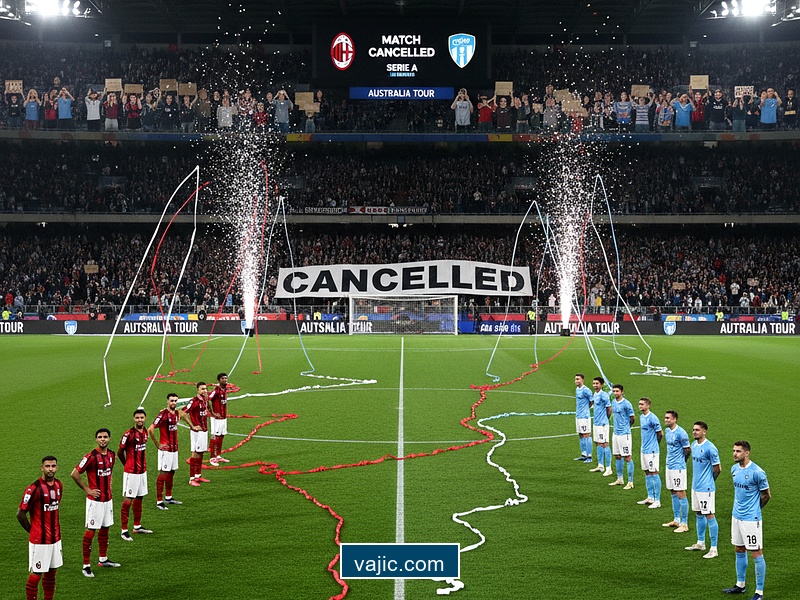
The announcement that Serie A has scrapped the proposed exhibition match between AC Milan and Como in Australia is being framed in corporate boardrooms as a missed commercial opportunity. A failure of logistics. A hole in the revenue spreadsheet.
But for Paulo Fonseca and Cesc Fàbregas, this cancellation is the greatest tactical victory of the season. It is a triumph of footballing logic over the voracious, often nonsensical appetite of modern brand expansion. To understand why this non-event matters, we must look past the travel itinerary and dissect the fragile, high-stakes "projects" currently under construction at both the San Siro and the Stadio Giuseppe Sinigaglia.
This was never just a friendly. It was a litmus test for two divergent philosophies of club ownership and tactical identity, both of which would have been severely compromised by a 24-hour flight to Perth for 90 minutes of exhibition jogging.
Fonseca’s House of Cards
Let us be brutally honest about the state of AC Milan. The "RedBird Capital Project" is currently defined by a friction between algorithm-driven recruitment and the chaotic reality of Serie A pitch mechanics. Paulo Fonseca was hired not as a revolutionary, but as a stabilizer—a manager expected to synthesize a squad of disparate, high-potential assets into a cohesive unit.
Fonseca’s tactical philosophy relies heavily on a hybrid 4-2-3-1 that morphs into a 3-2-5 in possession. It requires intricate spacing and, crucially, high-intensity pressing triggers from the front four. When Milan is fresh, they look devastating. When they are fatigued, the double pivot is bypassed with frightening ease, leaving the backline exposed. We saw this fragility against Liverpool in the Champions League and in the erratic defensive displays against Cagliari and Parma.
The modern Milan project treats players like software updates—compatible in theory, but buggy in execution without sufficient installation time.
Had this Australian tour proceeded, Fonseca would have been asked to take a squad already running on fumes, disrupt their recovery metrics, and perform for a global audience. For a manager whose system is entirely dependent on physical freshness to execute the high line, this trip was a tactical death sentence. Fonseca does not need brand exposure; he needs hours on the training ground at Milanello to drill the defensive transitions that have plagued his tenure.
The cancellation forces the ownership to confront a hard truth: you cannot monetize a team that you have not finished building. The "Moneyball" approach of Gerry Cardinale works only if the product on the pitch is consistent. By canceling the game, Serie A inadvertently prioritized the sporting integrity of one of its crown jewels over a quick payout.
The Como Blueprint: Boutique Football vs. Global Grind
If Milan is the corporate giant struggling for cohesion, Como 1907 is the boutique luxury brand exploding onto the scene. Under the Hartono brothers—the wealthiest owners in Italian football—and the managerial eye of Cesc Fàbregas, Como represents a fascinating experiment in "Lifestyle Calcio."
Fàbregas is not merely a figurehead; he is a disciple of the modern Spanish school, blending Wenger’s verticality with Guardiola’s positional rigidity. His Como side is built on bravery—playing out from the back regardless of the opponent. This requires mental sharpness even more than physical endurance. The recruitment of Raphael Varane (despite his injury misfortunes), Sergi Roberto, and Pepe Reina signals an intent to surround young talent with World Cup-winning mentalities.
Sending a newly promoted side to Australia would have been a seduction of the ego. It would have validated Como’s rapid rise, yes, but at what cost? Fàbregas is currently navigating the treacherous waters of Serie A survival while refusing to compromise his aesthetic principles. A long-haul exhibition would have shattered the meticulous micro-cycles of training Fàbregas utilizes to drill his passing lanes.
Como’s project is distinct because it doesn’t need the money. The Hartonos are worth exponentially more than most Serie A owners combined. Their project is about prestige and valuation growth through excellence and location (Lake Como), not scraping together match fees from international promoters. The cancellation protects Fàbregas from the commercial department’s hubris.
The Sustainability of the "Project"
This entire saga illuminates the disconnect in Italian football’s attempt to catch the Premier League. The English league succeeds globally because the product on the pitch is high-octane, relentlessly fast, and technically supreme. Serie A creates this quality through tactical sophistication, which is fragile and easily disrupted by poor logistics.
Let’s analyze the sustainability of the two projects saved by this cancellation:
| Metric | AC Milan (RedBird) | Como 1907 (Hartono) |
|---|---|---|
| Core Philosophy | Algorithmic Value Trading | Lifestyle Branding & Technical Excellence |
| Managerial Demand | Adaptability (Fonseca) | Dogmatic Style Implementation (Fàbregas) |
| Risk Factor | Player asset depreciation due to poor results | Relegation threat disrupting brand growth |
| Dependency | Champions League Revenue | Owner Investment & Tourism Synergy |
The cancellation of the Perth game suggests that perhaps, just perhaps, the decision-makers realized that the product itself—the football—was at risk of dilution. If Milan flies to Australia and plays a lethargic 0-0 draw because the players are jet-lagged, the brand suffers more than if they hadn't gone at all.
The Illusion of Global Expansion
We often hear about the need for Serie A to "expand its footprint." This is usually code for "play meaningless games in inconvenienct time zones." But true expansion comes from the strength of the domestic competition. The Premier League didn't conquer the world by playing friendlies in Perth in the 1990s; it conquered the world by creating a television product where the bottom team could beat the top team, played at a furious pace in full stadiums.
Fonseca is trying to build a Milan that dominates through possession and pressing. Fàbregas is trying to prove that a promoted team can play like champions. These are the narratives that sell rights deals. These are the stories that capture fans in Australia, the US, and Asia. Not a sleepy friendly played at 30% intensity.
The Blessing of the Void
There is a lesson here for the league office. The "Project" is not the marketing tour. The Project is the 90 minutes on Sunday. The Project is Rafael Leão tracking back (or failing to). The Project is Nico Paz threading a needle for Cutrone at the Sinigaglia.
By staying home, Fonseca gets a reprieve to fix his defense. Fàbregas gets to keep his squad focused on the tactical nuances required to survive the relegation dogfight. The cancellation of the Australia game is the most constructive thing to happen to both clubs this month. It serves as a reminder that in the desperate rush to monetize football, the sport itself must occasionally take precedence. If the football fails, the business fails. It is a simple equation that Serie A executives often forget, but this time, inadvertently, they got the answer right.