
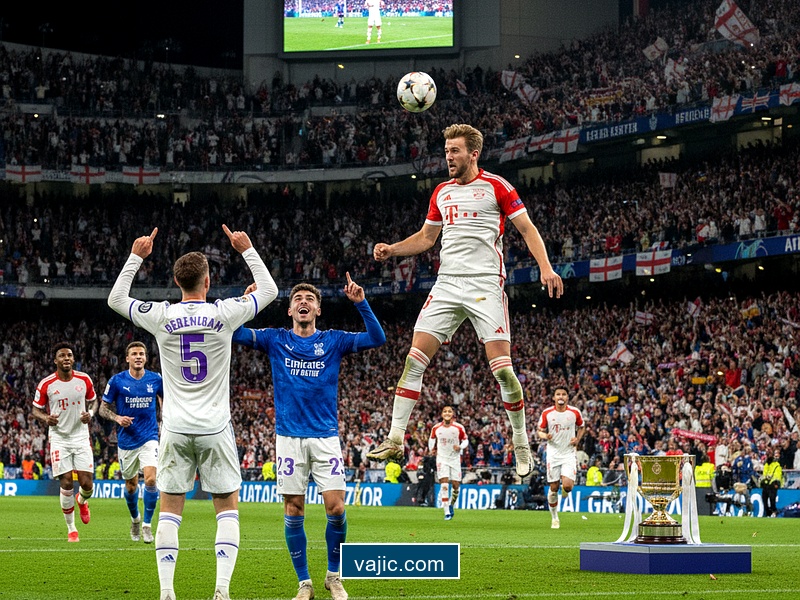
Harry Kane is inevitable. The Englishman has once again rewritten the Bundesliga history books, collecting accolades with the casual demeanor of a man picking up groceries. Fresh off winning a prestigious German media prize and shattering yet another scoring record, the headlines naturally gravitate toward the striker’s insatiable appetite for goals. Simultaneously, in Spain, Jude Bellingham and Conor Gallagher are keeping the La Liga title race heart beating with vital contributions for Madrid’s rival giants. It is a golden era for the "Brits Abroad."
But to focus solely on the goalscorers is to miss the tectonic shifts occurring in the dugouts. The statistics are merely the symptoms; the disease—or the cure, depending on your perspective—lies in the managerial philosophies orchestrating these performances. Specifically, at Bayern Munich, we are witnessing one of the most audacious tactical experiments in modern European football history.
Vincent Kompany’s appointment was viewed by many as a desperation heave by a Bayern board running out of options. Instead, the Belgian has installed a philosophical framework so radical, so uncompromisingly aggressive, that it makes the "Hansi Flick sextuple" era look almost conservative. Kane is the primary beneficiary, yes, but he is also the canary in the coal mine for a project that dances on the edge of a precipice.
The Death of Pragmatism at the Allianz
To understand the current Bayern project, one must first exhume the corpse of the Thomas Tuchel era. Tuchel was a pragmatist, a tinkerer obsessed with control and reactive nullification. His Bayern was rigid, often joyless, and prone to neurotic collapses. Kompany has not just pivoted; he has burned the playbook.
The "Kompany Ball" philosophy is rooted in a Guardiola-esque obsession with possession, but with a verticality that Pep often restrains. When Kane drops deep—a trait he perfected under Jose Mourinho at Spurs—he isn't just linking play; he is vacating space for a chaotic, fluid frontline of Musiala, Olise, and Gnabry to flood the box. This is why Kane is smashing records. He is not operating in isolation; he is the fulcrum of a machine designed to create overloads in central areas.
Historically, Bayern Munich demands dominance ("Mia san Mia"), but they also demand security. Kompany has seemingly discarded the latter. In possession, Bayern often shape-shift into a 2-3-5 or even a 1-3-6 formation. The defensive line pushes up to the halfway mark, compressing the pitch to a suffocating 30 meters. It is breathtaking when it works, allowing Kane to feast on chances created by high turnovers. But when the press is broken, the Allianz Arena holds its collective breath.
The Sustainability Paradox
"The definition of insanity is doing the same thing over and over and expecting different results. The definition of Kompany’s Bayern is doing the same thing over and over and demanding the opponent collapses before the defense does."
This brings us to the sustainability of the project. Can a team win the Champions League playing a defensive line that resides in a different postal code from its goalkeeper? Kane’s goals suggest the offense is championship-caliber, but the philosophical rigidity is alarming. We saw glimpses of this fragility earlier in the season against Aston Villa and Barcelona. When elite transition teams bypass the first wave of Kompany’s press, Bayern’s center-backs—often Dayot Upamecano and Kim Min-jae—are left isolated in vast acres of space.
This is not a bug; it is a feature. Kompany is betting the house that his attack can outscore the opponent’s ability to exploit his glass jaw. It is a philosophy of pure idealism. Unlike Xabi Alonso’s Bayer Leverkusen, which blends possession with a robust defensive structure, Kompany’s Bayern is an all-or-nothing proposition. Kane is scoring at a record rate because the system sacrifices everything for offensive output.
We must ask: Is Kane’s record-breaking season a product of his brilliance, or is it inflated by a system that will inevitably crash against a pragmatist manager in the Champions League semi-finals? History suggests the latter. High-line dogmatism rarely survives the gauntlet of April and May.
The Spanish Contrast: Ancelotti vs. Simeone
While Kompany conducts his high-risk orchestra in Bavaria, the British contingent in Spain highlights two starkly different managerial archetypes, further contextualizing the Bayern experiment.
Jude Bellingham’s continued influence at Real Madrid is a testament to Carlo Ancelotti’s "Anti-Philosophy." Ancelotti does not have a system; he has players. If Kompany is an architect drawing rigid blueprints, Ancelotti is a jazz musician. He adjusted Bellingham’s role from a false nine last season to a deeper, more laborious midfield engine this year to accommodate Kylian Mbappé. The fact that Bellingham is still impacting the score sheet speaks to Ancelotti’s ability to manage egos and moments rather than imposing tactical dogma.
Real Madrid thrives on chaos because they are comfortable in it. Bayern under Kompany creates chaos but seems terrified of it when the ball is lost. That is the difference between a project built on players (Madrid) and a project built on a manager’s ideology (Bayern).
The Grit of Gallagher
Then there is Conor Gallagher at Atletico Madrid. If Kane is the beneficiary of abundance, Gallagher is the soldier of scarcity. Diego Simeone’s philosophy has remained unchanged for over a decade: suffering is a virtue. Gallagher’s recent goal contribution in the title race is significant not because of tactical fluidity, but because he has bought into the cult of Cholismo.
Simeone’s project is the antithesis of Kompany’s. Atletico wins by dragging opponents into deep water and drowning them. Bayern wins by trying to drain the ocean. Gallagher fits Simeone because the system requires high-intensity running and defensive discipline—traits that are subservient to the collective. Kane fits Kompany because the system requires technical perfection and rewards offensive greed.
Verdict: The Architect’s Blind Spot
Harry Kane will likely win the Golden Boot. He may even break the 41-goal record set by Robert Lewandowski if he stays fit. The English captain is the perfect instrument for Kompany’s symphony. But trophies are not handed out in December or January.
The "Project" at Bayern is currently a beautiful illusion. It masks defensive deficiencies with overwhelming firepower. We have seen this movie before—Peter Bosz at Dortmund, or even the later years of Arsene Wenger. It dazzles against the mediocrity of the mid-table but often shatters under the pressure of elite tactical counters.
Kompany has restored the entertainment factor that Tuchel destroyed, and for that, the Bavarian faithful are grateful. But a philosophy that relies on scoring three goals because you are guaranteed to concede one is not a strategy for European dominance; it is a strategy for entertainment. Kane is having the time of his life, but unless Kompany learns to temper his idealism with a dose of Ancelotti’s pragmatism or Simeone’s grit, this record-breaking season may end with individual gold but collective silver.
The numbers don't lie, but they often deceive. Kane is conquering Germany, but Kompany’s refusal to compromise may yet cost them the war.