
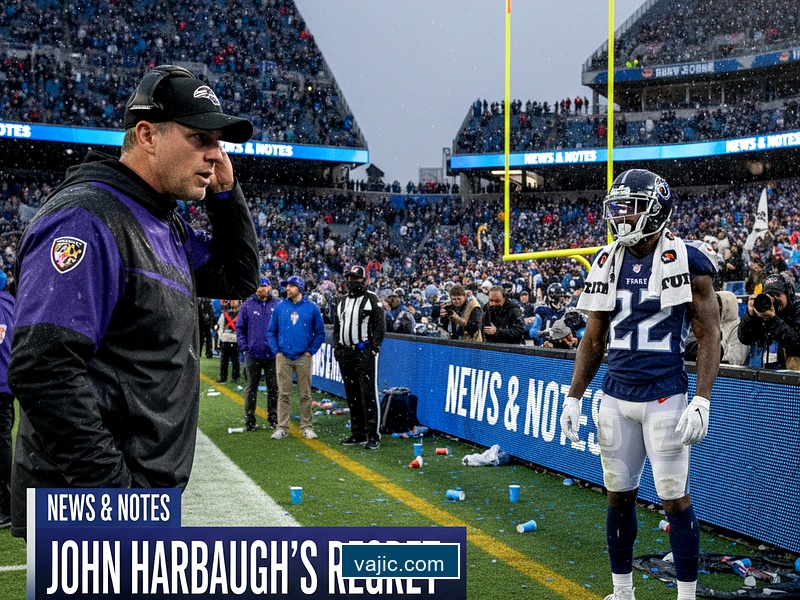
There is a specific kind of silence that falls over a locker room when a team realizes it has outsmarted itself. It is not the silence of being beaten by a superior opponent. It is the silence of self-sabotage. Following the Baltimore Ravens' baffling collapse against the New England Patriots—a game they controlled until they decided to stop playing their brand of football—John Harbaugh admitted he regretted keeping Derrick Henry on the sideline for the final 12 minutes and 50 seconds.
Regret is a polite word. In the sophisticated, high-stakes theater of the NFL, what transpired in Foxborough was tactical malpractice. It was a betrayal of the franchise's identity that would have made the architects of the "Baltimore Bully" era spit on the ground in disgust.
The Fallacy of Preservation
The logic, presumably, was preservation. With the playoffs looming, the Ravens' brain trust engaged in a cost-benefit analysis that belongs in an actuary's office, not on a gridiron. They looked at a lead against a rebuilding Patriots squad and decided it was safe to put the Ferrari in the garage to save mileage.
Here is the flaw in that logic: You do not "save" a player like Derrick Henry. You unleash him. Henry is not a scatback who operates on a pitch count. He is a physiological anomaly who gains strength as the opposing defense loses will. His career yards per carry average actually increases in the fourth quarter. He is the inevitability of gravity.
By sitting Henry for the final 12:50, Harbaugh didn't just remove a player; he removed the psychological anchor of the offense. The Patriots, a team that should have been planning their offseason vacations, suddenly realized they didn't have to tackle a 247-pound locomotive. The fear evaporated. The Ravens’ offense stalled, three-and-outs piled up, and the defense, gassed and devoid of the rest time Henry usually provides, crumbled.
The Ghost of 2003: A Lesson in Blunt Force
To understand the magnitude of this error, we must look back twenty years. In 2003, the Ravens possessed another transcendent back: Jamal Lewis. That season, Lewis rushed for 2,066 yards, the third-highest total in NFL history. He carried the ball 387 times.
Brian Billick, for all his offensive genius and occasional hubris, understood one fundamental truth about AFC North football: When you have the hammer, you strike until the nail is flush. There were games in that 2003 season—specifically late-season grinders against the Browns and Steelers—where Lewis was clearly battered. Did Billick pull him with 12 minutes left in a one-score game to "preserve" him for January?
Absolutely not.
"We didn't have analytics telling us about load management," a former Ravens scout told me years ago regarding that era. "We just knew that if Jamal was on the field, the other team's linebackers were thinking about their health, not the ball."
In 2000, during their first Super Bowl run, the Ravens went five consecutive games without scoring a touchdown. They won two of them. Why? Because they controlled the clock and the physicality of the game. They forced opponents to play in a phone booth. By benching Henry, Harbaugh tried to play a finesse game with a roster built for a street fight. He tried to win with a rapier when he was holding a sledgehammer.
The Closer Mentality: Henry vs. The Bus
Sports media often discusses "closers" in the context of baseball—the Mariano Riveras walking out of the bullpen. But football has closers, too. The Pittsburgh Steelers of the mid-2000s had Jerome Bettis. Late in his career, specifically the 2004 and 2005 seasons, "The Bus" wasn't averaging five yards a carry. He was often averaging three. But Bill Cowher knew that in the final eight minutes, Bettis was a nightmare. He converted first downs. He ate clock. He demoralized the opposition.
Derrick Henry is the modern evolution of that archetype, but with more explosive potential. He is the ultimate closer. When Harbaugh opted for Justice Hill or passing plays in that final quarter, he wasn't just changing personnel; he was changing the game state from "attrition" to "variance." Variance is how a rookie quarterback or a struggling team like New England finds a way to win. Attrition is how the Ravens win.
The Pattern of "Smartest Guy in the Room" Syndrome
This isn't an isolated incident for Harbaugh. It echoes the painful memories of the 2019 AFC Divisional Round against the Tennessee Titans. In that game, the 14-2 Ravens, featuring the greatest rushing attack in history, panicked after falling behind early. They abandoned the run, asking Lamar Jackson to throw 59 times while their running backs combined for just nine carries.
Who was on the other sideline that day? Derrick Henry. The Titans didn't overthink it. They handed him the ball 30 times. He threw a touchdown pass. He ran for 195 yards. He ended the Ravens' season.
The irony is suffocating. The Ravens brought Henry to Baltimore specifically to prevent that 2019 scenario from happening again. They acquired him to be the solution to short-yardage woes and fourth-quarter leads. Yet, when the script called for the star to take the stage, the director kept him behind the curtain.
Momentum vs. Metrics
The fallout from this loss is not just about the standings. It is about the psyche of the team entering the postseason. The 2012 Ravens, who won the Super Bowl, entered the playoffs on a skid, losing four of their last five. However, they had a rallying cry—Ray Lewis's "Last Ride." They had emotional clarity.
The current Ravens have confusion. They have a locker room wondering why their best weapon was shelved in a game they gave away. When players lose faith in the game plan, execution suffers. Harbaugh’s admission of regret is necessary, but it doesn't return the lost win probability. It doesn't erase the tape that future playoff opponents—the Chiefs, the Bills—are watching right now.
Those opponents now know that Baltimore can be baited out of its strength. They know that the Ravens' coaching staff fears injury more than they fear losing momentum. That is blood in the water.
The Verdict
Analytics have their place. Sports science has extended careers and improved the product. But football remains a game of imposition. You impose your will on the opponent until they break.
Derrick Henry is the greatest instrument of will in the National Football League today. To sit him out for the final 13 minutes of a competitive game is not strategy; it is a fundamental misunderstanding of the asset you possess. If the Ravens want to hoist the Lombardi Trophy in New Orleans, John Harbaugh needs to stop trying to manage the game and start trying to win it. And winning it means one thing: feeding the King until the clock hits zero.