
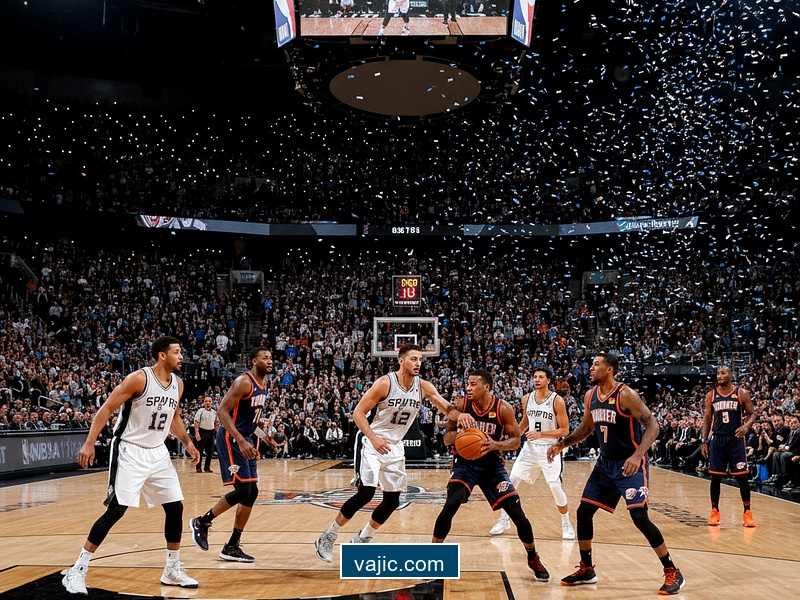
The tape doesn’t lie, but in the case of the renewed San Antonio Spurs versus Oklahoma City Thunder dynamic, the tape looks like it was generated by a sci-fi writer rather than a basketball coach. The league office, usually slow to pivot its marketing machinery, hasn’t hesitated here. Scheduling this matchup twice during Christmas week—including the marquee December 25th slot—isn't a gamble. It’s an acknowledgment that the tectonic plates of the Western Conference have shifted.
I’ve spent two decades watching big men bludgeon each other in the low block. What Victor Wembanyama and Chet Holmgren are doing is not that. We are witnessing the death of the traditional positional grid. But beyond the highlight reels and the media adoration, a deeper look at the film reveals a sophisticated tactical warfare brewing between Gregg Popovich’s institutional discipline and Mark Daigneault’s chaotic modernism.
Biomechanical Anomalies: The Tape Breakdown
To understand this rivalry, you must first strip away the box scores and look at the biomechanics. In 20 years of scouting, I have rarely seen two seven-footers move with this specific type of fluidity. However, they are not mirror images.
Holmgren moves like a oversized wing. Watch his hip fluidity when he switches onto guards in the pick-and-roll. He doesn’t just "drop" into the paint; he plays at the level of the screen, flips his hips, and slides laterally. His "second jump"—the ability to land and immediately explode upward again for a rebound or contest—is elite. It’s polished. It’s efficient. There is very little wasted kinetic energy in Holmgren's game.
"The difference isn't height; it's the recovery radius. Wembanyama can make a mistake, be two steps out of position, and still erase a shot at the rim. That breaks offensive schemes."
Wembanyama is different. He is raw physics. His stride length allows him to cover the court in fewer steps than anyone in history, but scout the "unseen" work: his deceleration. Last season, his biggest issue was stopping his momentum to contest without fouling. In the preseason flashes against OKC, specifically that game in Vegas, we saw improved core stability. He is learning to absorb contact into his chest rather than reaching over, a crucial adjustment for a player with a center of gravity that high.
Tactical Architecture: The Popovich vs. Daigneault Chess Match
The media sells this as player vs. player, but the coaching contrast is where the real basketball intellect is found. The Thunder run a "0.5 offense"—catch, shoot, or drive in half a second. It is predicated on spacing and relentless driving from Shai Gilgeous-Alexander (SGA) and Jalen Williams.
When San Antonio plays OKC, watch the "tagger" on the weak side. Daigneault spaces the floor so wide that the Spurs' defenders are forced into a brutal decision: stay attached to shooters in the corners or rotate to the rim to help Wembanyama. OKC weaponizes Holmgren as a spacer, pulling Wembanyama away from the basket. If Victor stays in the paint, Chet pops for three. If Victor closes out, SGA attacks the open lane. It is a pick-your-poison scenario that stresses the structural integrity of a defense.
Conversely, the Spurs are still installing the operating system. Popovich is running more "Horns" sets and "Pistol" actions to get Wembanyama the ball on the move. The unseen struggle for San Antonio has been the entry pass. Last year, the Spurs' guards lacked the angle recognition to feed the post effectively. This season, watch for Jeremy Sochan operating as the fulcrum at the elbow. By lifting the playmaking to the high post, they create better passing lanes for Wembanyama on the back cuts, neutralizing the Thunder's aggressive passing lane denial.
The Mental Game: Body Language and Frustration Tolerance
A scout’s eyes always drift to the bench during timeouts. This is where the maturity gap currently exists. The Thunder, despite their youth, possess the poise of a veteran unit. When a defensive rotation is missed, Holmgren points, communicates, and resets. There is a palpable connection between him and SGA. They understand the hierarchy. Holmgren is comfortable being the defensive anchor and the second or third offensive option.
Wembanyama’s body language is fascinatingly intense. He demands perfection. Last season, visible frustration surfaced when teammates missed him on lobs or botched switches. The "unseen" development for the Spurs this year isn't Victor's jump shot; it's his leadership in the huddle. Can he navigate the growing pains of a rebuilding roster while Holmgren and the Thunder are competing for the number one seed? That psychological friction is what builds genuine rivalries.
Historical Context: 2012 Redux or Something New?
It is lazy to compare this to the Duncan vs. Garnett battles of the early 2000s. Those were wars of attrition in a phone booth. The closest historical parallel might actually be the 2012 Western Conference Finals, where the Spurs' beautiful machine met the raw athleticism of the Durant-Westbrook-Harden Thunder. But even that falls short because the geometry of the court has changed.
We are looking at a reprisal of the Ralph Sampson promise—the idea of a 7'4" player who moves like a guard—realized 40 years later, multiplied by two. The salary cap implications also loom large here. OKC has a treasure chest of draft assets (the "war chest" Sam Presti built) that allows them to surround Holmgren with elite talent on rookie scales. The Spurs are years behind in that cycle. This creates an asymmetry: OKC must win now, while San Antonio is playing the long game. This disparity often fuels the most bitter feuds.
Christmas Day Implications
The NBA scheduling this matchup twice in late December is a stress test. They are banking on the Vegas preseason intensity translating to the regular season. For the betting markets, the lines will heavily favor OKC due to roster continuity, but the sharp money will be watching the individual matchup usage.
Specific look-ahead key: Watch how the Spurs defend the "Spain Pick and Roll" (a screen for the screener). OKC runs this to confuse drop coverage. If Wembanyama drops too deep, the back-screener pops open. If he steps up, the lob is there. How Popovich counters this specific action will tell us if the Spurs are ready to compete or just participate.
This rivalry isn't just about the future; it's the current reality of the Western Conference. The "Alien" and the "Stickman" aren't coming; they are here, and they are dismantling the old logic of basketball one possession at a time.