
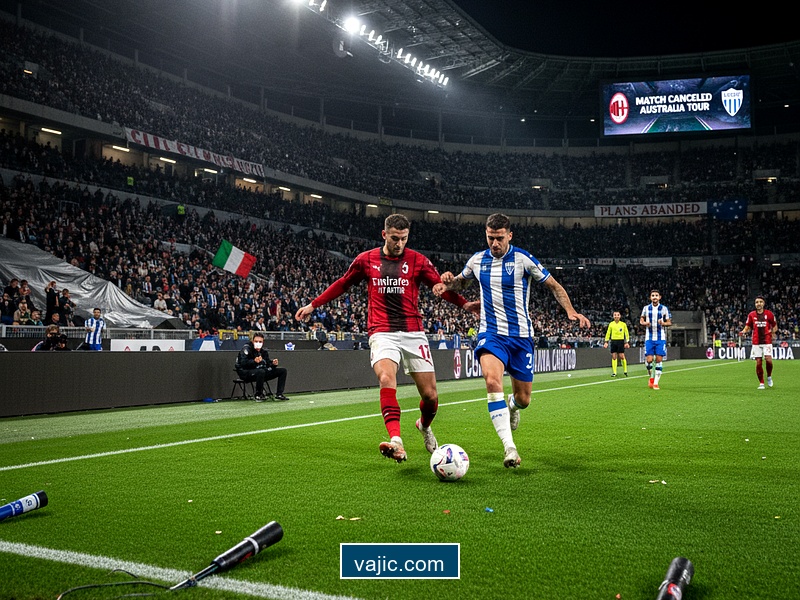
The announcement that the proposed Serie A fixture between AC Milan and Como 1907 in Australia has been abandoned is not a failure of logistics; it is a mercy killing of a bad idea. For the suits at RedBird Capital and the Sent Entertainment group, this is a lost revenue stream, a missed opportunity to hawk shirts in Perth. But for the purists, and more importantly, for the tactical integrity of Paulo Fonseca and Cesc Fàbregas, this cancellation is a divine intervention.
We need to stop looking at this through the prism of a failed friendly and start analyzing what this proposed desperate trans-continental cash grab actually represented. It highlights the friction between two distinct, philosophical projects currently warring for relevance in Italy. One is a historic giant trying to Moneyball its way back to European dominance; the other is a glamorous upstart playing a dangerous, idealistic game of tactical roulette.
The Fàbregas Experiment: Naivety or Genius?
Let us strip away the postcard images of Lake Como and the celebrity shareholders like Thierry Henry. Underneath the Hollywood veneer lies the most intriguing, and perhaps reckless, tactical experiment in European football. Cesc Fàbregas is not managing like a relegation scrapper. He is managing as if he is still sitting in the midfield of Guardiola’s Barcelona.
Most promoted sides in Serie A adhere to the unwritten rule of salvezza (survival): low blocks, counter-attacks, and physical attrition. Think of Nicola’s Salernitana or the gritty Verona sides of years past. Fàbregas has thrown that script into the trash. His Como sets up in a fluid 4-2-3-1 that morphs into a 2-3-5 in possession. He demands playing out from the back, even under extreme pressure, utilizing inverted fullbacks to overload the midfield.
"We do not change for the opponent. We change the opponent to suit us." — The unspoken mantra of the Como dressing room.
This philosophy is seductive, but history suggests it is often fatal. Zdeněk Zeman tried to impose pure offense on provincial teams for decades; his teams were beloved, but they leaked goals like a sieve. Fàbregas is attempting to implement "Sarriball" without the three years of drilling Maurizio Sarri usually requires. The overarching question isn't whether Como is marketable in Australia; it’s whether Fàbregas’s insistence on aesthetic dominance is sustainable against the tactical pragmatism of Italian coaches like Gasperini or Inzaghi.
The cancellation of the Australia trip is crucial here. Fàbregas does not need a promotional tour. He needs hours on the training pitch at the Mozzate sports centre to teach a squad—half of whom are new signings—how to press without leaving the back door wide open. The project relies on technical superiority in a league that feasts on tactical errors.
Fonseca and the RedBird Algorithm
Across the divide, we have AC Milan. Under RedBird Capital, the Rossoneri have become the poster boys for American corporatization in Calcio. The desire to play a league match in Australia screams of an ownership group that views the club as a content engine first and a football team second. This creates a massive headache for Paulo Fonseca.
Fonseca was hired not to ignite the passions of the Curva Sud like Antonio Conte would have, but to be a company man—a coach who fits the model. His philosophy is one of control and verticality, a shift from Stefano Pioli’s emotional, man-to-man chaos. However, Fonseca’s "Zorro" persona hides a tactical rigidity that is currently clashing with his best players. His insistence on positional discipline has neutralized the anarchic brilliance of Rafael Leão. When you strip Leão of his freedom, you strip Milan of its teeth.
The "Project" at Milan is built on algorithmic recruitment. They sold the soul of the team, Sandro Tonali, to fund a platoon of mid-range assets like Yunus Musah and Noah Okafor. It is a philosophy that prioritizes asset appreciation over the distinct culture of Italian defending. Fonseca is tasked with making a spreadsheet play like a championship team.
A Tale of Two Projects
The abandoned Perth match serves as a perfect lens to compare these two ownership models. Both wanted the exposure, but their on-pitch realities are vastly different.
| Feature | AC Milan (RedBird) | Como 1907 (Hartono Brothers) |
|---|---|---|
| Ownership Wealth | Private Equity (Investment focused) | Djarum Group ($45bn+ net worth) |
| Tactical Identity | Structured, vertical possession (Fonseca) | Total Football, High Risk/Reward (Fàbregas) |
| Recruitment Strategy | Data-driven, U25 resale value (Moneyball) | Veteran stardom (Varane, Roberto) mixed with youth |
| Primary Risk | Disconnect between management and ultras | Defensive fragility leading to relegation |
The Sustainability of Style
Is the Fàbregas approach sustainable? In the short term, likely not. The gap in quality between Serie B and Serie A is a chasm. Trying to out-pass Inter or out-maneuver Juventus with a squad assembled in three months is a suicide mission. However, the Hartono brothers are the richest owners in Italian football—wealthier than the Agnellis or Friedkins. Their project is not about surviving one season; it is about turning Como into the Monaco of Italy. If they go down, they will spend their way back up. The "Project" is robust, even if the tactics are naive.
Milan’s sustainability is different. They are financially healthier than they have been in a decade, posting profits and building a new stadium plan. But sporting sustainability is shaky. A club cannot rely solely on algorithms and ignore the intangible "Milan DNA" that Maldini represented. Fonseca is currently managing a team that looks like a collection of talented strangers. If results dip, the lack of emotional connection between the ownership and the fanbase will turn San Siro toxic.
The Verdict: Football Wins
The cancellation of this match is a victory for the integrity of Serie A. The league is currently undergoing a tactical renaissance. It is no longer the land of Catenaccio; it is the home of Bologna’s fluid rotations, Atalanta’s man-marking press, and now Como’s Spanish idealism.
To drag these teams to Australia for a glorified exhibition would have been an insult to the work required to succeed in this ecosystem. Fàbregas needs to figure out how to stop conceding two goals a game. Fonseca needs to figure out how to get Leão to track back without causing a civil war.
The "Project" for both clubs relies on what happens in the mud of the winter months, not the sunshine of an Australian summer. Como is fighting for an identity; Milan is fighting to retain one. Let them play in Lombardy, where the stakes are real, and the consequences of their managers' philosophies will be laid bare for all to see.