
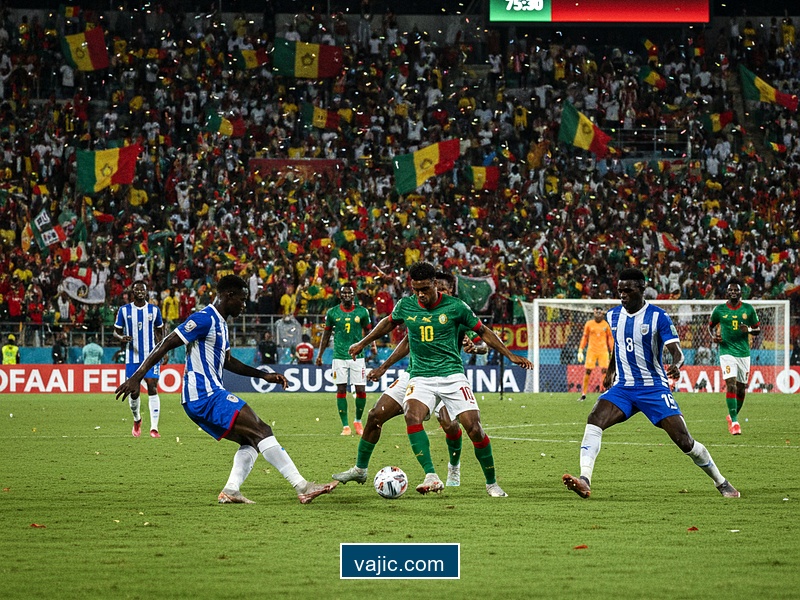
The average spectator watches the ball. The professional scout watches the space where the ball isn’t. As the Africa Cup of Nations unfolds, the true narrative isn't found in the highlight reels of Senegal or the scorelines of DR Congo; it lies in the microscopic adjustments of hip orientation, the scanning frequency of midfielders, and the structural integrity of a rest defense.
Having spent two decades analyzing the evolution of African football, I find the current iteration of the tournament to be a fascinating case study in tactical discipline clashing with individual brilliance. The recent fixtures involving Senegal against Botswana and the DR Congo’s tussle with Benin offer a masterclass in the unseen work that defines modern football.
The Kinetic Chain of Edo Kayembe
Let’s dissect the engine room of the Democratic Republic of Congo. The headlines celebrate the win, but the scout’s notebook circles Edo Kayembe. The Watford midfielder represents a specific archetype that is currently dominating the English Championship: the high-volume recycler with vertical intent. But in Rabat, playing for the Leopards, his role shifts.
Watching the tape, Kayembe’s value isn't in his tackle count. It is in his "pre-orientation." Before the ball arrives from the center-backs, Kayembe checks his shoulder an average of four times in ten seconds. This scanning creates a mental map of the Benin press. When he receives possession, his body is rarely closed off; he receives on the back foot, opening his hips to the entire field.
"The difference between a good midfielder and a great one is not the pass they make, but the space they kill before they touch the ball. Kayembe doesn't just pass; he manipulates the opposition's block."
Sébastien Desabre, a manager who cut his teeth in the intricate tactical battles of North African leagues before taking the Uganda job, has installed a system that relies heavily on this pivot. Unlike the chaotic transition games of the past, this DRC side uses Kayembe to bait the press. He holds the ball a fraction of a second longer than comfortable, drawing the Benin midfielders out of their slot, before releasing a line-breaking pass. This is high-risk, high-reward behavior that requires nerves of steel and elite proprioception.
Sadiki and the Education of Pressure
Then there is the case of Noah Sadiki. The hype surrounding the Sunderland youngster is palpable, but a scout looks for cracks in the armor of youth. In the Championship, the game is played at 100 miles per hour, often bypassing midfield complexity for sheer physical transitions. AFCON is different. It is played in the heat, on pitches that sometimes drag, against low blocks that refuse to budge.
Sadiki’s education at Anderlecht’s Neerpede academy—arguably Europe’s premier factory for technical talent—shows in his touch. However, the "unseen" work here is his recovery running. Modern scouting demands we look at a player's reaction within three seconds of losing possession. Does he sulk? Does he jog? Or does he immediately counter-press?
Against a team like Benin, known for their stubbornness, Sadiki’s off-the-ball movement into the "half-spaces" (the vertical channels between the wing and the center) is critical. He doesn't just run; he drifts. He occupies the blind side of the opposing defensive midfielder, forcing the defender to turn his head. This disruption of the defensive visual field is what creates the fraction of space needed for a striker to pull the trigger. It is a level of tactical maturity rare for his age, suggesting he isn't just "carrying hopes" but orchestrating structure.
The Benin Block: A Study in Compression
We must not overlook Benin. Under the guidance of Gernot Rohr, a man who essentially built the modern Nigerian tactical identity before his unceremonious exit, Benin plays a game of frustration. Rohr is a pragmatist of the highest order. He understands that talent wins games, but geometry prevents losses.
The "Cheetahs" employ a defensive compression that is suffocating. A scout watching Benin ignores the ball and looks at the distance between their defensive line and their midfield line. In possession, they expand; out of possession, that gap shrinks to less than twelve yards. This compactness forces teams like DRC to play laterally, creating the dreaded "U-shape" circulation that frustrates fans and delights defensive coaches.
This is where the reunion in Rabat becomes a chess match. Desabre knows Rohr’s tendencies. The battle wasn't won on the wings; it was won in the pockets of space that Kayembe and Sadiki managed to pry open within that compressed block. It is a war of attrition, not attrition of fitness, but of mental concentration.
Senegal’s Rotational Fluidity
Turning our gaze to the champions, Senegal’s match against Botswana offers a different flavor of tactical soup. The Teranga Lions have evolved past the pure athleticism that defined their teams of the early 2000s. Under Aliou Cissé, they have developed a sophisticated positional play that rivals top European clubs.
| Attribute | DR Congo (The Challenger) | Senegal (The Standard) |
|---|---|---|
| Build-up Phase | Vertical, reliant on pivot (Kayembe) | Patient, utilizing wide overloads |
| Defensive Shape | Mid-block, aggressive triggers | High line, dominant aerial control |
| Off-ball Movement | Rotational chaos to disrupt markers | Structured third-man runs |
| Key Metric | Line-breaking passes completed | Possession in final third |
Against Botswana, the key indicator was the interaction between the winger and the fullback. In amateur football, players occupy static positions. In Cissé’s system, they occupy dynamic zones. When the winger drops deep to receive, the fullback doesn't just overlap; he makes an "underlap" run into the penalty area. This is a nightmare to defend because it forces the opposing center-back to leave his zone to track a runner, destroying the defensive line's integrity.
Botswana’s challenge was maintaining visual contact with these runners. Fatigue in football is often perceived as physical, but the first thing to go is the neck muscles. Defenders stop checking their shoulders. Senegal exploits this ruthlessly. Their movement patterns are designed to induce cognitive overload in the opposition.
The Verdict: Structure Over Star Power
The narrative of the AFCON is shifting. We are moving away from the era of the singular talisman—the Drogba, the Eto’o—dragging a team to glory. We are entering the era of the system. The teams that succeed, like Senegal, and those rising, like Desabre’s DRC, are built on the principles of spacing, rest defense, and cognitive speed.
For Sunderland, Sadiki’s performance is data for his valuation. For Watford, Kayembe’s control is reassurance of his Premier League quality. But for the nations they represent, these technical details are the difference between a flight home and immortality. The scoreline tells you what happened; the body shape, the scan, and the run tell you why. And right now, the "why" suggests that the Leopards are building a spine capable of carrying the weight of a nation.