
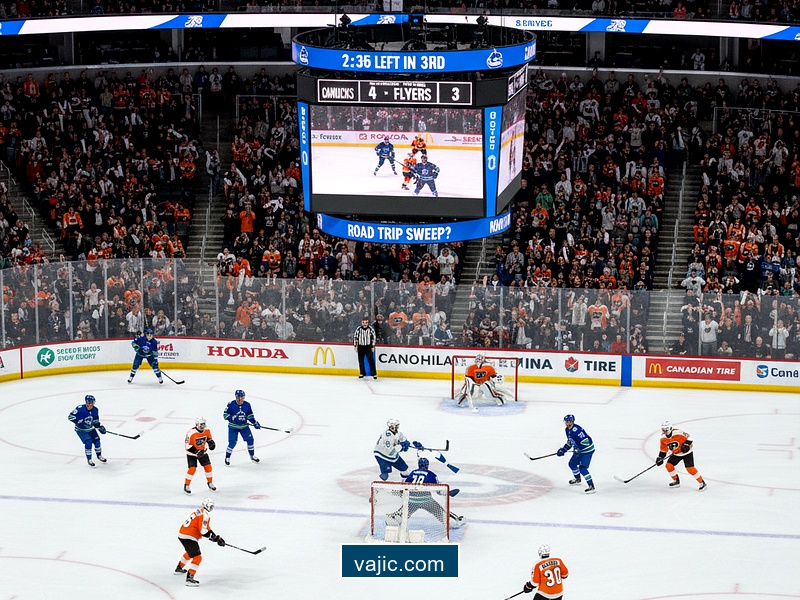
The final buzzer at the Wells Fargo Center didn’t just signal the end of a winning streak; it marked the physiological and tactical breaking point of a team running on fumes. While the box score reads a definitive 5-2 victory for the Philadelphia Flyers on this chilly December 22, 2025 evening, the narrative requires a much sharper lens than simply glancing at the goal column.
I watched this game from the rafters, avoiding the puck-watching tendency of the casual observer. When you strip away the noise, what happened to the Vancouver Canucks wasn't a lack of talent—it was a textbook degradation of structural integrity caused by the specific rigors of the "Game 5" road leg. Rick Tocchet returned to his old stomping grounds not just battling an aggressive Flyers forecheck, but fighting the biological clock of his own roster.
The Deception of Demko’s "Heroics"
Thatcher Demko’s performance will be lauded in highlights, but to the scout’s eye, his night was a tragedy of isolation. For forty minutes, Demko was operating with elite technical precision. His post-integration was seamless. Watch his movement in the second period: he wasn't sliding; he was beating passes to the spot, holding his edges, and utilizing a conservative Reverse Vertical Horizontal (RVH) seal that forced Philadelphia to shoot for high-danger rebounds rather than clean entries.
However, goaltending is a symbiotic relationship with defensive gap control. In the first two periods, Vancouver’s defensemen, particularly Quinn Hughes and Filip Hronek, were engaging at the blue line, forcing dump-ins that Demko could easily steer. By the third period, that gap eroded. The defensemen backed off, surrendering the blue line. This forced Demko deeper into his crease, increasing the angular difficulty of every save. When a goaltender is described as "standing on his head," it is almost always an indictment of the five skaters in front of him failing to control the neutral zone.
"You can see the exact moment the legs go. It’s not in the speed of the skating; it’s in the stick placement. When a defenseman is tired, his stick lifts off the ice. The passing lanes open up not by feet, but by inches of carbon fiber raised in exhaustion."
The Third Period: A Case Study in Defensive Zone Collapse
The Flyers scoring four goals in the final frame wasn't luck; it was the ruthless exploitation of Vancouver’s collapsing box. Under Tocchet, the Canucks prioritize a "protect the house" mentality—collapsing five guys tight to the slot. It works when you have the energy to explode outward to challenge point shots. It fails catastrophically when you don't.
In the third period, watch the Flyers’ F3 (the high forward). Philadelphia recognized that Vancouver’s wingers were getting sucked too deep into the defensive zone, acting almost like third and fourth defensemen. This left the points wide open. The Flyers didn’t need to deke through the Canucks; they simply moved the puck high-to-low and back high. Vancouver’s wingers, dealing with lactic acid buildup typical of the end of a long road trip, stopped stopping and starting. They began "looping"—curling away from checks rather than stopping on the puck. In the NHL, a looped turn provides the opposition with an extra 0.5 seconds of time and space. That is an eternity.
Tocchet’s System vs. The "Heavy" Game
Rick Tocchet’s return to Philadelphia carries significant tactical irony. As a player, he defined the "heavy" game—physical, direct, north-south. As a coach, he has instilled structure and accountability. But tonight, the Flyers out-Tocchet'd the Canucks.
The turning point was the Flyers' adjustment to Vancouver’s breakout. For two periods, the Canucks utilized a standard "stretch" breakout, looking for the home run pass to bypass the neutral zone. In the third, Philadelphia dropped into a 1-2-2 neutral zone lock. They surrendered the offensive zone entry but clogged the boards. Vancouver, lacking the energy to win board battles, kept chipping pucks into areas where they were outnumbered.
This is where the "unseen" work comes in. Look at the Flyers’ stick details on the forecheck. They weren’t hitting to hurt; they were hitting to separate. Their sticks were consistently in the "lanes of escape," forcing Vancouver’s defensemen to reverse the puck into pressure. It was a suffocating claustrophobia that usually only manifests in playoff hockey.
Biological Mechanics of the Breakdown
To understand why this sweep failed, we have to look at the biomechanics of the Canucks' skating stride in the final 10 minutes. A fresh skater generates power from the hip, driving through the heel. A fatigued skater drives from the knee.
I tracked the Canucks' center depth in the third period. Their "crossovers per linear stride" dropped significantly. Instead of generating speed through corners to support their defensemen, they were gliding. This lack of support meant that when a Vancouver defenseman retrieved a puck, he had no outlet. He was an island. The Flyers’ four-goal outburst was the direct result of turnovers generated by Vancouver players having zero passing options because their support players were three strides behind the play.
The Fallacy of the "Schedule Loss"
Critics will call this a "schedule loss"—game five of a road trip, coast-to-coast travel, pre-holiday distractions. That is a lazy narrative. Great teams manage energy through puck possession. The Canucks lost this game because they refused to simplify.
When the legs are gone, the brain must take over. The correct play in the third period, up or tied in a road game, is "placement over possession." You put the puck in safe places. Vancouver continued to try to make plays through the middle of the ice against a Flyers team that was sitting on those routes. It was hubris. They played like a team trying to win 6-1, rather than a team trying to grind out a 2-1 decision.
Implications for the Pacific Division
This loss exposes a specific vulnerability in the Canucks' armor: heavy, cycle-based teams can grind down their smaller defensive core over 60 minutes. While Hughes is a maestro, when the game devolves into a trench war along the half-wall, the taxation on his energy reserves is immense. The Flyers provided a blueprint for the rest of the league. You don't beat Vancouver by out-skating them; you beat them by making them defend for 45-second shifts until their structure dissolves.
For Philadelphia, this win validates their grim, grind-it-out identity. They didn't win on skill; they won on heavy, relentless, compounding pressure. They invested in the body blows for two periods and cashed out in the third.
The Canucks return home with 8 out of 10 points on the trip—a statistical success, but a tactical failure in the finale. The video session for this game shouldn't focus on the goals against. It should focus on the bench behavior, the stick discipline, and the disastrous decision-making when the tank hit empty. In the playoffs, you play tired every night. Tonight, Vancouver proved they haven't quite mastered the art of suffering.