
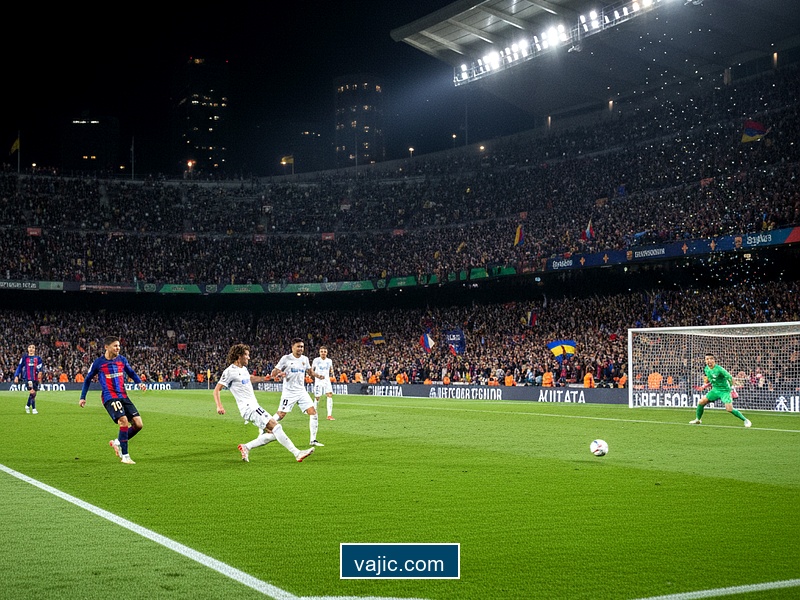
The midseason table suggests dominance, but the eye test screams vertigo. While Graham Hunter correctly identifies Barcelona as the runaway leaders in his recent verdict, simply looking at the points gap ignores the terrifying fragility of the current ecosystem. We are witnessing a LaLiga season that feels less like a march to coronation and more like a high-speed car chase where the lead vehicle has cut its brake lines.
To understand the dynamics of this 2024-25 title "race"—if we can charitably call it that—we must stop looking at last season's stats and start looking at history books. Specifically, we need to open the chapters on the 2008-09 Barcelona setup and the calamitous 2003-04 Real Madrid implosion.
The Flick Revolution: Chaos vs. Pep's Control
Hansi Flick has undoubtedly restored Barcelona’s pride, but let us dispel a lazy narrative: this is not a return to the Guardiola DNA. It is a mutation. When Pep Guardiola’s Barcelona dismantled opponents between 2008 and 2012, they did so through suffocation. They held 70% possession not to entertain, but to defend. If you didn’t have the ball, you couldn’t score. It was anesthetic football—surgical, precise, and totally risk-averse in its own half.
Flick’s Barcelona is the antithesis. This is heavy metal played on a Stradivarius. The defensive line sits so high it is practically sharing tapas with the opposition goalkeeper. This season’s offside trap statistics are absurd, dwarfing anything seen in the top five European leagues over the last decade.
"In 2011, Xavi Hernandez and Andres Iniesta would kill a game by passing you into a coma. Pedri and Marc Casadó are being asked to kill games by sprinting into a knife fight."
The historical parallel here isn't the 2011 team that mesmerized Wembley; it is the 1996-97 team under Bobby Robson, led by a young Ronaldo Nazário. That team scored 102 goals but conceded 48, losing the league to a disciplined Real Madrid under Fabio Capello. Flick is betting the house that Lamine Yamal and Raphinha can outscore the inevitable errors caused by a suicidal high line. It is thrilling, but it lacks the inevitability of the Messi era.
Real Madrid and the Queiroz Warning of 2004
Hunter questions if there is a title race. The answer lies not in Catalonia, but in the identity crisis currently gripping the Santiago Bernabéu. The arrival of Kylian Mbappe was meant to herald a new dynasty. Instead, it has resurrected the ghosts of the 2003-04 season under Carlos Queiroz.
Twenty years ago, Florentino Perez assembled the original Galacticos: Zidane, Figo, Ronaldo, Raul, and Beckham. They sold Claude Makélélé—the engine—believing artistry trumped industry. By March, they were leading the league. By May, they had collapsed, finishing fourth, losing six of their last seven games.
Look at the current squad. The retirement of Toni Kroos has left a hole the size of the Castellana. Without Kroos, there is no metronome. Jude Bellingham, Fede Valverde, and Eduardo Camavinga are exceptional athletes, but they are runners, not conductors. They are trying to play a symphony using only drums.
We see Vinicius Jr. and Mbappe occupying the same left-leaning spaces, much like how Figo and Beckham occasionally tripped over each other’s tactical responsibilities. Carlo Ancelotti is arguably the greatest man-manager in history, but he is currently trying to solve a physics problem with charisma. Unless Madrid finds their modern Makélélé or reinvents their structure immediately, the "race" is academic.
The Atléti Evolution: Searching for the 2014 Grint
If there is a dark horse that history smiles upon, it might be Atlético Madrid, though not for the reasons usually cited. Diego Simeone has spent a decade trying to evolve away from the "Cholismo" that won him the 2014 title—a team that defended with the violence of a street gang and scored through Diego Costa’s sheer will.
The acquisition of Julian Alvarez was a signal of intent to play "football," yet Atlético often looks most comfortable when they revert to the suffering of the Diego Godín and Gabi era. The issue is the mileage. In 2014, Koke was a lung-busting youth; today, he is a veteran managing his minutes. The intensity required to break the duopoly requires a physical freshness that this squad intermittently lacks.
| Element | Legendary Benchmark | Current Reality (2025) |
|---|---|---|
| Barca's Midfield | Xavi/Busquets/Iniesta (Control) | Pedri/Gavi/Casadó (Verticality) |
| Madrid's Anchor | Xabi Alonso / Casemiro | Tchouaméni (Inconsistent application) |
| The "Star" Dynamic | Messi vs. Ronaldo (Binary rivalry) | Yamal (Ascendant) vs. Mbappe (Integration) |
The Financial Chasm and the "Other" League
We cannot discuss the midseason verdict without acknowledging the structural decay of the league's middle class. In the early 2000s, teams like Valencia (Benitez era) and Deportivo La Coruña (Irureta era) were genuine title contenders. Valencia won the league in 2002 and 2004. Depor won in 2000.
That era is dead, buried by financial fair play strictures that seem to handcuff the proletariat while the aristocracy finds leverage levers. Barcelona’s ability to field a world-class squad despite their well-documented financial tightrope walking is a testament to La Masia, yes, but also highlights the inability of clubs like Sevilla or Villarreal to sustain a challenge. The gap in wage bills has turned the "race" into a private members' club.
The Verdict
So, is there a title race? Yes, but it is a race defined by imperfection. Barcelona is leading because they have embraced a tactical radicalism that teams have not yet figured out how to punish consistently. But the blueprint to beat them exists: one well-timed long ball over the top of Cubarsí or Martínez can shatter the illusion of invincibility.
Real Madrid is not chasing Barcelona; they are chasing their own shadow. They possess the individual talent to win 15 games in a row simply by brute force, but they lack the coherence of the 2017 double-winning side or the 2022 Champions League victors.
Expect the second half of the season to be volatile. Flick’s physical demands will test the hamstrings of a thin squad. If the injuries pile up, that high line will drop, and the pressing will fade. That is the moment Madrid is waiting for. But if Ancelotti cannot fix the imbalance in midfield, we will be watching a coronation by Easter, marking the triumph of Flick’s chaotic bravery over the Galactico model’s bloated excess.