
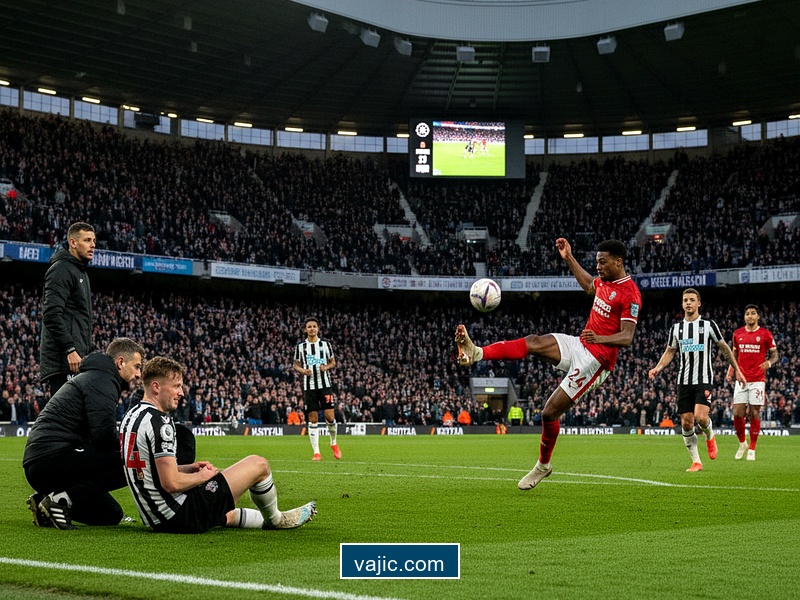
The sight of Alexander Isak trudging toward the touchline is becoming a recurring nightmare for the Gallowgate End, but to dismiss this latest setback as mere misfortune is to ignore the tectonic plates shifting beneath St James’ Park. The update regarding the Swede’s fitness—coupled with the swirling transfer market noise around Bournemouth’s Antoine Semenyo—tells a story far more complex than a simple medical bulletin. It reveals the friction point between Eddie Howe’s physiological demands and the harsh economic reality of the Premier League’s Profit and Sustainability Rules (PSR).
We are witnessing the collision of a manager who demands heavy metal football and a squad built with the depth of an acoustic set. The "Project" is hitting its first true existential crisis, and it is entirely self-inflicted.
The Cost of "Intensity is Our Identity"
Eddie Howe’s mantra since arriving on Tyneside has been unequivocal: "Intensity is our identity." It is a soundbite that looks great on a locker room wall but extracts a brutal toll on human physiology. When Newcastle United disrupted the status quo to qualify for the Champions League in the 2022/23 season, they did so by outrunning the opposition. They were the league’s relentless harassers, turning possession into a liability for their opponents.
However, tactical history warns us about the sustainability of this approach. Marcelo Bielsa’s Leeds United burned bright and burned out. Mauricio Pochettino’s Tottenham Hotspur pressed their way to a Champions League final before their hamstrings collectively snapped. High-pressing systems rely on a concept known in sports science as "repeated sprint ability" (RSA). It is not just about running 12km a game; it is about the ability to sprint 30 yards, recover for ten seconds, and do it again. A hundred times.
"Isak is a Rolls Royce being driven like a rally car. He possesses the technical elegance of Thierry Henry, yet the system demands he puts in the defensive shift of a Dirk Kuyt. Something eventually has to give."
The reliance on Isak is not just about his goals; it is about his unique ability to initiate the press while retaining the energy to drift into the channels. When he breaks, the system doesn't just lose a striker; it loses its trigger. Callum Wilson, for all his service, is physically compromised. Anthony Gordon is a winger masquerading as a nine. The refusal—or inability—to recruit a durable, elite alternative is a strategic failure that rests on the shoulders of the sporting directorate.
The Semenyo Paradox and the Transfer Ceiling
While Newcastle fret over Isak, the concurrent updates regarding Antoine Semenyo at Bournemouth offer a grim reflection of the Magpies' current paralysis. Semenyo, explosive and direct, is exactly the profile of player Newcastle should be targeting to rotate with their fragile frontline. Yet, the reported fees—likely north of £50 million given his current trajectory—render him difficult to acquire for the "richest club in the world."
This is the irony of the post-takeover era. Under Andoni Iraola, Bournemouth has become one of the smartest recruitment operations in Europe. They sold Dominic Solanke for a king’s ransom and reinvested in younger, high-ceiling assets. Newcastle, conversely, is handcuffed. They spent their initial capital on raising the floor (Trippier, Burn, Wood) and making statement signings (Isak, Tonali, Guimarães). Now, faced with the PSR ceiling, they cannot afford the luxury of depth.
They are stuck in a tactical purgatory: playing a style that requires two elite players for every position, while possessing a squad that barely has one. Manchester City can play high-intensity football because Pep Guardiola rotates Phil Foden, Jeremy Doku, Jack Grealish, and Bernardo Silva. Howe is flogging the same eleven players until the wheels fall off because the drop-off to the bench is precipitous.
Tactical Rigidity: The Howe Blindspot
We must also question Howe’s tactical evolution. In his 4-3-3 system, the number eights (usually Joelinton and Longstaff or Willock) are tasked with immense box-to-box responsibilities to support the press. When the legs go, the "rest defense"—the structure adopted while in possession to prevent counter-attacks—collapses. We saw this repeatedly earlier in the campaign. The gap between the midfield and the defensive line becomes a chasm.
A more pragmatic manager might dial back the press to preserve Isak’s hamstrings. A manager like Unai Emery at Aston Villa manages games through controlled possession and mid-blocks, conserving energy for explosive transitions. Howe, however, seems married to the throttle. It is a dogmatic approach that borders on naïve. If you drive the car in the red for 90 minutes every week, you cannot be surprised when the engine blows a gasket in November.
The Missing Link: Ball Retention as Defense
The root cause of Isak’s overloading isn't just the running without the ball; it's what Newcastle does with it. Unlike Arsenal or City, who use possession as a defensive tool—resting on the ball, moving the opponent around—Newcastle plays a transitional game. It is chaotic, vertical, and exhausting. Every attack is a sprint. Every turnover is a scramble.
Without a controller in midfield—a profile they lack despite Bruno Guimarães' brilliance (he is a creator and a fighter, not a tempo-setter like Jorginho or Rodri)—the game never settles. The ball is like a hot potato. This verticality forces Isak to make constant runs in behind. He is never allowed to just "be" in the game; he must always be "doing."
A Project at the Crossroads
The injury to Isak and the distant coveting of players like Semenyo highlight that the Newcastle project is entering its most dangerous phase: The Plateau. The initial adrenaline of the takeover and the "us against the world" mentality has faded. Now, they are judged on cold, hard metrics.
If Isak is out for an extended period, the club faces a terrifying reality. They are trying to break the "Big Six" monopoly with a wage bill that is restricted and a tactical blueprint that is physically unsustainable for a thin squad. The boardroom must ask tough questions. Is the medical department failing? Is the recruitment strategy too top-heavy? Or, most uncomfortably, is the manager’s philosophy incompatible with the resources available?
Eddie Howe has performed miracles to turn relegation fodder into Champions League participants. But gratitude does not win trophies. If he cannot adapt his system to protect his most valuable assets, or if the club cannot find a way to navigate the market to support him, the project risks stagnating into mid-table mediocrity—a Ferrari engine in a chassis that is slowly rattling apart.