
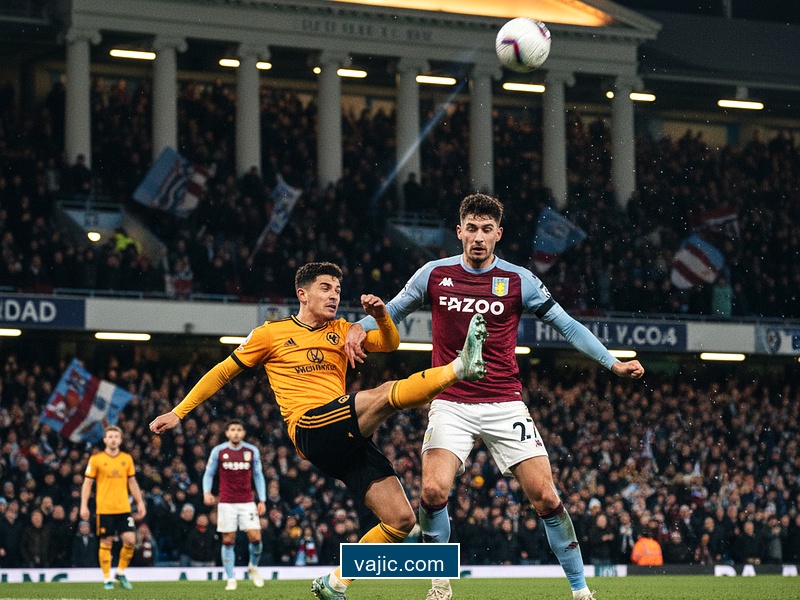
The untrained eye watches the ball. The fan watches the goal. The scout watches the space between the center-back and the full-back when the ball is sixty yards away. That is where the truth of the Premier League season lies, buried beneath the hysteria of "title race" chatter and relegation panic. ESPN and the pundits are asking if Aston Villa are legitimate contenders and if Wolverhampton Wanderers are historically doomed. These are questions of narrative. I am interested in questions of geometry.
Having spent two decades sitting in drafty gantries from Macclesfield to Milan, I can tell you that league tables in the early months are liars. But body shapes? Recovery runs? The synchronized step-up of a defensive line? Those never lie. When we strip away the noise and look at the biomechanics and tactical rigor of these two sides, the answers regarding their respective fates become glaringly obvious.
The Emery Algorithm: Calculated Risk, Not Luck
To dismiss Unai Emery’s Aston Villa as merely "in good form" is an insult to the unseen labor happening at Bodymoor Heath. We are witnessing a masterclass in spatial compression. The media fixation on Villa's high defensive line often misses the nuance of why it works. It isn't just about catching strikers offside; it is about shrinking the effective playing area to a 30-meter strip where Villa’s physicality dominates.
Watch Pau Torres off the ball. Most defenders scan for danger; Torres scans for passing lanes while defending. His body orientation is rarely square to the play. He stands semi-turned, ready to instigate an immediate transition the moment possession turns over. This is the hallmark of a team drilled in "rest defense"—the art of positioning yourself for an attack while you are still defending.
"The difference between a title contender and a pretender is often found in the 'half-spaces'—those vertical corridors between the wing and the center. Villa dominates these zones not by running more, but by standing in the right place."
The brilliance of Emery’s system is the "bait." Villa invites the press deep into their own box, using Emi Martínez almost as a third center-back. This isn't recklessness; it's a trigger. Once the opponent commits to the press, Villa bypasses the first line with vertical precision, usually finding Youri Tielemans or Amadou Onana in space. From there, it’s a 4-v-3 situation in the opponent's half. This is tactical rhythmic gymnastics. The players aren't thinking; they are executing muscle memory drilled into them through thousands of repetitions.
Ollie Watkins and the Cover Shadow
A scout’s notebook rarely focuses on a striker’s goals first. We look at their pressing triggers. Ollie Watkins is currently the gold standard for "curved runs" in the Premier League. He doesn't just run at the defender; he runs in an arc that cuts off the passing lane to the other side of the field. This is known as using a "cover shadow." By doing this, he forces the opposition into a predictable channel where Villa’s midfield trap is waiting to snap shut.
Are they title contenders? Structurally, yes. They possess the two non-negotiables of a championship side: a distinct identity in possession and a defensive structure that does not rely on individual heroism, but on collective geometry.
Wolverhampton Wanderers: The Anatomy of a Collapse
If Villa is a study in synchronization, Wolves are a case study in isolation. The "history" they are threatening to make isn't just about points; it’s about a complete breakdown of defensive connectivity. Watching Gary O'Neil’s side, the first thing a scout notices is the "vertical distance." Ideally, a team wants no more than 12 to 15 yards between their defensive line and their midfield pivot. At Wolves, I am consistently clocking gaps of 25 yards or more.
This gap is the "killing floor." It is where opposing number 10s go to feast. But the rot goes deeper than tactical spacing; it is etched into the players' somatic responses to adversity.
| Metric | Aston Villa (The Unit) | Wolves (The Fragmented) |
|---|---|---|
| Defensive Transition | Immediate counter-press (5-second rule). | Passive retreat; dropping off rather than engaging. |
| Body Language (Conceded Goal) | Hands clapping, immediate huddle or communication. | Hands on hips, looking at the bench, isolation. |
| Defensive Line Height | High, aggressive, compressing space. | Deep, fearful, inviting pressure. |
| Possession Purpose | Baiting pressure to exploit space behind. | Circulation without penetration (The "Horseshoe"). |
The Silent capitulation of the Center-Backs
The most damning footage from Wolves' recent performances comes from the blind-side movements against their center-backs. In professional coaching, we talk about "scanning frequency"—how often a player checks their shoulder. The Wolves backline looks fixed on the ball. They are reactive, not proactive. They are watching the disaster happen rather than preventing it.
Furthermore, the communication loops have severed. When a team is confident, you see constant pointing and shouting—passing on runners from midfield to defense. Wolves are silent. The midfield is getting bypassed, and the defenders are backing off into their own six-yard box, hoping a block will save them. This is "hope defending," and in the Premier League, hope gets you relegated.
The Technical Verdict
Is the chatter an overreaction? In Villa's case, the skepticism is misplaced. Their underlying numbers—Expected Goals Against (xGA) specifically relating to open play—suggest a robustness that rivals Arsenal and Manchester City. Emery has built a machine that functions regardless of the opponent. The "high line" anxiety is a media narrative; the reality is a compressed pitch that suffocates opponents.
For Wolves, the panic is understated. The specific biomechanical signs of a team that has quit on itself are present. When a winger loses the ball and jogs back rather than sprints; when a goalkeeper screams at his defenders and they look at the grass; when the technical area is frantic but the pitch is lethargic—that is terminal.
Tactics can be fixed on the training ground. You can drill a lower block; you can tighten the distances between lines. But you cannot drill "desire" into a player who has mentally checked out of a 50/50 challenge. Villa players are sprinting to celebrate defensive blocks. Wolves players are waiting for the whistle to end the misery.
The table will eventually catch up to the tape. Villa are not just in the race; they are redefining what it takes for a non-state-backed club to compete through superior tactical architecture. Wolves, conversely, aren't just losing games; they are losing the fundamental physical battles that define professional football. One team is playing chess; the other is barely setting up the board.