
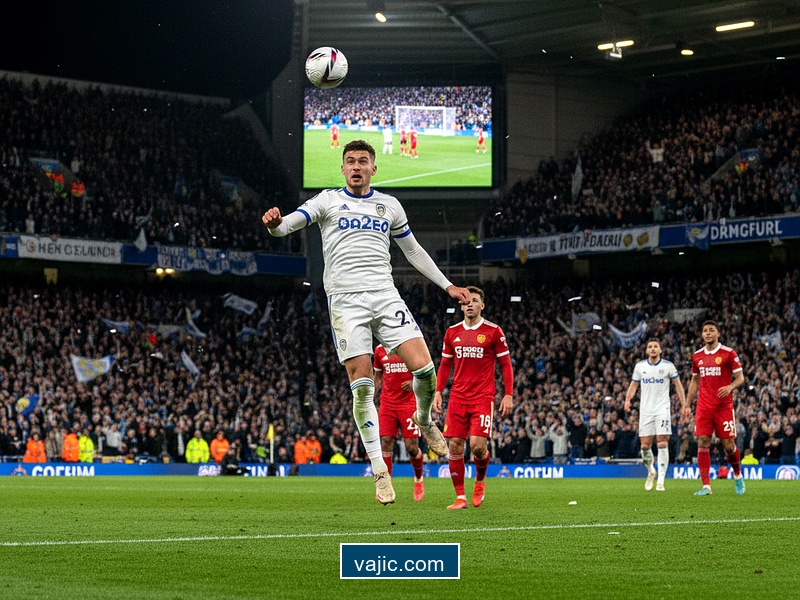
There is a specific frequency of noise that emits from the Gelderd End when a Leeds United centre-forward climbs above a flat-footed defender and buries a header. It isn't the sharp crack of a volley or the scuff of a tap-in. It is a thud, followed by a guttural roar that speaks to the very soul of this football club. Against Crystal Palace on this freezing December afternoon in 2025, Dominic Calvert-Lewin didn't just score his fifth goal in five games; he tapped into a lineage that has been dormant in West Yorkshire for nearly two decades.
Thomas Tuchel, watching from his perch with the 2026 World Cup horizon narrowing, must have felt a twitch of tactical intrigue. The Times suggests "no one heads the ball better," but that is an understatement. In a Premier League era suffocated by inverted wingers and false nines, Calvert-Lewin is playing with the devastating simplicity of a specialized weapon. He is a throwback, yes, but he is also the antidote to the over-complication of modern attacking play.
The Ghost of Mark Viduka
To understand the magnitude of Calvert-Lewin’s current run, one must look back through the mist to the early 2000s. The last time a Leeds striker possessed this specific gravitational pull—the ability to make the ball stick and terrify centre-backs with sheer physical presence—it was Mark Viduka.
While their styles differ—Viduka was a velvet tank, possessing feet that belonged to a ballerina and the hips of a heavyweight boxer—the impact is eerily similar. In the 2000-01 season, Viduka netted 22 goals, fueled by the manic energy of Alan Smith and the service of Harry Kewell. That Leeds team, the "O'Leary Babies," thrived on a blend of youthful arrogance and vertical aggression.
Compare that to the current setup. Calvert-Lewin isn't dropping deep to knit play like a budget Harry Kane. He is staying between the width of the goalposts. His five-game scoring streak puts him in elite company, mirroring the reliability of Viduka’s purple patch in November 2000. But statistically, Calvert-Lewin is offering something the Australian didn't: relentless aerial pressing. Viduka waited for the ball; Calvert-Lewin hunts it. The current Leeds side has realized that bypassing the midfield press to hit a target man isn't "hoof-ball"—it's efficient geometry.
The Everton Regret and the Rooney Verdict
Wayne Rooney’s comments this week regarding Everton’s "transfer regret" are more than just hindsight; they are an indictment of recruitment strategy at Goodison Park. Rooney, a man who understands the burden of carrying a city’s expectations, noted that Calvert-Lewin "has everything."
"You look at him now, fit and firing, and you see a player who was mismanaged physically and tactically for three years. He’s not a battering ram to be used in a siege; he’s a spearhead."
Everton’s loss has been Leeds’ gain, largely because the medical and tactical departments at Thorp Arch have aligned. At Everton, under the chaotic final years of the Moshiri era, Calvert-Lewin was often isolated, fighting two centre-backs alone 40 yards from goal. At Leeds, the wingers are instructed to hit the byline, not cut inside. It creates the one commodity Calvert-Lewin trades in: hang time.
The cross for the winner against Palace wasn't a drilled low ball—the darling of the xG nerds—it was a floated delivery. Modern coaching manuals scream against the high cross because the conversion rate is typically low. However, when you possess a striker with a vertical leap reminiscent of Cristiano Ronaldo circa 2013, the probabilities shift. Leeds have hacked the system by ignoring the trends.
Tuchel’s Dilemma: The Plan B for 2026
This brings us to the England question. Thomas Tuchel is a pragmatist. He knows that Harry Kane, despite his brilliance, is entering the twilight of his mobility. By the time the plane leaves for North America in 2026, England cannot rely solely on a striker who wants to play as a number 10.
During the Euros in 2024, England suffered from a lack of verticality. When the midfield of Bellingham and Rice was congested, there was no "out ball." Calvert-Lewin offers that escape valve. He turns 50/50 balls into 70/30s in his favor.
Historically, England managers ignore form at 'non-Big Six' clubs until it is too late. Sven-Göran Eriksson arguably wasted the peak years of Kevin Phillips. Fabio Capello never understood Peter Crouch. Tuchel has a chance to integrate a specialist. If England are chasing a game against a low block in the World Cup knockout stages, having the best header of the ball in Europe on the bench is not a luxury; it is a necessity.
Tactical divergence: The End of the False Nine?
We are witnessing a subtle shift in Premier League tactical cycles. For a decade, Guardiola’s influence meant everyone wanted a striker who could pass like a midfielder. Now, with defensive blocks becoming more athletic and organized, the need for physical disruption has returned. We saw it with Haaland's arrival, and we are seeing it now with Calvert-Lewin's renaissance.
Leeds United have committed to a strategy that supports this. Looking at the player heatmaps from the Palace game, the midfield trio played closer to Calvert-Lewin than Everton's midfield ever did. They are picking up the "second balls"—the knockdowns that Viduka used to feed to Lee Bowyer 25 years ago. It is a simple, brutal, and beautiful loop of football heritage repeating itself.
The Verdict
Five games, five goals. It is a statistic that looks good on a chyron, but the eye test tells the real story. Dominic Calvert-Lewin is playing with a chip on his shoulder the size of the Pennines. He has been written off as injury-prone, one-dimensional, and past his best.
Instead, he has found a spiritual home at a club that deifies the number nine shirt. He isn't just scoring; he is leading the line with the arrogant swagger of the greats who walked out of that tunnel before him. If he stays fit—always the caveat with explosive athletes—he won't just match the exploits of Viduka or Bridges. He might just drag Leeds back into European contention and force his way into Tuchel’s starting XI.
Football is often about timing. For Leeds United, signing a striker whom the elite had forgotten, just as the tactical winds shifted back in favor of the aerial specialist, looks like the masterstroke of the decade.