
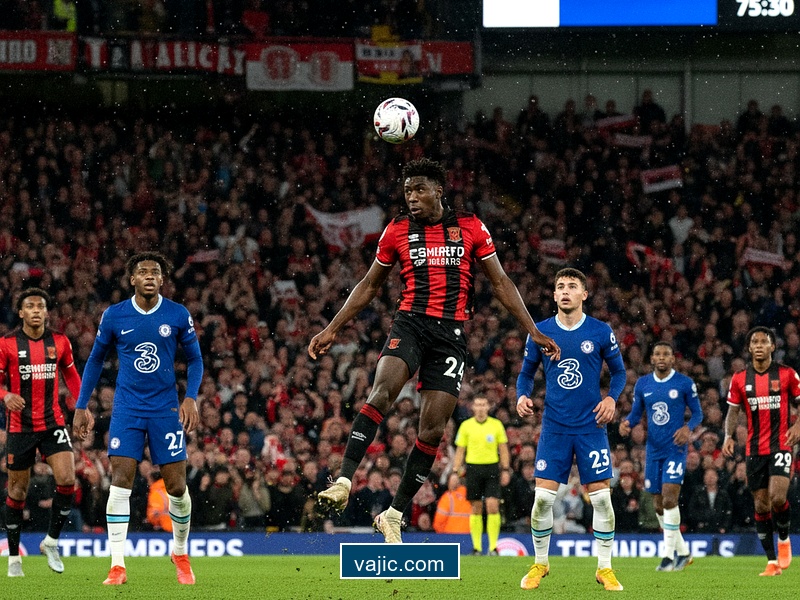
The January transfer window usually reeks of desperation, but the latest noise emanating from Stamford Bridge carries a different scent: specific, tactical intent. The reports from The Athletic regarding Chelsea’s enquiry for Bournemouth’s Antoine Semenyo suggest the Blues are finally looking beyond the spreadsheet and at the grass. As a scout who has tracked Semenyo since his loan spells in the muddy trenches of League Two, I see this not as just another winger on the pile, but as an acquisition of a specific physical profile that Enzo Maresca currently lacks.
To understand why Chelsea wants him, you have to ignore the highlight reels of goals. You have to watch how he stands when he doesn't have the ball.
Biomechanics: The Art of the "Rolling" Turn
Modern academy wingers are taught to receive on the back foot, open their hips, and play in two touches. It is clean, geometric, and predictable. Antoine Semenyo plays the game like a Greco-Roman wrestler. His biomechanics are an anomaly in the Premier League’s sanitized tactical landscape.
When scouting forwards, we look for "contact balance"—the ability to maintain velocity while absorbing impact. Semenyo is in the 99th percentile of this specific trait. He possesses a glute-dominant posterior chain that allows him to execute what we call the "post-up" on the wing. Most wide players drift wide to avoid contact; Semenyo drift inside to initiate it.
Watch his movement when a defender gets tight. He doesn’t flick the ball away; he leans back into the opponent, lowers his center of gravity, and uses the defender’s momentum as a fulcrum to spin. It is a "rolling" turn more common in basketball centers than wingers. For a Chelsea side that often struggles to break down low blocks because their attackers play in front of the defense, Semenyo offers a vertical solution: he occupies defenders physically, disrupting their shape not with passing, but with sheer mass and torque.
Deciphering the Pressing Triggers
Under Andoni Iraola, Bournemouth has morphed into one of the most sophisticated pressing units in Europe. Semenyo is the trigger man. While Cole Palmer and Noni Madueke are elite technicians, their defensive work rate is often reactive. Semenyo’s is proactive.
"You don't scout pressing by looking at distance covered. You scout it by looking at the angle of approach. Semenyo runs curved lines, cutting the passing lane to the fullback while simultaneously closing down the center-back. That is high-IQ energy."
This is the "unseen" work that changes games. In scouting terms, we analyze "recovery sprints"—the immediate reaction within three seconds of a turnover. Semenyo’s transition from attack to defense is violent. He decelerates instantly and counter-presses the ball carrier before they can lift their head. In Maresca’s possession-heavy system, the risk of counter-attacks is the Achilles heel. Semenyo acts as the first line of defense, a physical barrier that prevents the opposition from playing out cleanly. He doesn't just press; he tackles with the intent of a holding midfielder.
The EFL Education: A Grit You Can't Coach
There is a distinct pedigree difference between Semenyo and the current crop of Chelsea forwards. He is not a product of the pristine carpets of Cobham. His development accelerated during loans at Newport County and Sunderland. This context matters.
In League Two, technical fouls are rarely called and space is non-existent. You learn to protect the ball or you get substituted. This "school of hard knocks" education has instilled a level of ball retention under duress that cannot be replicated in U21 football. When Semenyo receives the ball in the half-spaces, he isn't waiting for the perfect overlap; he is comfortable in the chaos. He thrives on "scrappy" possession—situations where the ball is bouncing awkwardly or multiple defenders are converging.
Chelsea’s current attack is full of Ferraris—sleek, fast, and expensive, but fragile on rough terrain. Semenyo is a rally car. He offers a variation in tempo. When the intricate passing triangles fail, he provides a direct, blunt-force option to drive through the heart of a defense.
Tactical Theory: The "Wide Target Man"
Why enquire now? The tactical theory points toward the evolution of the "Wide Target Man." Historically, this role was occupied by players like Mario Mandžukić at Juventus. In the modern Premier League, we are seeing a resurgence of powerful wingers who can act as outlets for long balls.
Chelsea’s build-up often invites pressure to release the spare man. If the short option is cut off, they need a diagonal outlet. Currently, playing a high ball to Madueke or Mudryk is a 50/50 contest at best. Playing it to Semenyo shifts the odds to 70/30 in the attacker's favor. He has the aerial ability to cushion headers inside to onrushing midfielders (like Enzo Fernández or Caicedo), essentially bypassing the midfield press entirely.
Shot Mechanics: Minimal Backlift
Another scouting nuance is his shot generation. Semenyo does not require a "setup touch." Many wingers need to roll the ball out from their feet to generate power. Semenyo generates torque from the hip snap, allowing him to shoot with almost zero backlift.
This is a nightmare for goalkeepers because it removes the visual cue of the leg winding up. He shoots through defenders' legs, using them as screens. This instinct—to shoot early and violently—contrasts sharply with Chelsea’s tendency to over-elaborate in the penalty box. He brings a selfishness that is actually a virtue in a team guilty of trying to walk the ball into the net.
The Verdict: Raising the Floor, Not Just the Ceiling
Critics will point to his pass completion percentages or the fact that he isn't a "global superstar" name. They are missing the point. Squad construction is about profile diversity, not just stacking similar assets.
Chelsea possesses an abundance of technical ceiling. What they lack is a high physical floor. They lack a player who can turn a 0-0 draw away at Everton into a 1-0 win through sheer persistence and physical dominance. Semenyo is not being bought to replace Palmer; he is being targeted to destroy the low blocks that Palmer cannot unlock with passing alone.
The enquiry signals that Chelsea’s recruitment department is finally maturing. They are moving away from collecting Pokémon cards of famous wonderkids and looking for functional components of a winning machine. Semenyo is chaotic, aggressive, and plays with a chip on his shoulder the size of the Shed End. In a team of artists, he is the necessary bouncer.