
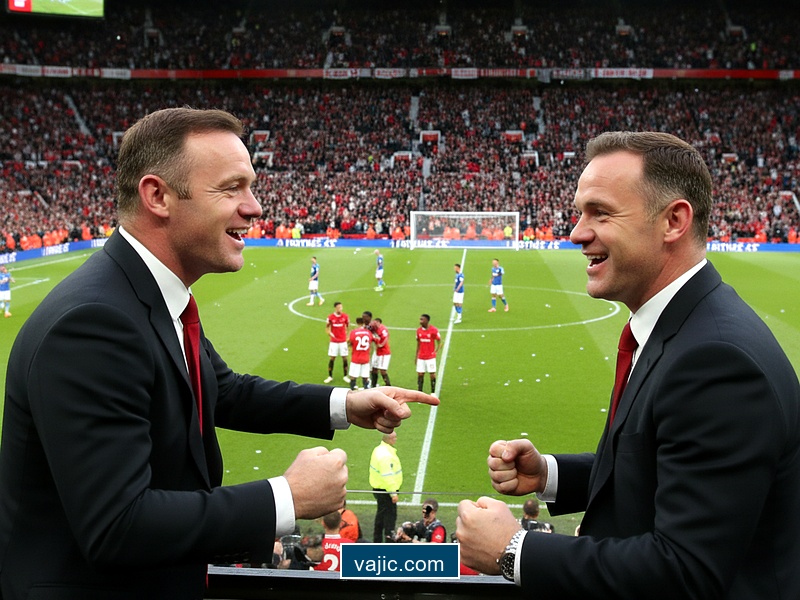
When Gary Neville and Wayne Rooney sit in a studio and nod in unison, the rest of the footballing world should check its pulse. It is a rare alignment of the stars. One was the neurotic drive behind Manchester United’s defensive fortitude; the other was the street-footballing genius who sacrificed personal glory for the collective good. Their reported agreement on the destination of this season's Premier League title isn't just punditry; it is a diagnosis based on the harsh reality of winning.
They look at the current table and they don't see xG charts, passing networks, or inverted full-back heat maps. They see ghosts. They see the specific psychological profile required to navigate the final ten games of a season, a trait that the Manchester United teams of 2006-2009 possessed in terrifying abundance.
If they are backing experience—specifically the robotic inevitability of Manchester City—over the emotional turbulence of Arsenal or the transitional energy of Liverpool, they are applying the "Ferguson Metric." It is a standard that has barely shifted in two decades, even if the tactics have.
The Myth of "Beautiful Football" vs. The 2008 Reality
There is a modern obsession with aesthetic dominance. Mikel Arteta’s Arsenal and Arne Slot’s Liverpool are praised for control and verticality respectively. Yet, Neville and Rooney are likely referencing a darker art: the ability to play poorly and win. This is where the comparison to the 2007-08 Manchester United vintage becomes critical.
That 2008 squad, often cited as the Premier League’s greatest, didn't always blow teams away. Yes, they had the holy trinity of Rooney, Tevez, and Ronaldo. But analyze the run-in of that season. It wasn't 5-0 drubbings. It was nervous 1-0 wins away at Derby County and gritty performances at the Stadium of Light.
"People remember the Champions League nights. They forget the 1-0 win against Bolton where we defended corners for 20 minutes. That’s where titles are decided." — Gary Neville, historically speaking on title run-ins.
The current Manchester City side mirrors this 2008 United team not in style, but in temperament. The 2008 United side conceded only 22 goals all season. They relied on the bedrock of Rio Ferdinand and Nemanja Vidić. Today, City relies on Ruben Dias and Manuel Akanji to suffocate games. The faces change, the principle remains: defense provides the platform for genius to steal the points.
The Fragility of the Challenger
The skepticism Neville often directs toward Arsenal—which Rooney appears to share—stems from the "Kevin Keegan Syndrome." In 1996, Newcastle United played the most electrifying football in Europe. They collapsed because they felt the emotion of the race too deeply. We saw echoes of this in Arsenal’s recent campaigns. The emotional expenditure of winning a match in the 97th minute is unsustainable over 38 games.
Contrast the defensive spine of the "Invincibles" (2003-04) with the current challengers. Sol Campbell and Kolo Touré were physical monsters who bullied opposition forwards. Today's defenders are ball-playing technicians. While William Saliba is a Rolls Royce, the question remains: can he be a tractor when the pitch is muddy at Goodison Park in April? Rooney knows that difference. He played with Vidić, a man who would tackle a brick wall if it meant keeping a clean sheet.
Rooney’s Role: The Lost Art of Sacrifice
Wayne Rooney’s perspective is particularly damning for modern ego-driven forwards. In that 2008 era, Rooney often played wide left to accommodate Cristiano Ronaldo’s central drift. He did the defensive running of a full-back to allow Ronaldo the energy to win the Ballon d'Or.
Look at the current challengers. Is there that same level of sacrifice? When we look at Mohamed Salah or Bukayo Saka, we see brilliance, but do we see the tactical humility to completely abandon their natural game for 90 minutes to nullify an opponent? City has this. Bernardo Silva is the modern Rooney in this sense—a technician who runs like a marathon runner. This utility is what separates champions from runners-up.
The Statistical Shift: 80 Points vs. 90 Points
We must acknowledge the inflation of excellence. In the 1990s, Manchester United won titles with 75-80 points. The 1998-99 Treble winners secured the league with 79 points. Today, that gets you third place. The margin for error that Neville and Rooney enjoyed has evaporated.
| Season | Champion | Points | Losses |
|---|---|---|---|
| 1998-1999 | Man Utd | 79 | 3 |
| 2003-2004 | Arsenal | 90 | 0 |
| 2007-2008 | Man Utd | 87 | 5 |
| 2017-2018 | Man City | 100 | 2 |
This statistical shift reinforces why the pundits back the machine. In 2008, United could afford to lose five games. In 2025, losing five games is a catastrophe. Only a team with supreme psychological hardness can handle the pressure of knowing a single draw in February might cost them the trophy in May. That pressure crushed Liverpool in 2014 and Arsenal in 2023.
The Sir Alex Ferguson Shadow
Ultimately, when Rooney and Neville agree, they are channeling Sir Alex Ferguson. Ferguson’s greatest skill wasn't tactics; it was fear management. He made his players fear him more than they feared losing. Pep Guardiola has achieved a similar feat through intellectual dominance rather than Scottish rage.
The current Arsenal squad, for all their camaraderie, operates on vibes and passion. The Liverpool squad is surfing the wave of a new era. But City operates on cold, hard duty. It is the closest thing to the 2007-2009 United mentality we have seen since Ferguson retired.
If Neville and Rooney say the race is done, or that one team has the edge, it is because they recognize the scent of weakness in the challengers. They know that pretty football fills stadiums, but ruthless pragmatism fills trophy cabinets. Until Arsenal or Liverpool prove they can win ugly, repeatedly and without emotion, the old guard will remain skeptical. And history suggests they are absolutely right to be.