
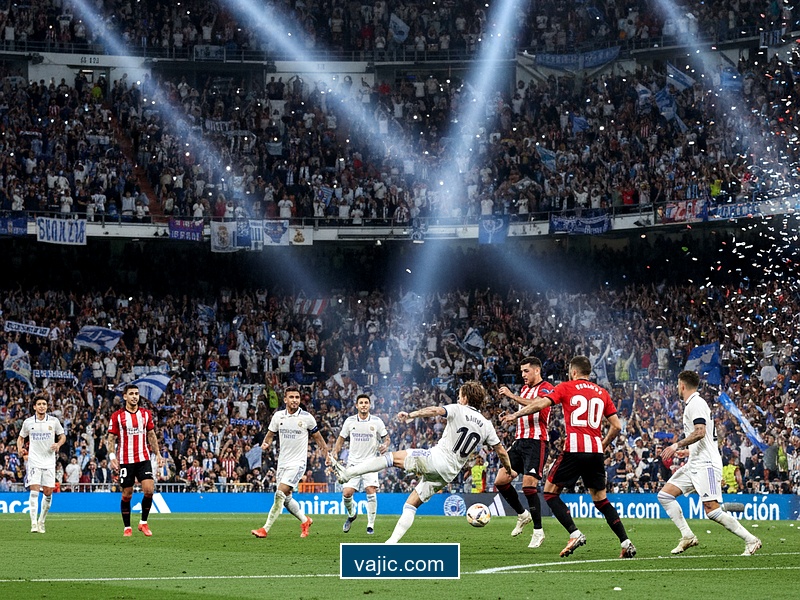
The Santiago Bernabéu has never been a place where a simple 1-0 victory is accepted without a caveat. The white handkerchiefs are always half-ready in the pocket, waiting for a drop in aesthetic standards. Yet, watching Real Madrid dismantle Sevilla—not necessarily on the scoreboard, but in the crushing inevitability of the play—one realizes we are witnessing a paradigm shift. This is no longer the circus of the early 2000s. The current iteration of Los Blancos has traded the fragile poetry of the first Galactico era for a terrifying, relentless athleticism that Florentino Pérez could only dream of twenty years ago.
Against a Sevilla side that arrived with the grim determination of a team trying to clog the midfield, Madrid did not panic. They did not rely on a singular moment of divine intervention, though they have the players for it. Instead, they suffocated the opposition with a physical engine that simply did not exist in the days of Vicente del Bosque or Carlos Queiroz.
The Fallacy of "Zidanes y Pavones"
To understand the magnitude of what Carlo Ancelotti has constructed, we must look back to the cautionary tale of the 2003-2004 season. That squad remains the romantic ideal for many: Zinedine Zidane, Luís Figo, Ronaldo Nazário, and David Beckham sharing a pitch. On paper, it was art. In reality, it was a structural disaster waiting to happen.
That team collapsed spectacularly, losing six of their final seven league games to hand the title to Valencia. Why? Because they sold the engine. The departure of Claude Makelele to Chelsea stripped the Ferrari of its wheels. They had all the creators and none of the destroyers.
"We will not miss Makelele. His technique is average, he lacks the speed and skill to go past opponents, and ninety percent of his distribution either goes backwards or sideways." — Florentino Pérez, 2003.
History has proven that quote to be perhaps the greatest miscalculation in modern football management. Fast forward to today against Sevilla. Look at the midfield. Federico Valverde, Aurélien Tchouaméni, and Eduardo Camavinga are the anti-2003 thesis. They possess the technical quality to play in small spaces, yes, but they are physically monstrous.
When Sevilla tried to break on the counter, they didn't find gaping holes left by Roberto Carlos jogging back. They hit a wall of recovery pace. Valverde’s ability to cover 70 yards in a defensive transition is something Figo, for all his genius, never offered. This Madrid doesn't need to score four goals because they control the chaotic spaces that the Galacticos left wide open.
Bellingham vs. The Shadow of Zidane
The lazy comparison is Jude Bellingham to Zinedine Zidane. It fits the narrative: the number 5 shirt, the elegance, the height. But statistically and tactically, this is a disservice to the Englishman's distinct profile. Zidane was a conductor; he dictated the tempo of the symphony. In his most prolific league season (2002-03), Zidane scored 9 goals. He was never the primary goal threat; he was the provider for Raúl and Ronaldo.
Bellingham is different. He is a predator masquerading as a playmaker. His movement against Sevilla wasn't about finding the perfect pass; it was about crashing the box with the timing of a vintage Frank Lampard but the ball control of a brooding number 10. By occupying the spaces that a traditional striker would vacate, Bellingham forces center-backs into a decision crisis that Zidane rarely imposed directly.
While Zidane seduced you into watching the ball, Bellingham beats you by moving where the ball isn't. The Sevilla defense, marshalled by veterans who remember a slower La Liga, simply could not track the late runs. It represents a tactical evolution from pure artistry to functional lethality.
The Vinícius Paradox
Then there is the left flank. For years, the Bernabéu worshipped the efficient brutality of Cristiano Ronaldo or the chaotic samba of Robinho. Robinho, specifically, is a painful memory for Madridistas—a player of infinite promise who lacked the steel to dominate consistently.
Vinícius Júnior is the correction of the Robinho error. Against Sevilla, his output was relentless. He doesn't just isolate the full-back; he harasses the entire defensive line. In the mid-2000s, wingers were often passengers when possession was lost. Vinícius presses with the intensity of a defensive midfielder.
This creates a tactical suffocation. Sevilla’s wing-backs could not advance because the threat of Vinícius in transition is constant. In 2005, teams like Sevilla or Valencia felt they could punch Madrid in the mouth if they survived the initial wave. Today, the wave never recedes.
The Death of the "Fragile Genius"
The overarching theme of this match, and this season, is the death of fragility. Real Madrid used to be a glass cannon—spectacular when firing, shattered when hit. Under Ancelotti’s current stewardship, they have become iron.
| Attribute | Galacticos (2003-04) | Modern Era (2024-25) |
|---|---|---|
| Defensive Transition | Non-existent / Reliance on Pavones | Aggressive high press & recovery pace |
| Midfield Role | Pure Creation (Guti/Beckham) | Hybrid Engines (Valverde/Camavinga) |
| Win Condition | Outscore the opponent | Control and suffocation |
Sevilla’s approach was valiant but antiquated. They played for set pieces and hopeful long balls, a strategy that worked against the Madrid of Guti and Gravesen. It does not work against a defense anchored by Antonio Rüdiger, who relishes the physical battle in a way that recalls the spirit of Fernando Hierro but with superior athleticism.
A New Era of Dominance
We must stop looking for the next Zidane or the next Raúl. That era, defined by individual brilliance masking systemic flaws, is over. What we saw against Sevilla was a triumph of system over individuals, even though the individuals are world-class.
Florentino Pérez has finally solved the equation that haunted his first presidency. He realized that you don't just buy Golden Ball winners; you buy athletes who can run for 90 minutes and then win the Golden Ball. This Madrid team might not produce the velvet touches of 2002 every single week, but they will not collapse in April like the ghosts of 2004.
The scoreline against Sevilla is a footnote. The headline is the method. Madrid has replaced the artist’s brush with the blacksmith’s hammer, and the rest of Europe should be terrified.