
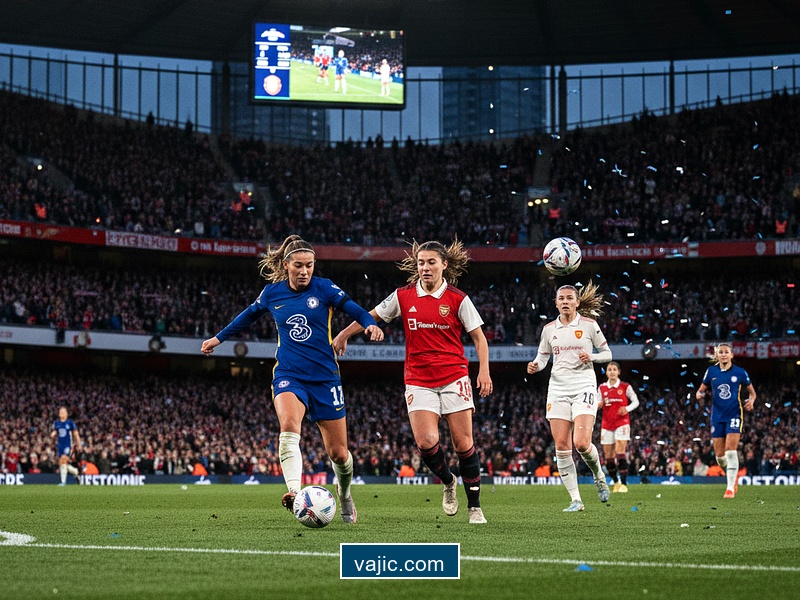
The euphoria of the Women’s Champions League draw always dissipates the moment the balls settle. For the marketing departments at Chelsea, Arsenal, and Manchester United, these fixtures are content opportunities. For the managers, they are forensic audits of their entire philosophical existence. The draw does not care about your Instagram engagement or your sold-out domestic crowds. It cares only about structural integrity.
We are past the point of celebrating English participation. The Women’s Super League (WSL) positions itself as the premier global product, yet when the continental lights flicker on, we see three distinct architectural projects in varying states of stability. We aren't looking at 90-minute matchups here; we are looking at the sustainability of three very different managerial regimes facing the harsh glare of European scrutiny.
Chelsea: The ruthless efficiency of a post-personality cult
Chelsea operates in a rarefied air that the other English clubs cannot yet breathe. For years, the narrative was Emma Hayes. It was her sheer force of personality that dragged the club through European muddles. But looking at their current trajectory, the project has shifted from a cult of personality to a systemic industrial complex. The "Chelsea Way" is no longer about adaptability; it is about inevitability.
"In Europe, you don't win with vibes. You win with a rest defense that suffocates the opponent's transition before it starts. Chelsea has mastered the dark arts of game management that Arsenal treats as beneath them."
The philosophical divergence here is stark. Historically, Chelsea’s European campaigns were defined by tactical chameleonism—playing three at the back against Wolfsburg, then switching to a flat four against Lyon. The current squad construction, however, suggests a move toward dominance through depth rather than tactical trickery. The acquisition strategy has been ruthless. They don't just buy talent; they stockpile specific profiles—physically imposing ball-carriers who can dismantle low blocks through individual gravity.
The danger for Chelsea isn't the draw itself; it's the internal transition of power. We have seen this with Manchester United men's team post-Ferguson. When the figurehead leaves, the vacuum can implode the structure. Chelsea's European success this season depends entirely on whether the "winning machine" is now self-perpetuating, or if it still requires the specific emotional leverage of its architect. The draw challenges them to prove the system works without the sorceress.
Arsenal: The fragility of aesthetic arrogance
Then we have Arsenal. Watching Jonas Eidevall’s side in Europe is an exercise in frustration. The project at Meadow Park is undeniably attractive. They play the most "modern" football of the three—inverted full-backs, high possession metrics, intricate triangulations in the half-spaces. But Europe has a nasty habit of punishing aesthetic arrogance.
The recurring issue for Arsenal is not talent; it is rigidity. Eidevall is a systems manager. He builds a machine designed to work perfectly under specific conditions. In the WSL, where the talent gap allows them to dictate 70% of the game, this looks majestic. In the Champions League, against sides like Paris FC or Wolfsburg who relish chaotic transitions, the system looks brittle.
There is a distinct "Wengerization" occurring at Arsenal Women. The philosophy prioritizes the purity of the process over the pragmatism required for knockout football. When the passing lanes are cut and the press is bypassed, Arsenal rarely has a Plan B that involves playing ugly. They die by the sword of their own philosophy.
This draw is a referendum on Eidevall’s stubbornness. Has he learned that in Europe, control is an illusion? The "Project" needs to evolve from building a beautiful team to building a hateful one—a team that can suffer without the ball for 20 minutes without capitulating. Until Arsenal learns to embrace the chaotic nature of European nights, they remain a domestic giant with a glass jaw.
Manchester United: The perilous gap between brand and reality
Manchester United’s presence in this conversation is both a miracle and a mirage. Marc Skinner talks a good game, frequently utilizing buzzwords about "growth mindsets" and "evolving landscapes," but the tactical reality on the pitch often betrays a lack of elite identity. United’s project is still in its infancy compared to the decade-long head starts of their rivals, but the Champions League does not offer handicaps for new money.
Skinner’s philosophy relies heavily on moments of individual brilliance rather than systemic suffocation. In the WSL, you can rely on a winger isolating a fullback to win a match. Against European elites, that winger is double-marked, and the space in behind is exploited by a number 10 you’ve never heard of but who possesses superior technical fundamentals.
| Metric | WSL Approach (Avg) | UWCL Elite (Lyon/Barca) |
|---|---|---|
| Pressing Trigger | Zone-based (Passive) | Touch-based (Aggressive) |
| Midfield Structure | Physicality/Athleticism | Technical Retention |
| Game State Management | Emotional Momentum | Calculated Tempo Control |
The deep concern for United is the sustainability of their recruitment model. They lost key pillars of their defense and attack in recent windows, replacing them with talent that requires time to gel. The Champions League is a cruel environment for a "geling" period. Skinner is trying to fly the plane while still reading the manual. The club’s hierarchy views UWCL qualification as the target achieved; the reality is that qualification is merely the entrance exam. If they treat these fixtures as a victory lap rather than a survival situation, they will be embarrassed.
The invisible war: Physicality vs. Technicality
Beyond the specific managers, this draw highlights the broader philosophical crisis of English women’s football. The WSL markets itself on physicality and pace. We sell the product based on end-to-end entertainment. Yet, when English sides meet Spanish or French giants, they are often dismantled by superior technical retention and positional discipline.
It is the classic English disease, mutated for the modern women's game. We value the running stats; they value the ball. Chelsea is the only English side that has partially immunized itself against this by recruiting players with continental pedigrees who understand the nuance of slowing a game down.
Arsenal and United are still guilty of trying to play WSL football on the continent. They try to out-run teams that pass around them. It is a fundamental misunderstanding of the European ecosystem. You cannot press a shadow. Until Eidevall and Skinner recognize that the chaotic energy that wins games at Leigh Sports Village gets you dissected in Munich or Barcelona, the ceiling for English clubs will remain the semi-finals.
The verdict on the projects
So, as the fixtures populate the calendar, ignore the noise about "tough groups" or "lucky draws." Look at the benches. Look at the managers.
Chelsea’s project is built to survive nuclear winter; they are safe, boring, and likely to go deep because their floor is higher than everyone else's ceiling. Arsenal’s project is a beautiful glass sculpture; exquisite to look at, but terrified of a hammer. Manchester United are the loud neighbors who bought a Ferrari but park it on the street; they have the assets, but they lack the infrastructure to protect them.
The draw didn't just give us matches. It gave us a timeline for the exposure of these flaws. The WSL is a league of entertainment. The Champions League is a league of truth. We are about to find out who has been lying to themselves.