
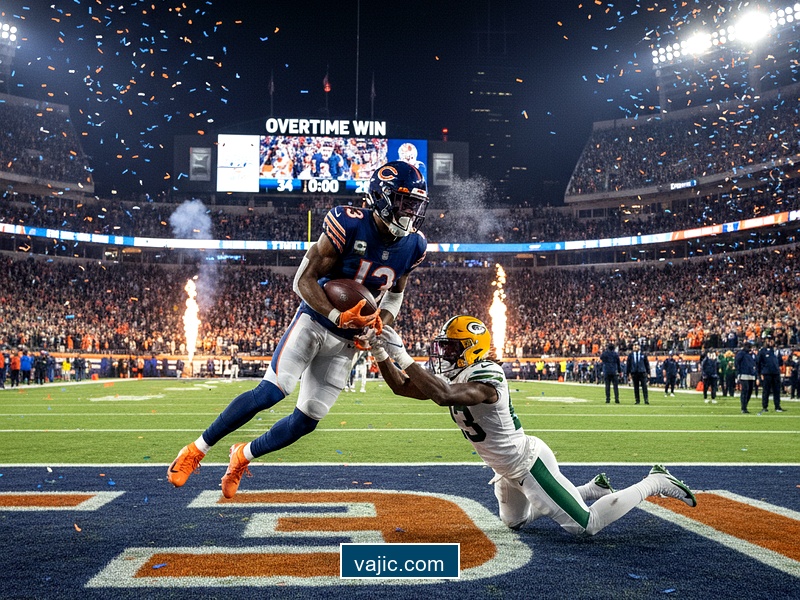
For two decades, the Green Bay Packers didn’t just beat the Chicago Bears; they owned the deed to the franchise. They treated the NFL’s oldest rivalry with the casual dismissiveness of an older brother holding a younger sibling’s forehead while they swing blindly at the air. Sunday wasn’t just a game. The overtime victory against Green Bay, fueled by Caleb Williams’ "Iceman" antics, was a violent shifting of tectonic plates that have been locked in place since Brett Favre arrived in Wisconsin in 1992.
I have covered this league long enough to remember when the Bears thought Rex Grossman was the answer because he could throw a football 60 yards (mostly to the wrong team). I sat in the press box for the Jay Cutler era, watching a man with a golden arm and a lead foot surrender to the Packers' pass rush repeatedly. What we witnessed in Week 16 was not a fluke. It was the arrival of a modern apex predator in a uniform that has historically been worn by prey.
The Historical Hegemony: A Statistical Nightmare
To understand the magnitude of Williams’ late-game heroics, you cannot simply look at the box score. You must look at the scar tissue. Since 1992, the Packers have started three primary quarterbacks: Favre, Rodgers, and Love. In that same span, the Bears have started over 35. The disparity created a psychological complex in Chicago that bordered on pathology.
The "Iceman" moniker Williams earned Sunday carries weight because he accomplished what his predecessors could not: he finished. In the 2013 regular-season finale, with the division on the line, the Bears watched Rodgers rip their hearts out on 4th and 8 to Randall Cobb. In the 2010 NFC Championship game, Caleb Hanie tried to play hero and threw a fat-man interception to B.J. Raji. Williams flipping the script in overtime—delivering the dagger rather than receiving it—is the specific type of history-cleansing performance this city required.
Anatomy of the "Him" Moment
The concept of "Him"—gen-Z parlance for a franchise cornerstone—is often overused on social media, but in scouting terms, it refers to a player who transcends the scheme. When Williams said, "I knew it was good when it left my hand," regarding the game-winning touchdown, he wasn't just speaking with confidence; he was speaking with the mechanics of a calibrated assassin.
Let's strip away the hype and look at the tape. The game-winning sequence wasn't the result of a perfectly blocked screen or a busted coverage. It was off-platform creation. Ten years ago, offensive coordinators demanded quarterbacks stay in the pocket. Tom Brady and Peyton Manning were the archetypes—statues who processed information at light speed.
Williams represents the post-2018 evolution of the position, modeled after Patrick Mahomes and, ironically, prime Aaron Rodgers. The ability to disassociate the upper body from the lower body—throwing with velocity while drifting left or backpedaling—is the hallmark of modern elite play. When Williams found DJ Moore ("That's My DJ!!" as the locker room shouted), it wasn't a gamble. It was a geometric calculation made by a player comfortable in chaos.
"Knew it was good when it left my hand." — Caleb Williams
That quote echoes the arrogance of the 1985 Bears, a swagger that has been missing from this organization since Jim McMahon wore sunglasses indoors. The Bears have had "nice" quarterbacks. They have had "hard-working" quarterbacks. They haven't had a quarterback who believes he is better than everyone else on the field—and is actually right—since the mid-80s.
The Ripple Effect: Detroit's Headache
While Chicago celebrates, the Detroit Lions are checking the rear-view mirror. The Pride of Detroit noted how this Packers meltdown impacts the Lions' path, but the subtext is far more alarming for Dan Campbell’s squad. The NFC North has been a two-horse race between Detroit and Green Bay for the last 18 months. Chicago was the little brother eating paste in the corner.
That dynamic died on Sunday. By toppling the Packers, the Bears didn't just hurt Green Bay’s playoff seeding; they announced that the 2025 season starts now. The Lions are currently the class of the division, built on grit and biting kneecaps, but they lack one thing Chicago now possesses: a rookie-contract quarterback playing at an MVP level.
In the salary cap era, this is the cheat code. Seattle rode Russell Wilson’s rookie deal to a Super Bowl. Kansas City did it with Mahomes. If Williams is indeed "Superman," the Bears have a three-year window to load the roster around him with premium talent while Detroit has to pay Jared Goff market-setting money. The economics of the division just shifted as violently as the win-loss columns.
Comparing the Rookies: 2004 vs. 2024
We need to contextualize Williams' rookie campaign against the gold standard of quarterback classes: the Class of 2004 (Eli Manning, Philip Rivers, Ben Roethlisberger). Roethlisberger went 13-0 as a starter his rookie year, largely by managing games for a dominant defense. Williams is doing something harder. He is carrying a flawed offense in a division that features two legitimate Super Bowl contenders.
| Metric | Ben Roethlisberger (2004) | Kyle Orton (Bears 2005) | Caleb Williams (Current Pace/Style) |
|---|---|---|---|
| Role | Game Manager | Passenger | Engine |
| Late Game Philosophy | Run the ball, rely on Defense | Don't turn it over | "Give me the ball" |
| Rivalry Impact | Maintained status quo | Lost to stars | Ended a dynasty |
The Bears of 2005-2006 (the Orton/Grossman years) won with defense and special teams. They hid the quarterback. Sunday’s game against Green Bay proved that Matt Eberflus and Shane Waldron are no longer hiding Williams. They are featuring him. The "Superman" cape isn't a prop; it's the offensive game plan.
The Verdict
We sports writers are guilty of hyperbole. We crown kings in September and guillotine them in November. But 20 years of watching the Bears curl into a fetal position against Green Bay allows me to say this with absolute certainty: The dynamic has changed.
Caleb Williams did not just win a football game in overtime. He looked across the line of scrimmage at the Green Bay Packers—the bogeyman of the Midwest—and didn't blink. For a franchise that has been wandering in the quarterback wilderness since Sid Luckman retired in 1950, finding a guy who knows the ball is good before it lands isn't just a relief. It’s a resurrection.
The Packers melted down. The Lions are on notice. And Chicago? For the first time in a generation, they aren't hoping for a miracle. They have one under center.