
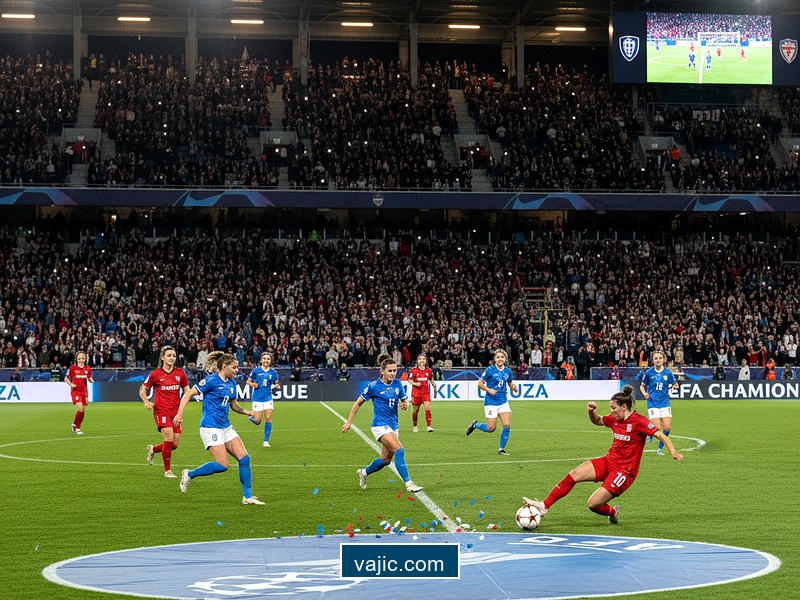
The air in Nyon is always distinctively sterile. It smells of polished marble, expensive coffee, and the cold mathematics of UEFA coefficients. As the balls were plucked from the bowls for the Women’s Champions League knockout phase, the flashing cameras captured the fixtures, but they missed the ghosts standing in the back of the room. To understand the gravity of this quarter-final lineup, you cannot simply look at the tactical spread of 2025. You must look back two decades to when the soul of this competition was forged in the freezing north of Sweden and the industrial heartlands of Germany.
The modern narrative is obsessively focused on the technical perfection of FC Barcelona Femení or the dynastic resilience of Olympique Lyonnais. Yet, watching the draw unfold, I found myself longing for the raw, chaotic brilliance of the mid-2000s UEFA Women's Cup. We are witnessing a sanitized supremacy today that, while aesthetically pleasing, often lacks the visceral narrative of the era when Umeå IK and 1. FFC Frankfurt held the continent in a vice grip.
The Swedish Blueprint vs. Catalan Tiki-Taka
Barcelona is rightly hailed as the pinnacle of modern footballing architecture. Their possession metrics and the telepathic interplay between Aitana Bonmatí and her supporting cast are suffocating. However, before the Blaugrana painted Europe in their colors, there was Umeå IK. Between 2003 and 2008, this small club from northern Sweden didn't just win; they terrified opponents.
Comparing the current Barcelona squad to the Umeå team of 2003-04 offers a stark lesson in how the sport’s center of gravity has shifted from individual genius to systemic control. Umeå relied on the sheer, unbridled electricity of a young Marta and the lethal finishing of Hanna Ljungberg. In the 2003 final against Fortuna Hjørring, Umeå won 7-1 on aggregate. It wasn't about passing triangles; it was about vertical devastation.
Historical Note: In the 2002-03 campaign, Hanna Ljungberg scored 10 goals in the tournament. She wasn't a "false nine" or an "inverted winger." She was a pure predator, a profile that has almost vanished from the elite game in favor of the fluid, multi-positional forward typified by Caroline Graham Hansen.
The draw in Nyon sets up fixtures that reward system over stardom. If Umeå played today’s Barcelona, they would likely be starved of the ball for 70 minutes. But that 20 minutes of possession? Marta would have torn the high line to shreds. The modern game has gained control but lost that specific brand of anarchy.
Frankfurt’s Irony and the German Regression
The presence of German clubs in the draw feels different now than it did fifteen years ago. Today, Wolfsburg and Bayern Munich are formidable, but they are vulnerable. Contrast this with the era of 1. FFC Frankfurt. Led by the imposing Birgit Prinz and the tireless Kerstin Garefrekes, Frankfurt didn't just play football; they engaged in attrition warfare.
From 2002 to 2015, Frankfurt lifted the trophy four times. Their dominance was built on a 3-4-3 or a rigid 4-4-2 that utilized superior physicality and direct transitions. They were the "Bayern Munich" of the women's game before the actual Bayern Munich invested. The current German sides have tried to hybridize—adopting Spanish possession elements while keeping German physicality—and in doing so, they have lost their identity.
Watching Wolfsburg navigate the group stages recently, they looked indecisive compared to the Frankfurt machine of 2008 that crushed Umeå 4-3 on aggregate in the final. That Frankfurt team had Renate Lingor pulling strings—a playmaker who dictated tempo through long distribution, not short interplay. The current crop of German midfielders is too obsessed with retaining possession rather than hurting the opposition.
The English paradox: Money cannot buy 2007
The English contingent in the draw represents the financial muscle of the Women’s Super League, yet the trophy cabinet remains dusty. Chelsea and Manchester City operate with budgets that Vic Akers could not have hallucinated in his wildest fever dreams. And yet, the only British team to ever conquer Europe remains Akers’ Arsenal side of 2007.
That 2007 triumph is the anomaly that haunts every English team in Nyon today. Arsenal won the "Quadruple" with a semi-professional setup, washing their own kits and sharing tracksuits. They beat Umeå over two legs not because they were better players—Marta hit the post in the second leg, a sound that still rings in Borehamwood—but because they possessed a tactical cohesion that money cannot buy.
| Metric | Arsenal (2007) | Barcelona (Modern Era) |
|---|---|---|
| Core Philosophy | Defensive Grit / Counter-Attack | Total Possession / High Press |
| Star Structure | Local Core (Kelly Smith, Alex Scott) | Global Galacticos |
| Tactical Shape | Rigid 4-4-2 | Fluid 4-3-3 |
| Key Stat | Clean Sheets (0 goals conceded in final) | Pass Completion (>85%) |
The modern English sides are All-Star teams, assemblages of world-class talent often lacking the siege mentality of that Arsenal unit. When Chelsea plays in Europe, they look like a collection of expensive parts trying to figure out the instruction manual in real-time. Akers’ team was a monolith. The draw today pit financial heavyweights against each other, but I have yet to see a Premier League side display the defensive arrogance of Faye White and Casey Stoney in that 2007 final.
The Death of the Specialist
Analyzing the tactical implications of the draw reveals another loss: the death of the specialist. In the mid-2000s, teams were built around distinct roles. You had the stopper, the destroyer, the creator, and the finisher. Today, every player must be a generalist. Center-backs must have the passing range of midfielders; goalkeepers must be sweepers.
This homogenization makes the knockout phase harder to predict but somewhat repetitive to watch. When Olympique Lyonnais faces a top-tier rival, it is effectively a mirror match. Compare this to the tactical clash of styles in the 2005 final between Turbine Potsdam and Djurgården/Älvsjö. Potsdam played a high-energy, high-pressing game long before Jurgen Klopp made it cool, while the Swedes played a technical, patient style. The friction between those opposing philosophies created sparks. Today, almost every team in the Nyon draw wants to play the same way: build from the back, press high, invert the fullbacks.
Nyon’s Cold Verdict
The draw determines the road to the final, but it also highlights the stratification of the women's game. In 2009, Zvezda Perm from Russia reached the final. In 2003, Fortuna Hjørring from Denmark was there. Today, the consolidation of wealth in the "Big Five" leagues has made such runs impossible.
We celebrate the professionalism and the packed stadiums, as we should. But as the executives in Nyon shook hands and the club representatives checked their flight schedules, the unpredictability that once defined this tournament felt absent. We are left with a competition of supreme quality but diminished romance.
The challenge for the teams pulled from the glass bowls is not just to win, but to prove they are more than just corporate assets maximizing a budget. They need to channel the spirit of Marta in the snow at Umeå, or the grit of Kelly Smith on one leg. The stats sheets will be perfect, and the passing maps will be art, but unless someone flips the table, we are merely watching the inevitable march of the deepest pockets.