
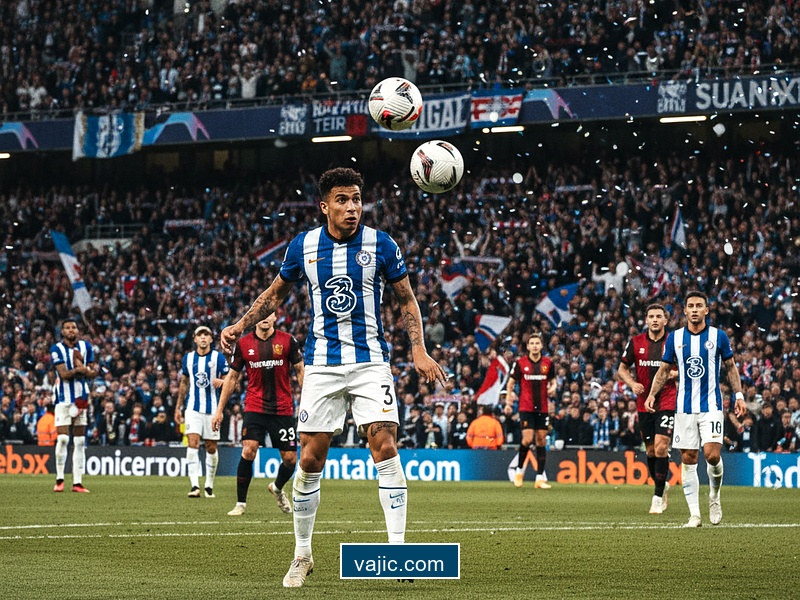
There is a specific kind of arrogance in modern football that assumes once a player passes the age of 34, they are better suited for the MLS retirement circuit or a lucrative desert mirage than the Champions League. Thiago Silva, at 41, has taken that assumption, folded it neatly, and set it on fire. The news that the Brazilian icon is joining FC Porto—a two-time Champions League winner—is not just a transfer; it is a glitch in the matrix of modern sports science and a direct challenge to the sport’s obsession with youth.
This move is being labeled a "shock," but for those of us who have scrutinized the center-back’s career trajectory, the only shock is that he didn't do it sooner. This isn't a vanity signing. This is a tactical acquisition that mirrors a very specific, historical precedent set by the very club he is joining.
The Shadow of the Milanello Laboratory
To understand why Silva can compete in the Primeira Liga at an age when most of his peers are nursing hip replacements, we must look back twenty years to the sophisticated machinery of AC Milan. Silva is the last operational artifact of the "Milan Lab" philosophy that extended the careers of Paolo Maldini and Alessandro Costacurta well into their fourth decades.
In 2007, when Milan lifted the Champions League trophy in Athens, their captain, Maldini, was 38. Costacurta was 41. The prevailing wisdom then was that speed could be sacrificed for cognitive processing. Silva is the spiritual heir to that lineage. Where modern defenders like William Saliba or Micky van de Ven rely on recovery pace—masking positional errors with athletic sprints—Silva operates in a different time zone. He perceives the game three seconds faster than the opposition, rendering sprinting unnecessary.
Compare this to the Premier League's current obsession with high lines. Ange Postecoglou’s Tottenham plays a suicide line that requires sprinters. Porto, conversely, understands the dark arts of game management. By signing Silva, they aren't looking for a chaotic presser; they are acquiring a quarterback who plays in the back four.
Porto’s History of the 'Geriatric' Enforcer
There is a poetic symmetry in Silva arriving at the Estádio do Dragão just as Pepe departs. Pepe, who played at the highest level for Porto until age 41, proved that the Portuguese league prizes technical defending over the frantic pinball nature of the Premier League. However, the two players represent diametrically opposite ends of the defensive spectrum.
Pepe was chaos incarnate—a defender who thrived on confrontation, physical intimidation, and the dark arts. He was the heavy metal to Silva’s classical symphony. Silva returns to Porto not as the aggressive destroyer he was at Fluminense in 2008, but as a surgical instrument. This is a direct parallel to the transition at Juventus in the mid-2010s, moving from the aggression of Giorgio Chiellini to the cerebral distribution of Leonardo Bonucci. Porto is trading brutality for control.
"In a world of athletes who run 12 kilometers a game to look busy, Thiago Silva stands still and changes the outcome. He doesn't tackle because he doesn't have to. That is the definition of mastery."
The Tactical Archaeology: The Libero Returns
Tactically, Silva’s role at 41 will likely mirror that of Franco Baresi in his final years (1996-1997). We are witnessing the rebirth of the Libero, not in position, but in function. Modern formations often isolate center-backs in one-on-one duels on the wing. Silva cannot survive that. Porto’s manager knows this.
Instead, expect Silva to operate at the base of a compact block, similar to how Lothar Matthäus extended his career at Bayern Munich in the late 90s. The "information gain" here for the tactical enthusiast is watching how Porto’s double-pivot midfield will drop deeper to protect Silva’s lack of pace, allowing him to step up solely for interceptions and distribution.
| Attribute | Thiago Silva (2010 - AC Milan) | Thiago Silva (2025 - FC Porto) |
|---|---|---|
| Primary Asset | Explosive recovery speed & leaping ability | Positional anticipation & line-breaking passes |
| Tactical Role | The Stopper (Covering for Nesta) | The Orchestrator (Organizing the block) |
| Interceptions/90 | 2.1 (Based on reaction) | 1.8 (Based on prediction) |
| Pass Completion | 88% (Safe distribution) | 94% (Playmaking from deep) |
A Rebuke to the Chelsea Model
One cannot discuss this transfer without casting a critical eye back at West London. Chelsea’s current ownership group, led by Todd Boehly and Behdad Eghbali, has treated experience like a contagious disease. They pushed out the "Old Guard" to sign under-23 prospects on eight-year contracts, resulting in a squad lacking emotional maturity.
Silva’s departure from Chelsea was the removing of the training wheels before the kids learned to ride. In 2021, under Thomas Tuchel, Silva was the calm amidst the storm that delivered a Champions League title. His move to Porto exposes the flaw in Chelsea’s algorithm: you cannot buy leadership on a spreadsheet. Porto, a club operating on a fraction of Chelsea’s budget, recognizes that a 41-year-old winner offers more value than a £60 million 21-year-old with potential but no pedigree.
The Ghost of 2005
There is a grim irony to Silva choosing Porto. It was here, in 2005, playing for the B team, that his career nearly ended before it began. A severe bout of tuberculosis kept him hospitalized for six months in Portugal. Doctors considered removing part of his lung, which would have ended his career. He contemplated retirement.
To return to the city that nearly killed him, 20 years later, as a global icon and Champions League winner, is a narrative arc that screenwriters would reject as too heavy-handed. It speaks to a psychological fortitude that separates the legends from the merely great. This isn't just a job for Silva; it’s a victory lap over mortality itself.
The Verdict
Critics will point to the intensity of the Champions League and argue that Silva will be exposed by the likes of Vinícius Júnior or Kylian Mbappé. They are missing the point. If Silva is left isolated against Mbappé, the system has failed, not the player.
FC Porto has not signed a 41-year-old to chase wingers into the channels. They have signed a professor to teach a masterclass. In an era where football has become increasingly robotic, governed by pressing triggers and heat maps, Thiago Silva remains the ultimate argument for the human element—the thinking man’s defender who proves that while legs may wither, the mind only sharpens.