
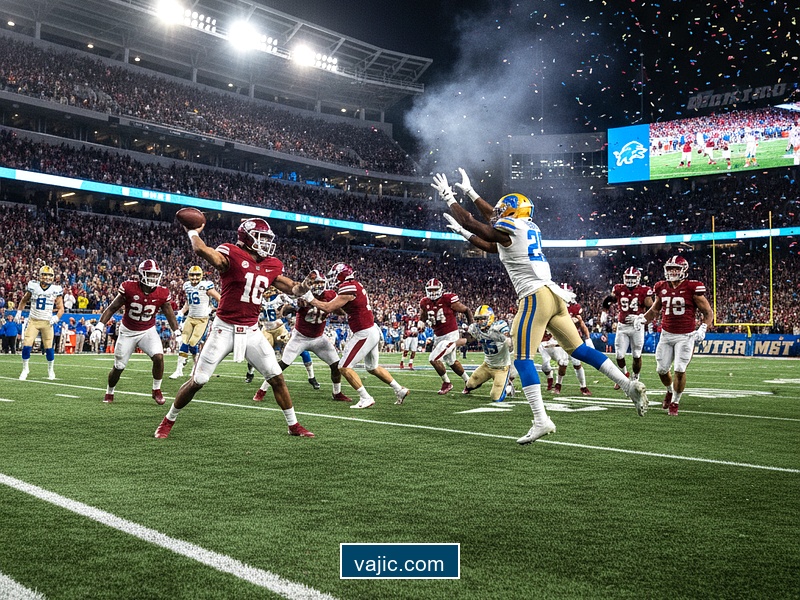
"We don't play to the scoreboard. We play to the standard." — A tired cliché, perhaps, but in the expanded College Football Playoff, the 'standard' is no longer a slogan. It is a distinct, corporate strategy of roster management and tactical identity.
The quarterfinals of this expanded College Football Playoff are not merely a collection of football games. Viewing them through the lens of point spreads or injury reports is reductionist. What we are witnessing this New Year’s is a collision of disparate architectural blueprints. We are watching four distinct "Projects"—to borrow a term from European football—collide to determine which philosophy is viable in the modern, unregulated transfer market era.
For twenty years, I have covered the sport's clumsy transition from the regional idiosyncrasies of the BCS to this industrialized tournament structure. The coaches roaming the sidelines this week are no longer just play-callers; they are portfolio managers. The quarterfinals represent the audit.
The Lanning Doctrine: The Mercenary Hybrid
Let us begin with what Dan Lanning has constructed at Oregon. To treat the Ducks simply as a "fast" team is to rely on lazy, decade-old narratives from the Chip Kelly era. Lanning’s project is far more cynical and far more brilliant. He has not built a college football team; he has built a semi-pro franchise that treats the transfer portal not as a stopgap, but as a primary acquisition strategy.
Historically, championship teams required a three-year gestation period to develop high school recruits. Lanning’s philosophy rejects this timeline. His Oregon is built on the premise of "Plug-and-Play" cohesion. The tactical innovation here isn’t the offensive tempo; it is the defensive versatility designed to negate the very spread offenses Oregon helped popularize.
Lanning utilizes a "Simulated Pressure" philosophy—showing blitz, dropping into coverage, and rushing four from unexpected angles. This requires high-IQ veterans, which high school recruits rarely are. By importing seasoned defensive talent, Lanning has hacked the learning curve. If Oregon advances, it validates the idea that culture can be bought, provided the check clears and the coaching is rigorous enough to weld the parts together instantly.
Kirby Smart and the Suffocation Model
Contrast Oregon’s mercenary speed with the terrifying permanence of Kirby Smart’s Georgia. Smart is the last true heir to the Nick Saban "Process," but he has evolved it. The Georgia Project is based on a concept I call "Defensive constriction via depth."
In the 90s and 2000s, defenses relied on a few star playmakers. Smart’s philosophy is industrial. He hoards four- and five-star talent at a rate that disrupts the market for everyone else. This is not about the starting 11; it is about the second-string defensive line being superior to the opponent’s starting offensive line.
Tactically, Georgia plays a "Mint" front (a variation of the 3-4/4-2-5 hybrid) that demands two-gapping defensive linemen who can eat space. It is unglamorous. It is violent. But the philosophical sustainability here is key. Smart is betting that in a 16 or 17-game season, flash wears down. Glass cannons shatter. His team is a rolling ball of butcher knives designed to grind opponents into dust by the fourth quarter. If Georgia wins, it is a victory for developmental stability over portal fluidity.
Sarkisian’s Texas: The Ferrari with a Roll Cage
Steve Sarkisian’s Texas presents the most fascinating physiological experiment in the field. For a decade, "Texas is Back" was a punchline because the program prioritized recruiting rankings over schematic identity. Sarkisian changed the Project. He brought the sophisticated motion mechanics of the NFL directly to Austin.
The core of Sarkisian’s philosophy is "schematic over-leverage." He uses pre-snap motion not just to identify coverage, but to force defenses into "checks" (communication adjustments) that they cannot execute in real-time. It is cognitive warfare. However, the historical flaw of such offensive-minded projects (see: Lincoln Riley at Oklahoma) is a lack of physicality.
Sarkisian has attempted to weld a fierce SEC defensive front onto a Big 12 offensive mindset. This quarterfinal is the stress test for that welding job. Can a team built on finesse and complexity survive a street fight in freezing temperatures or against a bludgeoning run game? If Texas falters, it reinforces the old adage that you cannot out-scheme toughness.
The Big Ten Existential Crisis
Then we have the traditional powers of the Big Ten (Ohio State/Penn State types) facing an identity crisis. Ryan Day, specifically, manages a Project defined by anxiety. The philosophy in Columbus has shifted from "Tressel-ball" (conservative, field position) to a desperate arms race for perimeter talent to match the SEC.
This approach has diminishing returns. By chasing the offensive dragon, these programs often lose the grimy, trench-warfare identity that made them unbeatable in November. The "Project" here feels reactive rather than proactive. They are trying to be Alabama North or Georgia North, rather than perfecting their own self. The quarterfinals will punish this lack of authentic identity. You cannot beat the original by becoming a copy.
Comparative Analysis of Program Philosophies
To visualize the clash, we must strip away the logos and look at the operational metrics of these managers.
| Manager/Program | Primary Philosophy | Roster Construction | Tactical vulnerability |
|---|---|---|---|
| Dan Lanning (Oregon) | Adaptive Aggression | Portal Heavy (Instant Impact) | Chemistry breakdown in adversity |
| Kirby Smart (Georgia) | Attrition Warfare | HS Development (Hoarding) | Offensive explosiveness (WR Separation) |
| Steve Sarkisian (Texas) | Cognitive Overload | Balanced / QB Centric | Physicality in the trenches |
| Ryan Day (Ohio State) | Talent Accumulation | Star-gazing | Identity crisis (Toughness vs. Speed) |
The Verdict on Sustainability
The 12-team playoff format fundamentally changes what constitutes a "successful" philosophy. In the 4-team era, you could rely on a Heisman quarterback to mask roster deficiencies (the Cam Newton model). That is no longer sustainable. Three or four consecutive games against elite competition requires a roster density that only a few managers possess.
This is why the "Project" matters more than the specific game plan. A game plan wins 60 minutes. A philosophy wins a decade. The teams that rely on trickery, tempo, or a single generational talent are doomed in this new format. The quarterfinals will filter out the programs that are merely good football teams from the organizations that are built for the long war.
We are not just watching athletes; we are watching the validation or refutation of roster management theories. When the final whistle blows, we will know which CEO built a company that can survive the market correction, and which one is merely riding a bubble.