
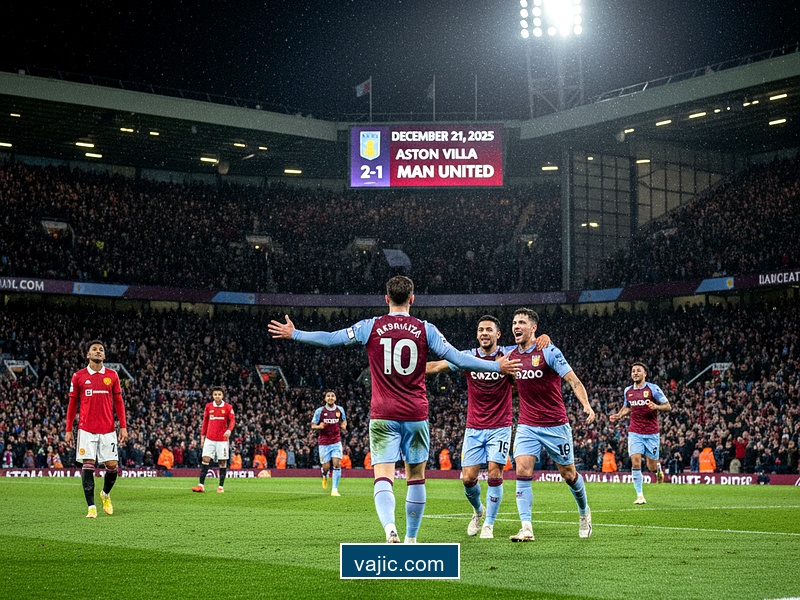
There is a specific sound inside Villa Park when the tactical plan is working. It isn’t just the roar of a goal; it is the collective hum of anticipation when the passing angles open up. On December 21, 2025, against a Manchester United side that looked less like a football team and more like a collection of expensive disparate parts, that sound was deafening. Unai Emery didn't just out-coach the opposition dugout; he exposed a fundamental biomechanical and structural deficit in the visitors that no amount of transfer spending can fix.
Watching from the gantry, the 2-1 scoreline flattered United. This wasn't a contest of margins; it was a lecture on spatial dominance. To understand why Morgan Rogers was able to dissect the Red Devils, and why Villa now sit just three points off Arsenal, we have to look past the highlights and focus on the unseen work—the scanning, the hip orientation, and the dark art of 'rest defense.'
The Biomechanics of Morgan Rogers
The headline is that Rogers scored the winner. The scout’s report, however, notes how the space for that winner was manufactured 15 seconds prior. Modern elite attackers are defined by their "scanning frequency"—the number of times a player checks their shoulder before receiving the ball. Top-tier midfielders average 0.6 to 0.8 scans per second. Against United’s disjointed pivot, Rogers was operating at an elite level, identifying the pockets of space behind the United midfield line before the ball even left Pau Torres’ boot.
Physically, Rogers creates what we call "gravity." When he receives the ball on the half-turn—a technical skill where the hips are open to both the passer and the goal—he forces the opposition center-backs to make a decision: step up and leave a gap behind, or drop off and allow him to drive. Martinez and Maguire (or whichever combination United fields) were paralyzed by this. Rogers possesses the low center of gravity of a much smaller man, allowing him to decelerate and change direction violently. This is a nightmare for defenders who are sprinting backward facing their own goal.
In the lead-up to the decisive goal, watch Rogers’ movement away from the ball. He utilizes "blind-side runs," moving across the defender's eyeline to vanish from their peripheral vision. By the time the United center-half re-adjusted his body shape, Rogers had already encroached into Zone 14 (the critical central area just outside the penalty box). It is a geometry problem United could not solve.
United's Structural Rot: The Broken Accordion
To understand Manchester United's failure, one must revisit the theories of Arrigo Sacchi. The legendary Italian manager believed a team should ideally operate within a 25-meter vertical strip from the center-forward to the center-back. This compactness chokes the opponent. United, conversely, played stretched over 50 to 60 meters. In coaching circles, we call this a "broken accordion."
When United lost possession, their transition to defense was catastrophic. A functioning side employs a "rest defense"—a structure maintained while attacking specifically to handle a turnover. Villa’s rest defense typically involves a 3-2 shape, locking down central channels. United’s shape was non-existent.
The "negative transition" (the moment possession is lost) revealed shocking body language from the visitors. There is a specific lethargy in the first three steps of a recovery run that tells a scout everything. When Villa bypassed the first line of pressure, United’s midfielders were jogging. Not sprinting. Jogging. In the Premier League, if you do not sprint to recover shape within two seconds of a turnover, you are dead. Villa’s second goal came directly from exploiting this lethargy, driving through a midfield vacuum that should have been plugged by a disciplined #6.
The Emery Cage: Tactical Periodization in Action
Unai Emery has turned Villa Park into a fortress not through passion, but through the weaponization of the offside trap and controlled possession. This is a masterclass in "provoking the press."
| Tactical Phase | Villa's Action | United's Reaction | Outcome |
|---|---|---|---|
| Build Up | Martinez places foot on ball, center-backs split wide. | United forwards trigger a disjointed, individual press. | Villa bypasses first line easily via pivot. |
| Midfield Progression | Full-backs invert or Rogers drops deep to create a 'Box Midfield'. | United midfield gets overloaded (4v2 or 4v3). | Free man created in the half-spaces. |
| Final Third | Rapid verticality into runners like Watkins/Bailey. | United defensive line retreats, creating gap for cutbacks. | High-quality chances created (xG spikes). |
Emery’s system relies on the "third man principle." Player A passes to Player B to find Player C. United, man-marking lazily, constantly chased the ball (Player B) while Player C (often Rogers or Tielemans) ran free into space. It is a tactical setup reminiscent of the peak Valencia teams of the early 2000s, but with the physical intensity of the modern Premier League.
The Unseen Psychology
Beyond the chalkboard, the body language disparity was stark. When a Villa player made a mistake, the immediate reaction was a collective compression of space—teammates swarming to cover the error. When a United player erred, arms went up in frustration. This is the difference between a team operating as a hive mind and a team of individuals protecting their own reputations.
Fernandes, usually the talisman, spent the second half drifting laterally, looking for the ball in harmless areas to pad passing stats, rather than staying central to affect the game state. In contrast, John McGinn’s heat map would show a player who understands "value-added space." McGinn didn't run just to run; he ran to block passing lanes. He utilized his unique shielding technique—backing into players to protect the ball—to kill United's momentum whenever they tried to build a rhythm.
Contextualizing the Title Charge
We need to stop treating Aston Villa as plucky underdogs. The data suggests they are a legitimate machine. Being three points off Arsenal in December is not a fluke; it is the result of squad building that prioritized specific tactical profiles over marketing value. Arsenal plays a possession-heavy game; Villa plays a space-manipulation game. In a league that is becoming increasingly homogenous, Emery’s distinct, high-risk high-line style is the perfect counter-punch.
For Manchester United, this loss wasn't about bad luck or a refereeing decision. It was a structural failure. Until they fix the vertical distance between their lines and the scanning frequency of their midfielders, they will remain a team that produces moments, but never a season. Rogers didn't just beat them; he out-thought them.