
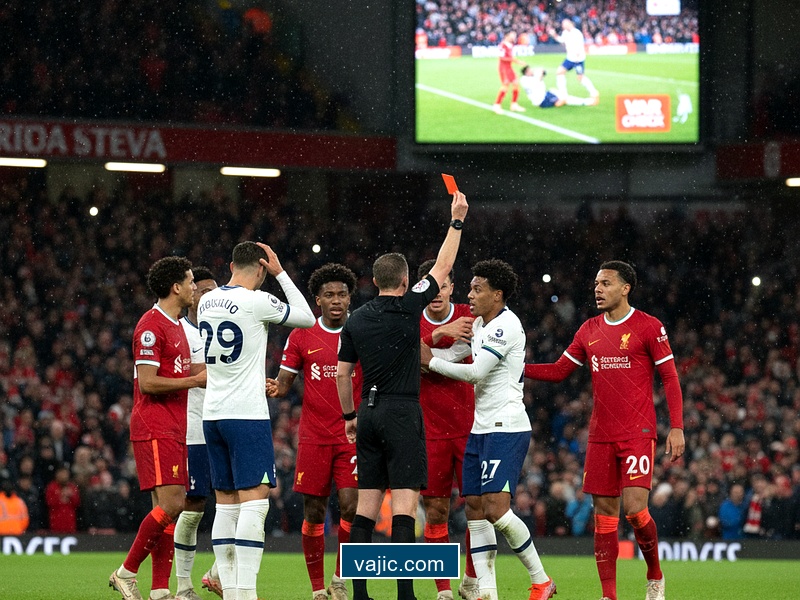
The apology was almost worse than the error. "Significant human error," the PGMOL called it. A sterile, corporate euphemism for a catastrophic failure of protocol that saw Luis Diaz’s legitimate goal against Tottenham erased from history, not by the laws of physics, but by a breakdown in communication that rivals a slapstick comedy sketch. But nobody on Merseyside is laughing.
The fallout from Liverpool’s defeat at the Tottenham Hotspur Stadium—marred by that disallowed goal and two controversial red cards—transcends the immediate loss of points. It signifies a fundamental rupture in the contract between the sport and the spectator. As I watched Curtis Jones trudge off the pitch, victim of a tackle that looked innocuous in real-time but murderous in super-slow-motion 4K resolution, I couldn't help but cast my mind back two decades.
The Sterilization of the "Reducer"
Let’s rewind to the 2004-2005 season. Rafael Benitez had just arrived at Anfield. The Premier League was a visceral battleground, not a forensic laboratory. In that era, the midfield engine room was occupied by the likes of Steven Gerrard and Dietmar Hamann. If you examine the Jones incident through the lens of 2004, play simply continues. It was a 50/50 challenge, a collision of intent and momentum.
Back then, we called them "reducers"—tackles designed to let the opponent know you were there. Think of Javier Mascherano a few years later; his game was predicated on the very aggression that VAR now criminalizes. The freezing of a frame at the exact point of contact removes the context of force and motion. It turns a footballing action into a still image of violence.
The modern game is being refereed by technicians, not instinctive arbiters of sport. If the 2005 Champions League winning squad played under today's protocols, Jamie Carragher would be serving a permanent suspension and Hamann would be virtually uninsurable.
The sophisticated officiating of the mid-2000s, led by figures like Pierluigi Collina on the continent or a prime Graham Poll domestically, understood the "temperature" of a match. They managed men. Today’s officials manage monitors. The Curtis Jones red card wasn't just harsh; it was a betrayal of the biomechanics of the sport. His foot rolled over the ball. In 2005, Gerrard shakes hands with Bissouma, the ref waves play on, and the Kop roars.
Tactical Rigidity vs. The Chaos Engine
Beyond the officiating disaster, the match revealed a fascinating tactical evolution in how Liverpool handles adversity compared to the Benitez era. When Liverpool went down to nine men against Spurs, they retreated into a 5-3-0 defensive shell that nearly held out. It was heroic, yet heartbreakingly breached by Joel Matip’s late own goal.
Contrast this with the "Rafalution." Benitez was the master of the low block before it was fashionable. The 2005 team, lacking the offensive firepower of Salah or Diaz, was built on an obsidian-hard defensive structure. Sami Hyypiä and Carragher didn't need to play a high line because the system didn't require compression of space in the opponent's half; it required domination of the 18-yard box.
Klopp’s "Liverpool 2.0" is different. Even with ten men, and then nine, the instinct remains to transition quickly. The tragedy of the Diaz offside isn't just the disallowed goal; it's how it altered the game state. In the 2008/09 season, when Liverpool chased Manchester United to the wire, games were often decided by a singular moment of Xabi Alonso brilliance or a Torres burst. They controlled games through possession and geometry.
Today, the Premier League is a transition-based league. By wrongly disallowing that goal, the officials didn't just subtract one from the scoreboard; they forced Liverpool to expend critical energy reserves chasing a game they should have been leading. That physical tax led directly to the fatigue that caused the defensive lapses later in the match.
The Erosion of Authority and the "Check Complete" Fiasco
The specific nature of the error—the VAR official believing the on-field decision was "goal," saying "check complete," and inadvertently confirming the "no goal" call—is a bureaucratic nightmare that belongs in a Kafka novel, not elite sports. This is where the comparison to the past becomes most damning.
Twenty years ago, if a linesman flagged for offside, he was often wrong. We accepted it as human fallibility. The anger was visceral, directed at a man doing a hard job. Now, the anger is intellectual, directed at a system that claims perfection but delivers incompetence. The technology was sold to us as a way to end debates. Instead, it has weaponized them.
| Era | Authority Figure | Error Type | Fan Reaction |
|---|---|---|---|
| 2004-2010 | The Referee (Sole Arbiter) | Visual/Speed of play | " The ref is blind" (Accepted chaos) |
| 2023-Present | VAR / PGMOL Hub | Procedural/Communication | "The game is rigged" (Systemic distrust) |
This shift from "human error on the pitch" to "negligence in a booth" is toxic. It feeds conspiracy theories and undermines the integrity of the league title race. In 2009, Liverpool lost the title with 86 points—a record for a runner-up at the time. They lost only two games all season. The margins were razor-thin then, but they are microscopic now given Manchester City's robotic consistency.
The Ghost of Mascherano and the Spirit of Szoboszlai
If there is a silver lining to this farce, it is the performance of Dominik Szoboszlai. In the 2007-2008 era, Liverpool relied on the destructive genius of Javier Mascherano to break up play. Szoboszlai, however, is a hybrid engine—possessing the lungs of Dirk Kuyt and the technical arrogance of a young Gerrard. His ability to cover ground with nine men was reminiscent of the 2005 Champions League final extra time, where sheer will compensated for tactical disadvantage.
However, the emotional toll of these injustices is heavier now. The 2005 squad thrived on a siege mentality—"Us against the World." Klopp has fostered a similar culture, dubbing his team "Mentality Monsters." But there is a breaking point. When the governing body of the sport admits to altering the reality of a match through sheer incompetence, the psychological blow is profound.
A Legacy Under Siege
The Premier League risks becoming a product consumed rather than a sport experienced. The raw emotion of a goal celebration is now paused, pending a grid line drawn by a technician at Stockley Park. Liverpool’s history is paved with triumphs over adversity—from the Miracle of Istanbul to the corner taken quickly against Barcelona.
But those were battles against superior teams or impossible odds on the grass. This current battle is against a sanitized, bureaucratized version of football that punishes the very physicality and spontaneity that made the English game the envy of the world. If the PGMOL wants to know why fans are furious, they shouldn't look at the monitors. They should look at the history books.
The Liverpool of Benitez, Hyypiä, and Gerrard would not have accepted an apology. They would have demanded a revolution. Perhaps it is time Klopp’s Liverpool does the same.