
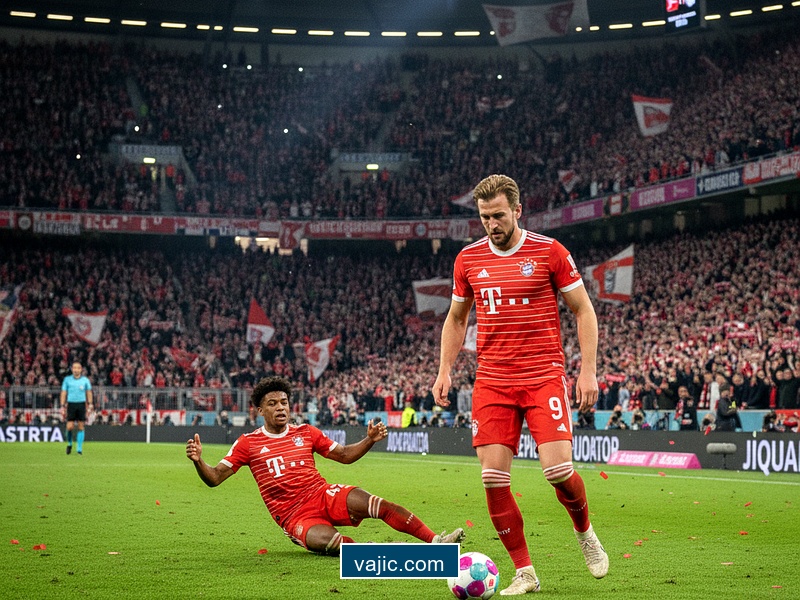
The latest market value update from Transfermarkt is not merely a spreadsheet adjustment; it is an indictment of the high-wire act currently performing at the Allianz Arena. When the Bundesliga’s most expensive assets—Harry Kane and Jamal Musiala—see their valuations dip simultaneously, we are witnessing more than just market correction. We are seeing the first economic symptoms of Vincent Kompany’s radical, high-risk philosophy.
For two decades, I have tracked the correlation between tactical systems and asset appreciation. Under Hansi Flick, valuations soared because the chaos was productive. Under Pep Guardiola, they stabilized through dominance. Under Kompany, however, we are seeing a disturbing trend: the system is consuming the individuals.
While the headlines will scream about the €40 million explosion in value for teenage prodigy Lennart Karl, the real story—the dangerous story—is the depreciation of the Crown Jewels. This suggests that the "Kompany Project" is failing to protect the long-term equity of the club in pursuit of short-term, adrenaline-fueled results.
The Kane Paradox: Depreciation by Design?
Harry Kane’s value drop is easy to dismiss as a consequence of Father Time. He is on the wrong side of 30, and the algorithm is cruel to aging strikers. However, that analysis is lazy. Robert Lewandowski maintained a valuation north of €50 million well into his mid-30s at this very club. The difference lies in the utilization.
Kompany’s insistence on a relentless, suffocating high press—a holdover from his Manchester City tutelage but applied without City’s possession-based safety net—is physically taxing Kane in areas of the pitch that yield no ROI (Return on Investment). When your €100 million striker is spending 40% of his energy engaging in defensive transitions near the center circle, you are eroding his sharpness for the six-yard box.
The market reacts to ceiling, not just current output. By forcing Kane to be a workhorse rather than a sniper, Kompany is signaling to the market that Kane’s years of elite statistical output are being shortened by tactical exhaustion.
Historically, Bayern Munich protects its strikers. Giovane Élber, Roy Makaay, and Lewandowski were serviced by the system, not enslaved by it. Kompany has flipped this script. He demands total football from a specialist, and while it creates glorious highlights, it accelerates the physical decline of the asset. The market sees a player burning the candle at both ends.
Musiala and the Suffocated Half-Space
The dip in Jamal Musiala’s valuation is far more alarming than Kane’s. Musiala is the poster boy of German football, the generational talent who should be immune to market fluctuations. If his value is down, the system is broken.
The issue here is spatial. Kompany’s 4-2-3-1 (which often morphs into a 2-3-5 in possession) is overly congested. By inverting full-backs and pushing wingers high, the "half-spaces" where Musiala operates are no longer his private playground; they are a traffic jam. Musiala thrives on isolation dribbling—the ability to turn one defender and drive. Kompany’s structure brings extra bodies into Musiala’s zone, bringing extra defenders with them.
We saw this happen with Thomas Müller under Niko Kovač. When the structure becomes too rigid, the Raumdeuter (space interpreter) has nothing to interpret. Musiala requires anarchic freedom, akin to Jude Bellingham at Real Madrid. Instead, he is being treated as a cog in a pressing machine. The market value drop reflects a fear that under Kompany, Musiala’s statistical ceiling is capped by tactical duty.
Lennart Karl: The €40 Million Lifeboat
Amidst the stagnation of the first-team stars, the astronomical €40 million rise of Lennart Karl is the anomaly that explains the future strategy. This is not just a youth player having a good month; this is a market recalibration of what the Bayern "Campus" is actually worth.
For years, Bayern has failed to produce a homegrown star that sticks. Musiala was poached from Chelsea; Davies from Vancouver. You have to go back to David Alaba or Thomas Müller to find true integration. Lennart Karl represents the board's insurance policy against Kompany’s spending.
| Player | Trend | Tactical Implication |
|---|---|---|
| Harry Kane | ▼ Down | Overworked in defensive transition; tactical fatigue. |
| Jamal Musiala | ▼ Down | Stifled by congested central channels. |
| Lennart Karl | ▲ Up (€40m) | The new "Yamal" effect; pure potential unbound by system rigor. |
Karl, a left-footed dynamo often compared to a young Arjen Robben but with better playmaking instincts, has exploded because he operates outside the rigidity of the first team’s current struggles. His rise is a signal that scouts value individual brilliance over systemic compliance. The €40 million jump is the market saying: "This kid is the only one playing with freedom."
The Sustainability of "Kompany-Ball"
We must ask if Vincent Kompany’s philosophy is sustainable for a club that operates as a business first and a football team second. Bayern Munich is not Manchester City; they cannot simply write off depreciating assets and buy new ones. The "Mia San Mia" ethos is built on financial prudence and maximizing player value.
Kompany plays with a defensive line so high it gives Bavarian cardiologists job security. This "Restdefense" relies on athletic perfection. When it works, they win 4-0. When it fails, they look vulnerable. This volatility makes investors—and the transfer market—nervous. Volatility is the enemy of valuation.
If Musiala feels he cannot win the Ballon d'Or playing in a system that forces him to share space with an inverted right-back, he will leave. If Kane burns out by March because he’s been pressing center-backs in Augsburg in November, the Champions League dream dies. Kompany is managing for Saturday, but the market values are managed for the decade.
The Verdict: A collision Course
The juxtaposition of Karl’s rise and the stars’ fall creates a dangerous narrative for the manager. It suggests that the talent is there (Karl), but the current application of the elite talent (Kane/Musiala) is flawed.
Bayern Munich is currently a project divided. On one hand, you have the youth academy finally delivering a diamond in Lennart Karl, suggesting the future is bright. On the other, you have a manager whose tactical dogmatism is shaving millions off the club’s balance sheet by misusing its primary assets.
Vincent Kompany was hired to bring the intensity of the Premier League to the Bundesliga. He has done that. But the Premier League eats its young and burns out its old. The Transfermarkt update is a warning flare: The "Project" is currently cannibalizing its own value. Unless Kompany learns to protect his stars from his own system, the next update will be even bloodier.