
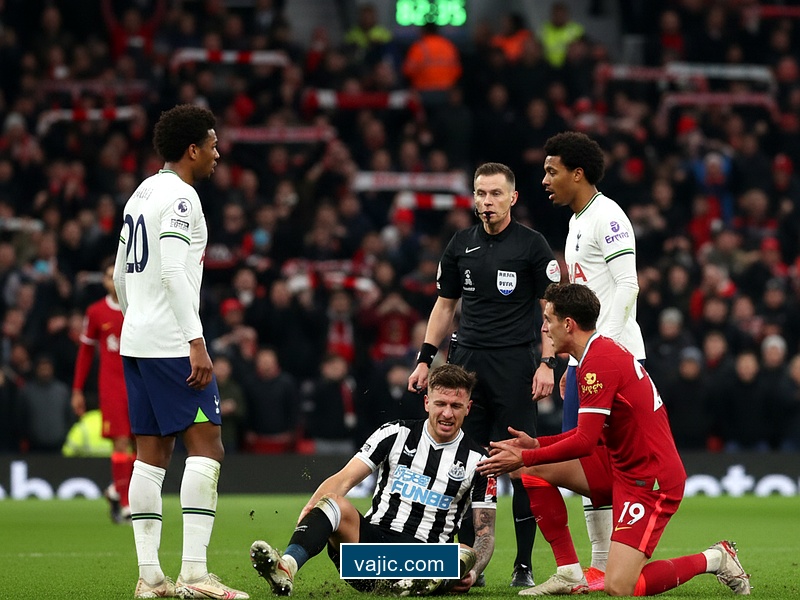
The silence that fell over Anfield in the 73rd minute against Tottenham wasn’t just the shock of the moment; it was the collective PTSD of a fanbase that has seen this specific tragedy play out before. When Alexander Isak, Liverpool’s record-shattering acquisition, clutched his leg without a white shirt within five yards of him, the air didn't just leave the stadium—the belief evaporated with it.
We are told by the modern data analysts that football is a squad game, that the "system" overrides the individual. That is a comforting lie we tell ourselves to mitigate disaster. The truth, visible in the pained grimace of the Swedish striker, is that elite teams are often held together by the gravity of a single, superlative talent. For Liverpool, Isak was meant to be the final piece of a puzzle that has been scattered since the departure of Sadio Mané. Instead, we are looking at a potential catastrophe that threatens to derail a title challenge before the autumn leaves have fully turned.
The Ghost of El Niño
To understand the depth of this fear, one must look back 15 years. The parallel is not Darwin Núñez or even Daniel Sturridge; it is Fernando Torres. The 2008-09 season remains the great "what if" of the Rafa Benitez era, and the similarities to our current predicament are terrifying.
That year, Liverpool possessed the best spine in Europe: Reina, Carragher, Mascherano, Alonso, Gerrard, and Torres. They lost only two league games all season—fewer than the champions, Manchester United. Yet, they finished second. Why? Because Fernando Torres, the lightning rod of the attack, started only 20 Premier League matches. His hamstring was as fragile as his finishing was lethal.
"We are witnessing the recurrence of the 'Ferrari in the Garage' syndrome. You cannot win a Premier League title against a machine like Manchester City with your primary weapon sitting in the stands wearing a wool coat."
Isak, like Torres, offers something rare: the ability to create goals from nothing. He is a transitional monster. Against a high line like Tottenham’s, he is the ultimate weapon. Losing him forces Liverpool back into a tactical structure that requires perfect passing sequences to score, rather than the chaotic brilliance of individual quality. When Torres played in '09, Liverpool averaged 2.15 points per game. When he didn't, the draws against Stoke, Fulham, and West Ham piled up. Isak’s injury threatens to turn this season into another catalogue of regrettable draws.
Tactical Ramifications: The Loss of Verticality
The injury to Isak does more than remove a goalscorer; it fundamentally alters the geometry of the pitch. Under the current tactical setup, the center-forward is required to pin the opposition center-backs deep, creating the pockets of space for the inverted wingers and the advanced 8s to operate.
Isak excels at "channel running"—drifting into the half-spaces between the center-back and fullback. This terrifies defenders like Cristian Romero because they hate being dragged out of the central corridor. Without Isak, Liverpool’s alternatives offer a different, less threatening profile:
- Diogo Jota: An elite poacher, but he lacks Isak’s physical stature and ability to carry the ball 40 yards upfield to relieve pressure.
- Darwin Núñez: Chaos personified, but he lacks the surgical clinical edge Isak provides. Darwin creates volume; Isak provides precision.
- Cody Gakpo: He wants the ball to feet and drops deep, compressing the play rather than stretching it.
If Isak is out for three months, the opposition defensive line steps up five yards. That five yards suffocates the midfield. It is a domino effect. We saw this against Spurs immediately after the substitution; the Tottenham backline, previously terrified of the ball over the top, squeezed Liverpool into their own half. The vertical threat vanished.
The "Record Signing" Curse
There is also the psychological weight of the price tag. Liverpool has a complicated history with "record signings" at the striker position. For every Mohamed Salah (who was a bargain), there is an Andy Carroll. The £35 million spent on Carroll in 2011 was an albatross around the neck of the club for years. While Isak is infinitely more talented than Carroll, the mechanism of failure—injury leading to a loss of rhythm, leading to a crisis of confidence—is a path well-worn.
The fee paid for Isak demands availability. It is a ruthless assessment, but at the elite level, durability is a skill. Luis Suarez, for all his controversies, was made of granite. He almost never missed a game through injury. That robustness allowed Brendan Rodgers to build an entire ecosystem around him in 2013-14. You cannot build an ecosystem around a player who is available 60% of the time.
Comparative Analysis: The Fragility Factor
Let’s look at the numbers contrasting the availability of Liverpool’s legendary strikers versus the current concern. This table highlights the correlation between striker availability and title success.
| Player | Season | League Starts | Team Result |
|---|---|---|---|
| Fernando Torres | 2008-09 | 20 | 2nd (4 pts off) |
| Luis Suarez | 2013-14 | 33 | 2nd (2 pts off) |
| Roberto Firmino | 2019-20 | 34 | Champions |
| Alexander Isak | Current Proj. | 18-22? | Unknown |
The data is stark. To win the league, your main man must play 30+ games. If the medical reports confirm a significant tear, Liverpool are mathematically shifting from title favorites to top-four scramblers overnight. The Premier League creates a relentless pace; Manchester City and Arsenal do not wait for hamstrings to heal.
The Medical Reality Check
We must also address the elephant in the room: Isak’s history. During his time at Newcastle, he missed significant chunks of time with recurring groin and hamstring issues. This was a known risk. The gamble Liverpool took was that their superior medical department and rotation policy could manage his load better than the Magpies did.
That gamble appears to have backfired. The intensity of Liverpool’s pressing game, even if modified from the heavy metal football of the Klopp era, demands distinct biomechanical stress. Isak is a thoroughbred—elegant, fast, but seemingly fragile. The "significant leg injury" descriptor usually implies soft tissue failure or ligament damage. If it is the former, it is a management issue; if it is the latter, it is bad luck. But for a player with his history, the former is the more damning indictment of the recruitment strategy.
A Season on the Brink
This weekend was supposed to be a statement. Beating Tottenham would have solidified the credentials of this new-look side. instead, the result is secondary to the bulletin from the Kirkby medical center.
The manager now faces the definitive test of his tenure. Benitez couldn't solve the Torres puzzle in 2009—he tried N'Gog and Kuyt, but the drop-off was too steep. The current squad has more depth, certainly, but it lacks a direct replacement for Isak's specific skillset. We are about to find out if this Liverpool team is a genuine collective or if it was, once again, a fragile structure relying on a singular, brittle genius to crack the safe.
History suggests that when the Anfield number 9 goes down, the title challenge goes down with him. It is up to the remaining forwards to prove that 2024 is not 2009 reborn. But as Isak limped down the tunnel, head in hands, it was hard to shake the feeling that we just watched the season limp away with him.