
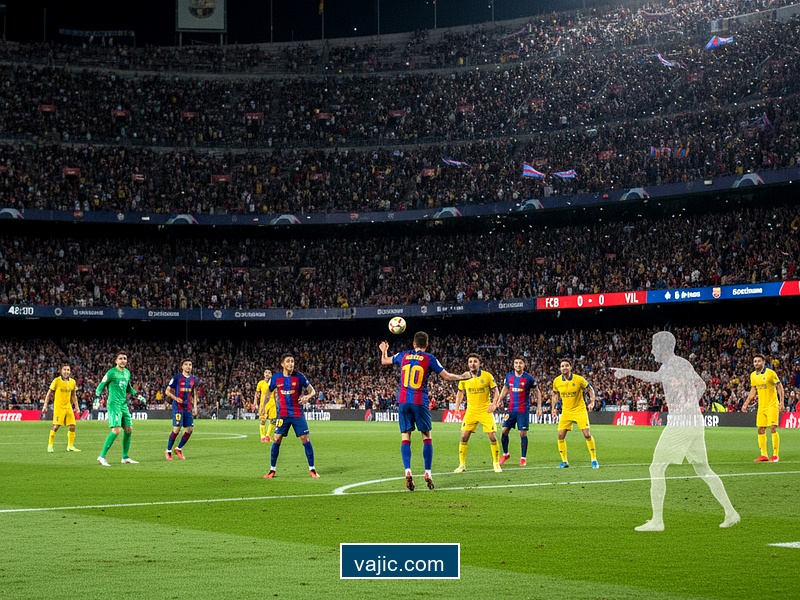
The teamsheet for the upcoming clash at El Madrigal might feature a glaring omission, but focusing on the absence of a single name misses the forest for the trees. Whether it is Dani Olmo, Ferran Torres, or the ghostly figure of Gavi still haunting the physio room, the headlines surrounding Barcelona’s trip to Villarreal inevitably fixate on who isn't playing. This is a mistake. The story of the 2024/25 season isn't about personnel attrition; it is about the imposition of a brutal, high-risk philosophy that renders the individual secondary to the machine.
Hansi Flick has not just taken the reins; he has stripped the carriage down to the chassis and replaced the engine. We are witnessing a cultural exorcism. The "major absence" reported in the news cycle is merely a stress test for a system designed to function at a metabolic rate that La Liga has rarely seen since the prime years of Jurgen Klopp’s heavy metal football. To understand if this result—and this title charge—is sustainable, we must ignore the 90 minutes against Villarreal and dissect the terrifying ambition of the Flick project.
The Death of the "Paura"
For nearly a decade, Barcelona suffered from a psychological condition best described as paura—fear. It was the fear of losing the ball, the fear of transition, and the fear of physicality. Xavi Hernandez, for all his legendary status, attempted to cure this by doubling down on control. His philosophy was possession as a sedative: if we have the ball, they cannot hurt us.
Flick has inverted this logic. His Barcelona does not seek to sedate; it seeks to suffocate. The German tactician has introduced a verticality that feels almost heretical to the purist Cruyffista element of the fanbase. But look closer at the data. The pressing triggers have moved fifteen yards up the pitch. The defensive line plays with a kamikaze arrogance, condensing the space to a degree that invites disaster against pacy wingers like Villarreal’s Yeremy Pino or Nicolas Pépé.
This is not carelessness. It is a calculated gamble based on arithmetic. Flick bets that his team can win the ball back in the final third enough times to render the opponent’s counter-attack statistically irrelevant. It is the philosophy of the 2020 Bayern Munich side—the same machine that dismantled Barcelona 8-2—transplanted into the humid air of Catalonia.
The Physicality Deficit: A Historical Correction
The most startling aspect of this new regime is the physical transformation. Historically, Barcelona’s midfield was a place for artists, not athletes. Iniesta and Xavi did not need to sprint because the ball moved faster than the man. However, modern football has evolved into a game of transitions.
Flick’s staff has reportedly overhauled the club's preparation metrics, focusing on "repeated sprint ability" (RSA). This is crucial when analyzing the predicted lineup against Villarreal. Even with a major absence in the creative department, the system demands that the replacements—likely the likes of Pablo Torre or a deeper-dropping Raphinha—maintain the physical output. The project relies on the team being able to run the opposition into the ground by the 70th minute.
"Barcelona has moved from a philosophy of 'pass to move the opponent' to 'run to break the opponent.' It is a shift from chess to rugby."
This shift explains why the team has managed to grind out results even when not playing fluidly. They are physically overpowering teams in the last quarter of matches, a trait historically associated with Real Madrid, not the Blaugrana.
La Masia: The Engine Room of Necessity
We cannot discuss the sustainability of this project without addressing the elephant in the room: the squad depth is perilously thin. The financial levers have been pulled, the salary cap is a constant noose, and Flick is operating with one hand tied behind his back. Yet, this economic austerity has forced a tactical purity.
In previous eras, a major injury meant signing a panic buy (think Kevin-Prince Boateng or Martin Braithwaite). Under Flick, the answer lies in La Masia. But he uses these kids differently. He is not just looking for technical excellence; he is demanding tactical obedience. Marc Bernal (prior to his tragedy), Marc Casadó, and Pau Cubarsí have been integrated not as luxury passengers, but as structural pillars.
The reliance on youth is the project's greatest strength and its most volatile weakness. The "Major Absence" mentioned in the report is likely a muscle injury—a direct consequence of asking teenagers and veterans to play Red Bull-style football on a La Liga schedule. If Flick burns out Lamine Yamal or Pedri by December, the high line will collapse. The system requires fresh legs; without them, the suicide line becomes simply suicide.
Tactical Breakdown: The Marcelino Trap
Villarreal, managed by the astute Marcelino, represents the perfect anti-Flick weapon. Marcelino’s 4-4-2 block is compact, disciplined, and designed to spring like a coil. This match is not just a league fixture; it is a litmus test for the "Plan B."
When a key connector is missing from Barcelona’s lineup, the usual response is to slow the game down. Flick will likely demand the opposite. We should expect to see:
| Tactical Element | Xavi Era Approach | Flick Era Approach |
|---|---|---|
| Ball Loss | Tactical foul or retreat to shape | Immediate, swarm-based counter-press |
| Fullbacks | Inverted to create midfield box | Overlapping to stretch pitch width |
| Verticality | Patient build-up from the back | Direct balls to bypass midfield lines |
If Barcelona wins at El Madrigal without their key playmaker, it validates the system over the star. It proves that the "automations"—the pre-programmed movements Flick drills into them—are robust enough to survive personnel changes. If they lose, the critics will immediately point to the naivety of the high defensive line.
The Verdict: Sustainable or Kamikaze?
Is this sustainable? Logic suggests no. The sheer volume of injuries piling up across Europe suggests that high-intensity football is eating its own children. Barcelona’s squad is too small to play "heavy metal" football for 50 games a season without suffering a catastrophic mechanical failure.
However, Flick has no choice. He cannot out-spend Real Madrid. He cannot out-depth Manchester City. His only path to hegemony is to out-work and out-think them. The project is an all-or-nothing wager on physical preparation and tactical bravery.
The absence of a star player against Villarreal is a nuisance, but for Hansi Flick, it is an opportunity to prove that the machine is greater than the sum of its parts. Barcelona is walking a tightrope over a canyon of financial ruin and past failures. Flick hasn’t taught them how to walk carefully; he’s taught them to run across it. It is terrifying, it is exhausting, and it is the only way this club returns to the elite.