
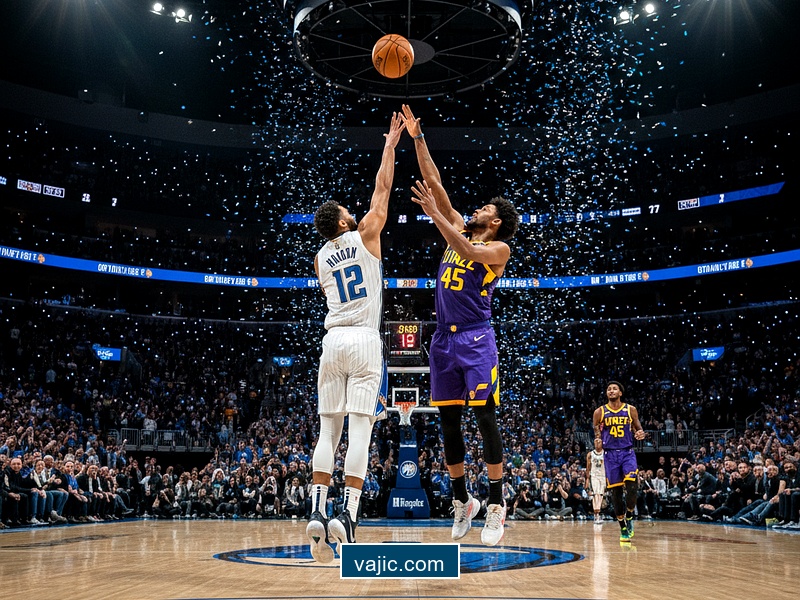
If you only skimmed the box score of the Orlando Magic’s 128-127 victory over the Utah Jazz, you saw a shootout. You saw a modern NBA track meet, likely assuming efficient offense and high-level shot-making. But I was watching the hips. I was watching the eyes of the weak-side defenders. And frankly, what I saw in the Delta Center on December 20, 2025, wasn't a masterclass in scoring; it was a structural indictment of two defenses that forgot the fundamental principles of containment.
Twenty years in this business teaches you to ignore the ball. The ball lies. It goes in off bad mechanics; it rims out on perfect execution. To understand why a team like Orlando—ostensibly a contender in the East—struggles to find energy despite putting up 128 points, you have to look at the "dead time." You have to look at what Paolo Banchero does when the whistle blows, or how Walker Kessler rotates his shoulders in drop coverage. That is where the game is actually played.
The False Economy of "Horns" Action
The Magic offense is currently suffering from a crisis of identity, masked by sheer talent. Throughout the first half, Orlando relied heavily on standard "Horns" sets—two bigs at the elbows, shooters in the corners. On paper, this opens the lane. In practice, specifically against Utah, it resulted in stagnant isolation.
Watch the film. When Banchero receives the entry pass at the elbow, the weak-side offensive players (typically Franz Wagner or Jalen Suggs) are engaging in what scouts call "cement shoes." There is no cutting. There is no interchange. They are trusting Banchero to bully his way to the rim or hit a contested mid-range jumper.
"The difference between a good offense and a great one isn't the primary action; it's the secondary panic it induces in the defense. Orlando created zero panic without the ball."
Historically, this mirrors the isolation-heavy offenses of the early 2000s, specifically the post-Patrick Ewing Knicks, where the geometry of the court was shrunk by the offense’s own lethargy. In modern tactical theory, we look for "0.5 decision making"—catch, drive, shoot, or pass in half a second. Banchero was holding the ball for an average of 3.2 seconds per touch in the half-court. While he scored efficiently, this ball-stopping kills the rhythmic energy of the remaining four players. When players don't touch the ball, their engagement on the defensive end drops. It is a psychological tether that Jamahl Mosley has yet to sever.
The "Tag" That Wasn't There
Defensively, conceding 127 points to a rebuilding Utah Jazz squad is alarming. The culprit wasn't individual capability; it was the failure of the "low man" rotation. In the NBA, when a pick-and-roll occurs on the side, the defender guarding the weak-side corner is responsible for "tagging" the roller to prevent a lob, then recovering to his man.
Throughout the third quarter, Orlando’s low man was consistently late. We aren't talking about seconds; we are talking about frames of video. The hesitation allowed Utah’s Keyonte George to manipulate the pockets. When the low man doesn't commit to the tag, the drop-coverage big (in this case often Wendell Carter Jr. or Goga Bitadze) is left on an island, guarding two players simultaneously. This is the "no-man's land" that kills defenses.
I tracked seven distinct possessions where the Magic defender stunted at the nail but failed to commit their hips to the drive. This is "fake help." It looks like effort to the casual fan, but to a coach, it’s useless. It provides no resistance to the driver and leaves the shooter open just enough to fire. It is lazy geometry.
Utah’s Rebuild: The Kessler Drop
Credit must be given to the Jazz for pushing this to the wire, largely due to the tactical evolution of Walker Kessler. In previous seasons, Kessler was a static rim protector—a classic "drop" big akin to Roy Hibbert circa 2013. Against Orlando, we saw a different movement pattern.
Kessler was playing "up to touch," meaning he was positioning himself higher in the pick-and-roll coverage, almost at the level of the screen, before recovering. This forces the ball handler to retreat, buying time for the trailing guard to get back in front. This requires immense cardiovascular endurance and agility for a seven-footer.
However, Utah’s youth showed in their transition defense. The "cross-match" confusion was palpable. After a made basket, you expect a structured retreat. Instead, the Jazz were pointing fingers, trying to determine who had Banchero. In the chaotic final three minutes, Orlando scored six points simply because Utah failed to "build the wall" in transition. They were running alongside the Magic players rather than getting in front of them—a cardinal sin in defensive transition theory.
The Body Language of Fatigue
We are deep in December. This is the "dog days" of the NBA calendar, where the initial adrenaline of the season fades and the All-Star break is a distant mirage. You could see the mental fatigue in the stoppage of play. When a foul was called on Jalen Suggs late in the fourth, he didn't look at the referee; he put his hands on his knees and looked at the floor. That is a "tell."
In high-level scouting, we look for "palms up" reactions. When a teammate misses a rotation, does the player sprint back, or do they throw their palms up in exasperation? Orlando displayed a worrying amount of "palms up" body language in the second half. It suggests a disconnection in trust. A team that scores 128 points usually feels good about itself. The Magic looked like they were surviving a shift at a factory.
Tactical Verdict: The Empty Calorie Win
This game was won on talent, not execution. Orlando managed to escape Salt Lake City because they employ 6'10" wings who can create shots out of nothing, effectively breaking the defensive scheme. But sustainable winning—championship winning—requires the unseen work.
It requires the "screen assist" where a guard sacrifices his body to free a teammate. It requires the "X-out" rotation where defenders swap responsibilities on the fly to cover open shooters. It requires cutting with violent intent even when you know you won't get the ball, simply to drag a defender away from the lane.
The scoreboard says Orlando 128, Utah 127. The tape says both teams have significant structural flaws. For Utah, it is part of the developmental curve. For Orlando, a team with aspirations of an Eastern Conference Finals run, relying on a coin-flip shootout against a lottery team is not a strategy; it’s a gamble. And in this league, the house always wins eventually.