
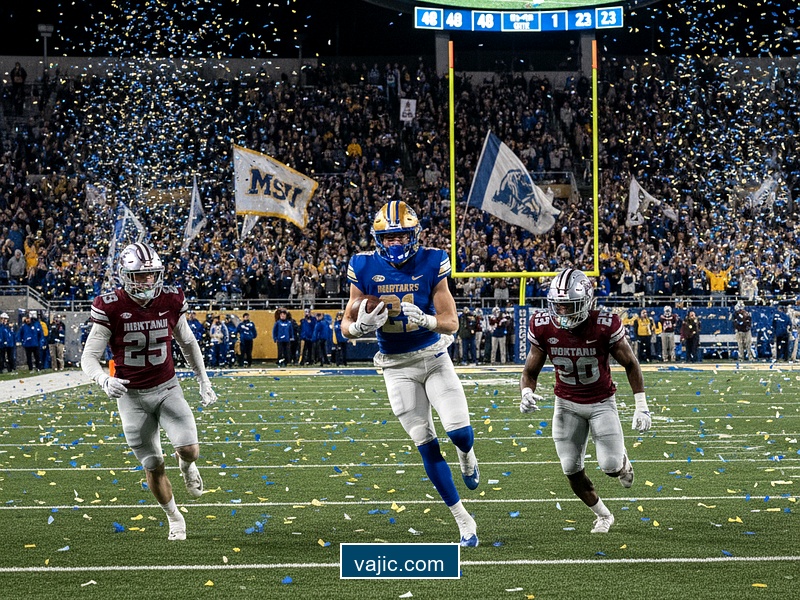
You can learn more about a football team in the five minutes before kickoff than you can in a season’s worth of press conferences. On Saturday, in the sub-zero air of Bobcat Stadium, the distinction was written in the hips and eyes of the athletes. During warmups, the Montana Grizzlies looked tight—shoulders hunched, movements jerky, eyes darting toward the opposing sideline. They looked like a team burdened by the history of the rivalry and the pressure of a semifinal.
Montana State? They looked bored. Loose hips, fluid stride lengths, methodical breathing. That physiological difference—the gap between anxiety and intent—manifested immediately in a 48-23 dismantling that sent the Bobcats to Frisco and the Grizzlies back to Missoula with an identity crisis.
The scoreline suggests a blowout, but the film reveals something far more damning: a schematic and physical submission. As a scout, you look for "quit" not in the grand gestures, but in the micro-movements of the fourth quarter. I saw safeties making business decisions in the alley. I saw defensive tackles standing up at the snap. This wasn't just a loss; it was a clinic in leverage.
The Geometry of Violence: MSU's Gap Scheme
To understand how MSU hung 48 points on a defense that prides itself on discipline, you have to look at the offensive line’s footwork, specifically on the counter-trey concepts. In their regular-season meeting, Montana successfully "spilled" these runs—meaning their defensive ends crashed hard inside, forcing the runner to bounce laterally to waiting linebackers.
Saturday was different. The Bobcats’ adjustments were subtle but devastating. Instead of standard splits, the MSU guards widened their alignment by six inches. This seemingly minor tweak forced the Montana 3-technique tackles to widen their stance, creating a natural washing angle for the down-blocks.
When you watch the tape of the Bobcats' 28-point second-half explosion, focus on the backside guard pulling. In November, he was pulling to kick out. In December, he was pulling to log. By sealing the defensive end inside rather than kicking him out, MSU turned the Griz's aggression against them. It changed the geometry of the run from a horizontal stretch to a vertical pierce. The Montana linebackers, expecting the ball to spill outside, were caught flat-footed, stuck in the wash of bodies while the back was already at the second level.
The most demoralizing thing in football isn't the deep pass; it's the six-yard run on 3rd and 5 where the defense knows exactly what is coming and still gets moved backward against their will.
Quarterback Mechanics: The Art of the Fake
Much will be written about the Montana State quarterback’s rushing yards, but the box score ignores the "unseen" labor: the mesh point mechanics. The Zone Read is often lazy in the FCS; quarterbacks stick the ball in the gut of the back and pull it based on a binary read. The MSU signal-caller, however, manipulated the Montana linebackers with his eyes, not just the ball.
There is a concept in scouting called "influence steps." On three separate touchdown drives, the MSU QB utilized a subtle shoulder dip away from the play direction before the snap. This false key caused the Montana safeties to rotate early, vacating the alley. When the ball was snapped, the QB wasn't reading the defensive end; he was reading the space the safety vacated. It’s high-level processing speed that usually doesn't show up until the NFL Combine.
Conversely, the Montana defense suffered from "hero ball" syndrome. You could see it in their pursuit angles. Instead of maintaining gap integrity—staying in their assigned lane—Griz defenders started peeking into the backfield, trying to make the splash play. Once a defense loses gap discipline against a heavy personnel run team like MSU, the structural integrity of the unit collapses. The 48 points were a direct result of individual Grizzlies trying to do too much, and consequently doing nothing.
The Myth of the Rematch Difficulty
Pundits love to parrot the cliché that "it's hard to beat a good team twice." History and analytics suggest otherwise, especially when the winning team possesses the physical advantage. The team that wins the collision at the line of scrimmage in the first game usually wins it more decisively in the second. Why? Because bruises accumulate. Doubt accumulates.
Montana State understood this psychological warfare. They utilized "heavy" personnel packages (13 personnel: 1 running back, 3 tight ends) early in the first quarter, not necessarily to run the ball, but to force Montana to match with their base defense. This tired out the Grizzlies' big bodies early. By the time the third quarter rolled around, the Montana defensive front was playing with high pads. In scouting terms, "pad level is the lie detector." When a lineman stands up, he's tired. Montana was exhausted by halftime.
Defensive Backfield: A Study in Hip Fluidity
While the trenches decided the tempo, the athleticism disparity on the perimeter sealed the coffin. The Montana State secondary played primarily in "press-bail" technique. They aligned tight to the line of scrimmage, feigning a blitz or press coverage, only to bail into deep zones at the snap.
This confused the Montana passing attack. The Griz quarterback repeatedly held the ball for an extra "hitch"—a delay in his drop-back timing—because the pre-snap picture didn't match the post-snap reality. That hesitation is fatal against a pass rush that gets home. The Bobcats’ cornerbacks showed elite hip fluidity, flipping their hips without losing speed to stay in phase with receivers. There were no "stiff" transitions. They dictated the route stems, forcing Montana receivers toward the sideline and shrinking the field.
The Big Sky Paradigm Shift
For a decade, the narrative of FCS dominance resided in the Missouri Valley Football Conference (MVFC). NDSU and South Dakota State built dynasties on the premise that no one else could match their physicality. Saturday’s semifinal proved that the center of gravity has shifted West. Montana State didn't win with "gimmicks" or "air raid" tactics; they won by out-muscling a program that defines itself by toughness.
This game was a referendum on recruiting profiles. MSU has clearly prioritized length and twitch in their front seven. The defensive ends possess the arm length to keep offensive tackles off their chest, allowing them to shed blocks and make plays on the ball carrier. Montana, by contrast, looked smaller and slower at the point of attack. They relied on scheme to generate pressure; MSU relied on personnel.
Frisco Bound
As the clock wound down and the snow began to settle on the synthetic turf, the body language disparity returned. The Montana State sideline wasn't frantic with celebration; they were shaking hands, checking tablets, and preparing for the next rep. They looked like professionals.
The National Championship in Frisco awaits, and whoever comes out of the other side of the bracket needs to worry. MSU isn't just winning games; they are breaking the will of their opponents. When you can rush for 300+ yards in a semifinal against your bitter rival, you aren't just a football team. You are a rolling ball of butcher knives.