
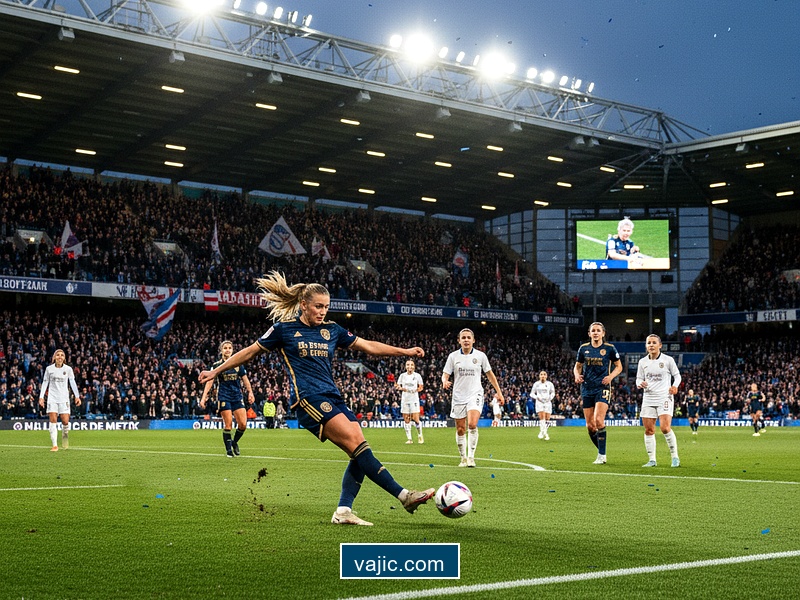
The swift, brutal decapitation of the coaching staff at London City Lionesses this week was not merely a sacking; it was a notification of intent. By dismissing Jocelyn Prêcheur, owner Michele Kang has officially imported the ruthless, blood-on-the-walls urgency of the elite men's game into the Barclays Women’s Championship. For those of us who have watched the slow, organic growth of the women's pyramid over the last two decades, this feels like a watershed moment—and not necessarily a comfortable one.
The headline is simple: Prêcheur is out. But the subtext is a complex treatise on the friction between hyper-capitalism and the attritional reality of England’s second tier.
The Ghost of Fulham Past
To understand the precarious position London City Lionesses currently occupy, we must look backward, past the current WSL boom, to the turn of the millennium. The current situation at Princes Park bears a haunting resemblance to the Mohamed Al-Fayed era at Fulham Ladies in the early 2000s.
In 2000, Al-Fayed decided Fulham would be the first fully professional women’s team in Europe. He threw money at the project with reckless abandon, signing the best players available, expecting to steamroll the amateur opposition. For a brief, shining moment, they did—winning the treble in 2003. But the project was synthetic. It lacked the roots of the Arsenal Ladies dynasty, and when Al-Fayed grew bored or frustrated with the lack of return on investment, the funding was slashed, and the club reverted to semi-pro status.
Michele Kang is not Al-Fayed—her multi-club ownership model involving the Washington Spirit and Olympique Lyonnais suggests a far more structural, long-term vision. However, the behavior exhibits the same terrifying impatience. Sacking Prêcheur, a man with a pedigree involving Paris Saint-Germain, implies that Kang believes the checkbook alone should have guaranteed dominance. She is learning a hard lesson: the Championship is a graveyard for egos.
The Galáctico Fallacy in the Mud
The recruitment strategy at London City this summer was nothing short of aggressive. Bringing in Kosovare Asllani was the women’s football equivalent of Middlesbrough signing Fabrizio Ravanelli in 1996, or perhaps more accurately, Robinho landing at Manchester City in 2008. Asllani is a technician, a mercurial talent accustomed to the pristine surfaces of the Champions League and the tactical nuance of elite international football.
Dropping a player of that profile into the English second tier creates a tactical dissonance that Prêcheur clearly failed to resolve. The Championship is not a league of tactical intricacy; it is a league of transition, physicality, and grinding attrition. It is a division defined by the likes of Durham or Birmingham City—teams that will happily kick you off the park and score from a set-piece.
"You cannot play Philharmonic music when you are standing in a mosh pit. Prêcheur was conducting a symphony, but the league demands heavy metal."
We saw this same disconnect with QPR in the men’s game around 2012. Tony Fernandes signed Champions League winners (Julio Cesar, Bosingwa) who viewed the club as a retirement home and the league as beneath them. The result was relegation. While LCL isn't fighting relegation, they are fighting for the singular, golden ticket of promotion, and a squad of mercenaries often lacks the cohesion to grind out a 1-0 win on a rainy Sunday in Sheffield.
The Tactical Mismatch: Why Prêcheur Failed
Prêcheur’s pedigree at PSG suggested a possession-dominant style. Analyzing the Lionesses' performances this season, the stats show a team comfortable with the ball but allergic to the final third. This is the classic "managerial idealism" trap.
In the Championship, possession without penetration is suicide. Teams sit deep, absorb the pressure, and hit on the counter. LCL has looked vulnerable in transition all season. The squad is top-heavy, loaded with creative midfielders and attackers, but lacks the gritty, unglamorous spine required to control games when the football isn't pretty.
Furthermore, the integration of so many new signings requires time—a commodity Kang clearly feels she cannot afford. When you sign 10+ new players, you destroy the dressing room hierarchy. We saw this with Chelsea in the early Roman Abramovich years (2003-2004). Claudio Ranieri was juggling so many new stars that the "Tinkerman" moniker became a curse. He was sacked despite finishing second. Prêcheur has fallen victim to the same dynamic: high investment creates an expectation of immediate perfection.
The Structural Gamble of the Multi-Club Model
This sacking highlights a specific flaw in the multi-club ownership model when applied to a lower-league side. London City Lionesses are effectively the "development project" in Kang's portfolio, sitting below the behemoths of Lyon and the Spirit. The danger is that the club loses its local identity and becomes a mere outpost for corporate ambition.
The decision to sack the manager suggests that decisions are being made based on a spreadsheet of expectations rather than the reality of the grass. The replacement will likely be tasked not with "building a project" but with "winning every game immediately." This narrows the pool of viable candidates significantly. They don't need a visionary; they need a pragmatist. They need a Sam Allardyce figure, spiritually speaking—someone who understands that getting out of the Championship requires pragmatism over purity.
The Table Never Lies
Looking at the current standings, LCL is not in a crisis of results by normal standards, but they are in a crisis of dominance. In a league where usually only one team goes up (a structural bottleneck that remains the biggest failing of the women’s pyramid), being "good" is insufficient. You have to be perfect.
| Era | Club Scenario | Outcome |
|---|---|---|
| Fulham (2000-2003) | Massive spending, turned pro early. | Won treble, owner pulled plug, collapse. |
| QPR Men (2012) | Aging stars, high wages, low cohesion. | Relegation and financial ruin. |
| Man City Women (2014) | Bought best domestic players, clear system. | Stabilized, then dominated. |
| London City (2024) | Global stars in 2nd tier, impatient owner. | manager sacked. Future uncertain. |
LCL is currently attempting the Manchester City 2014 speedrun but without the benefit of starting in the top tier (City were granted entry directly to the WSL). They are trying to brute-force their way through a league that prides itself on being a banana skin.
The Verdict
Michele Kang has pulled the lever. The sacking of Jocelyn Prêcheur removes the shield of "transition" from the players. Now, Asllani and her cohorts have nowhere to hide. If this expensively assembled squad fails to gain promotion, it will go down as one of the great financial miscalculations in the history of the domestic women's game.
This is no longer a fairy tale of an independent club fighting the big boys. It is a corporate takeover encountering the stubborn resistance of sporting reality. The next manager walks into a pressure cooker that would make early 2000s Stamford Bridge look like a meditation retreat.