
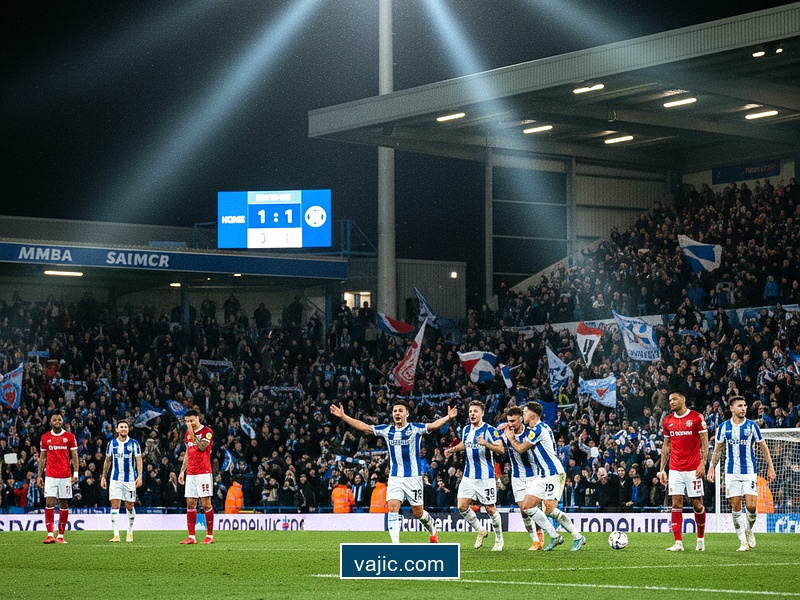
Ben Wiles returned to the ground that forged him not with a bouquet of flowers, but with a dagger hidden in his boot. In a match where Huddersfield Town desperately needed to arrest a six-game slide, their midfield architect treated his former home with the cold detachment of a professional assassin. The 3-1 victory was not just a win; it was a statement of severance from the past.
| METRIC | PREVIOUS 5 GAMES (AVG) | VS ROTHERHAM UNITED |
|---|---|---|
| Points Gained | 0.4 | 3.0 |
| First Half Intensity | Reactive | Dominant |
| Psychological State | Fragile | Resurgent |
Why The Numbers Matter
Football is often romanticized as a game of passion, but the cold reality lies in the columns of efficiency and momentum. The statistics above illuminate a stark transformation. For five games, Huddersfield Town wandered through the League One wilderness, lacking bite and direction. The contrast against Rotherham United was not subtle; it was violent. The "Dominant" designation for the first half is not hyperbole—it is the statistical reflection of a team, led by Wiles, that decided the contest before the halftime whistle ever blew. This was a correction of the trajectory, a realignment of potential versus performance.
The Return of the Native
There is a specific kind of cruelty reserved for the prodigal son who returns not to embrace his father, but to foreclose on the house. Ben Wiles knows every blade of grass at the New York Stadium. He knows how the wind swirls off the River Don and how the home crowd groans when a pass goes astray. For years, he was the heartbeat of Rotherham United, a local boy made good. Yet, this weekend, wearing the colors of Huddersfield Town, he became the architect of their misery.
The narrative coming into this fixture was heavy with anxiety for the visitors. Huddersfield had not tasted victory in six attempts. The pressure cooker was whistling. A lesser player, burdened by the sentimental weight of facing his former club, might have shrunk. He might have played the safe pass, avoided the heavy tackle, or disappeared into the midfield traffic. Wiles did the opposite. He seized the game by the throat from the opening minute.
The first half was less a football match and more an exorcism. Huddersfield blew Rotherham away, scoring three times before the hosts could even comprehend the shape of the game. At the center of this whirlwind was Wiles. He operated in the pockets of space he used to protect, turning Rotherham’s defenders—his former comrades—inside out. His movement was intelligent, sharp, and utterly devoid of mercy. He dictated the tempo, speeding up play when Rotherham gasped for air and slowing it down to kill their rhythm.
A Tale of Two Trajectories
While Wiles orchestrated Huddersfield's redemption, he simultaneously compounded the tragedy unfolding for his former employers. The atmosphere at Rotherham is turning toxic, a stark contrast to the relief flooding through the Terriers' camp. Wiles stood on the pitch as a symbol of what Rotherham has lost: quality, drive, and Premier League ambition. His performance highlighted the widening gulf between the two sides on the day.
The aftermath of the game painted a grim picture for the home side. The Rotherham manager's words were those of a man staring into the abyss, accepting culpability in a way that felt like a resignation of spirit, if not position.
“If I keep losing games, I'm a manager ... I get it – it's me. I'm fully aware of that.”
Wiles heard these echoes. He knows the pressure of that dressing room. But professionalism demands a certain level of amnesia. During the ninety minutes, friendship is suspended. He dismantled the system of a manager under fire, adding the heaviest stone yet to the burden carrying Rotherham down the table. It is the tragic nature of sport that one man's renaissance often requires another man's ruin. Wiles provided the spark that Huddersfield had missed for six long games, but in doing so, he may have scorched the earth of his beginnings.
Redemption in Blue and White
For Huddersfield Town, this player spotlight isn't just about a good performance; it's about the re-emergence of a leader. The winless run had raised questions about the character of the squad. Were they fight-ready? Could they handle the grit of a local derby away from home? Ben Wiles answered those questions with emphatic silence-breaking action.
This was a masterclass in modern midfield play—dynamic, aggressive, and technically superior. The "rewards" that Lee Grant spoke of were visible in the way Wiles linked defense to attack, transitioning the ball with a velocity that Rotherham simply could not handle. He embodied the team's renewed focus. The first half blitz wasn't luck; it was the product of intent, driven by a player who refused to let the slide continue.
As the final whistle blew, sealing the 1-3 scoreline, the contrast was complete. Rotherham sank into introspection, while Huddersfield rose. Ben Wiles walked off the pitch, perhaps with a heavy heart for his old friends, but with his head held high for his new allegiance. He did what champions do: he arrived when it mattered, ignored the noise, and delivered the knockout blow. The drought is over for the Terriers, and they have their midfield general to thank for leading them back to the promised land of three points.