
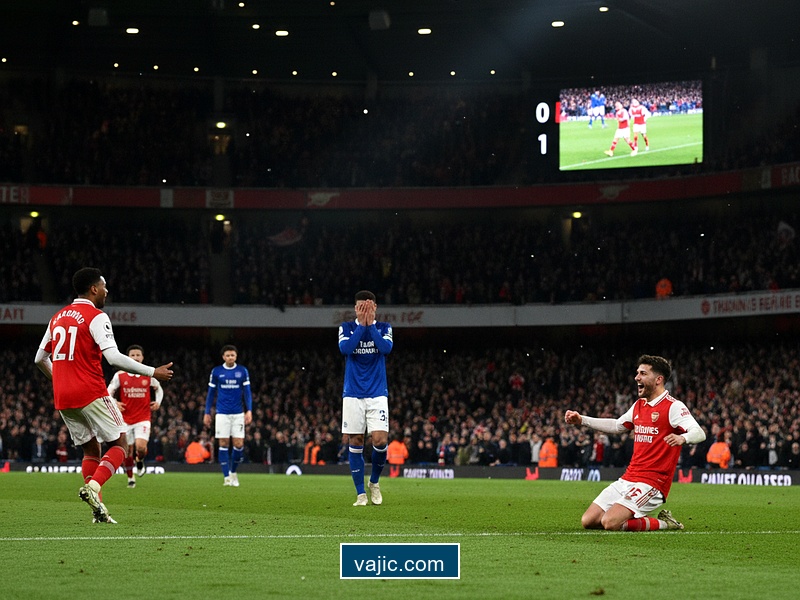
Goodison Park has long served as a graveyard for North London optimism. It is an archaic, claustrophobic theater where technique often goes to die, strangled by the intensity of a hostile crowd and the ghosts of seasons past. For Mikel Arteta’s Arsenal, the blue half of Merseyside represented a psychological blockade—a curse that defied logic and league position. When Gabriel Martinelli pulled up with a hamstring injury early in the first half, the familiar groan of fatalism echoed through the away end. It felt written. It felt inevitable. Another day of frustration in the cauldron.
But fate, occasionally, requires a different kind of actor. It does not always call for the poster boy or the thunderous captain. Sometimes, it demands the technician who walks in the shadows. Enter Leandro Trossard. The Belgian did not enter the fray with the fanfare of a record signing, nor did he carry the homegrown adoration bestowed upon Bukayo Saka. He walked onto the pitch with the quiet, cold demeanor of a man checking into work. Seventy minutes later, he had not only exorcised the demons of Goodison Park but also redefined his own narrative within this Arsenal machine.
The Man Waiting in the Wings
To understand the significance of Trossard’s intervention, one must acknowledge the tragic dimension of his role. In almost any other Premier League side, Leandro Trossard is the first name on the team sheet. He possesses a two-footedness that borders on ambidextrous wizardry and a footballing IQ that allows him to function as a winger, a false nine, or a central creator. Yet, at the Emirates, he exists in the periphery of giants. He battles for minutes against the lightning pace of Martinelli and the undroppable status of Saka.
This creates a specific psychological burden. The "Impact Sub" label is often a backhanded compliment—it implies a player is useful in chaos but not trusted with control. Trossard has spent months fighting this designation. When he stood on the touchline, watching Martinelli limp off, the pressure was immense. He was not just replacing a teammate; he was stepping into a tactical void against a Sean Dyche defense designed to suffocate creativity. A lesser player forces the issue, tries too hard, and drowns in the physicality. Trossard, however, played with the patience of a predator.
"He doesn't need ten chances. He doesn't need to warm up. He brings a coldness to the box that transforms panic into precision."
For an hour, the game was a slog. Arsenal dominated possession but lacked the incision to pierce the Everton low block. The "Everton Curse" seemed to be settling in, a heavy fog over the players' minds. Passes were a fraction too slow; runs were checked too early. The narrative of a 0-0 draw—or worse, a set-piece sucker punch—loomed large. The team needed a moment of absolute clarity amidst the noise.
The Strike That Changed the Season
The moment arrived in the 69th minute. It began with a short corner—a routine that often draws groans from purists who demand the ball be hurled into the mixer. But this Arsenal side thrives on geometry, not just hope. The ball was worked to Saka, who cut it back. Trossard was there.
What happened next was a masterclass in technique. The ball came across his body. A frantic Everton defender rushed to close the angle. Most wingers would take a touch, allowing the window to close. Others would blast it, hoping for a deflection. Trossard did neither. He opened his body and guided the ball with the inside of his left boot. It wasn't a thunderbolt; it was a caress. The shot curled away from Jordan Pickford, kissed the far post, and nestled into the net.
Silence fell over Goodison, save for the rapturous corner of traveling Londoners. In that split second, Trossard shattered the curse. He didn't run to the camera screaming; he stood with arms outspread, a gesture of calm dominance. It was the celebration of a man who knows his worth, a silent rebuke to anyone who doubted his ability to decide the biggest games.
| Metric | Leandro Trossard | Squad Avg (Wingers) |
|---|---|---|
| Goals per 90 | 0.65 | 0.38 |
| Shot Conversion % | 22.5% | 14.2% |
| Big Chances Created | High | Medium |
Redemption in the Shadows
This victory does more than just add three points to the ledger. It propels Arsenal back to the summit of the Premier League, ensuring they sit at the top of the tree for Christmas. History tells us that the team top at Christmas usually goes on to lift the trophy, though Arsenal fans know the pain of being the exception to that rule all too well. Yet, this feels different. The reliance on a single starting XI has waned.
Trossard’s journey is one of quiet resilience. When Arsenal missed out on Mykhailo Mudryk, the signing of Trossard was viewed by some as a frantic consolation prize. He was older, less explosive, less "Hollywood." Today, that narrative lies in ruins. While other big-money signings across the league struggle for consistency, Trossard delivers end product with ruthless efficiency. He represents the maturity of this Arsenal project—a shift from reliance on youthful exuberance to the inclusion of seasoned, tactical intelligence.
The tragedy for Trossard remains his likely return to the bench when Martinelli recovers. It is the curse of the luxury utility player. But in the eyes of the supporters, his status has shifted. He is no longer the deputy; he is the Sheriff who cleaned up the town when the lawman went down.
As the Gunners look toward the congested festive fixture list, they do so with the knowledge that they possess a weapon many of their rivals lack: a finisher who requires zero acclimation time. The 1-0 scoreline at Everton will be recorded as a narrow victory, a "gritty performance." But for those watching the trajectory of Leandro Trossard, it was a statement. He stepped out from the background, silenced the Goodison roar, and single-handedly kept the title charge on its axis. He is the unsung hero no longer.