
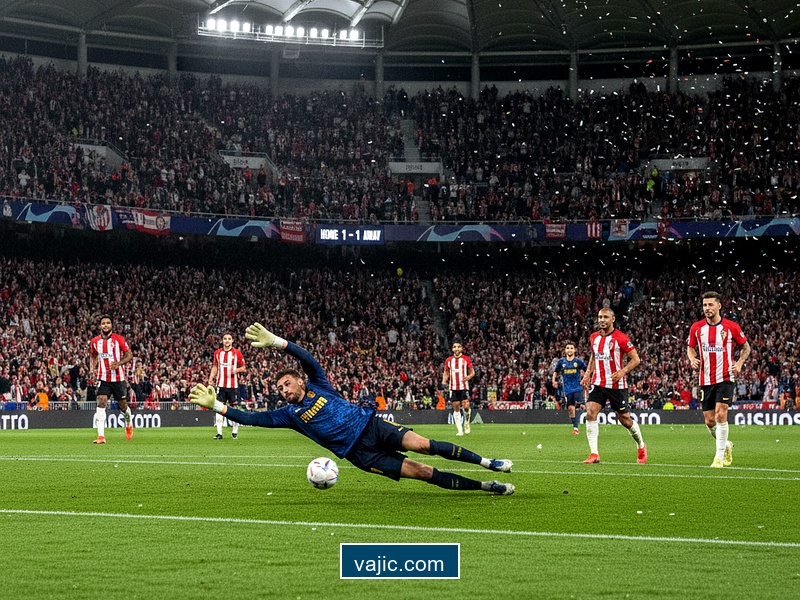
"We need to improve our football. It is not enough to just win; we must control the game."
When a goalkeeper of Thibaut Courtois's caliber issues a public mandate regarding the quality of play, it is rarely an emotional outburst. It is a diagnostic assessment from the player with the most comprehensive view of the pitch. Courtois stands at the apex of the defensive triangle, watching the structural integrity of the team unfold—or collapse—in front of him. His recent comments following Real Madrid’s unconvincing performances suggest a frustration not with effort, but with geometry.
The narrative surrounding Carlo Ancelotti’s side often leans on the "magic" of the Bernabéu or the individual brilliance of Vinícius Júnior and Kylian Mbappé. However, magic is not a metric. Courtois is reacting to a tactical regression that has seen Los Blancos lose control of the central corridors and suffer in defensive transitions. The current setup forces the Belgian shot-stopper into a volume of high-quality saves that is unsustainable for a title-contending side.
The Disconnected Pressing Structure
The root cause of Courtois's concern lies in the vertical compaction of the team. Modern elite football relies on a compressed shape, usually keeping the distance between the center-backs and the center-forwards to under 25 meters during the defensive phase. Watching Real Madrid’s recent outings, this distance frequently expands to 40 or 45 meters.
This expansion occurs due to a disjointed trigger mechanism in the high press. The forward line, often comprised of Mbappé and Vinícius, initiates a press without the requisite support from the midfield line. When the forwards jump, but the pivot (typically Aurélien Tchouaméni or Federico Valverde) remains deep to protect against long balls, a massive chasm opens in the midfield.
Opponents exploit this by dropping a "number 6" or an inverted fullback into this vacuum. Once the first line of pressure is bypassed, the opponent has time to turn and drive at an exposed back four. This forces the center-backs to step up aggressively, breaking their defensive line and creating channels for through-balls—scenarios that leave Courtois in one-on-one situations far too often.
The Toni Kroos Void: Loss of Tempo Control
Tactical analysis cannot ignore the structural deficit left by Toni Kroos. Courtois’s plea to "improve our football" is a direct reference to ball retention and game management. Kroos operated as the team's metronome, utilizing lateral distribution to shift opposition blocks and create fatigue.
The current midfield profile is exceedingly athletic but lacks a natural regista. Valverde, Camavinga, and Bellingham are vertical carriers. Their instinct is to drive the ball forward into space. While dynamic, this verticality results in shorter possession sequences and more frequent turnovers.
| Midfield Metric | 2023/24 (With Kroos) | 2024/25 (Current) | Tactical Implication |
|---|---|---|---|
| Possession Reset % | 42% | 28% | Fewer safety passes to reorganize shape. |
| Vertical Prog. Speed | 4.2 m/s | 6.8 m/s | Rushed attacks leading to open counters. |
| Opponent Transitions | 8.5 per game | 14.2 per game | More chaos for the backline to handle. |
Without a controller to recycle possession, Real Madrid enters a "basketball match" state—end-to-end transition wars. This suits the physical attributes of their midfielders but exposes the defense. Every time the ball is lost vertically, the team is stretched. Courtois wants "football" which, in this context, implies La Pausa—the ability to slow the game down, compress the team shape, and deny the opponent the chaos they thrive on.
Defensive Role Allocation: The Left-Side Overload
Heat maps from recent fixtures display a disturbing asymmetry. Real Madrid attacks heavily down the left flank (Vinícius and Mbappé drifting left), but they also concede the highest volume of progressive passes on that same side.
The tactical issue here is the "Rest Defense" configuration. When Real Madrid attacks, the left-back (Mendy or Garcia) pushes high to provide width, allowing Vinícius to tuck inside. However, neither Vinícius nor Mbappé offers consistent defensive tracking back. This leaves the left-sided center-back (often Rüdiger or Alaba) isolated in wide areas against opposition wingers.
Courtois finds himself having to cover the near post and the cut-back zone simultaneously because the defensive chain has been pulled apart. The Belgian is effectively demanding that the coaching staff implement a more rigid asymmetrical structure: if the left side overloads the attack, the right side (Carvajal/Valverde) must tuck in to form a back three, rather than overlapping and leaving two center-backs to defend the entire width of the pitch.
The Solution: Restoring Compactness
Fixing the issues Courtois highlighted requires a shift in formation philosophy. The experimentation with a fluid front three must be grounded by a fixed double pivot in midfield. By deploying two holding midfielders rather than a single pivot, Ancelotti can secure the central channels.
This creates a "box midfield" when in possession (3-2-2-3), ensuring that if the ball is lost, there are four central players ready to counter-press immediately. This reduces the travel distance for the defensive line and keeps the block compact.
Courtois is arguably the best goalkeeper in the world, but his shot-stopping ability should be the emergency brake, not the primary defensive strategy. His comments serve as a tactical alarm bell. Real Madrid possesses the talent to dominate, but without re-establishing the geometric connections between the lines—specifically the distance between the press and the cover—they remain a team of moments rather than a cohesive unit. The data sup