
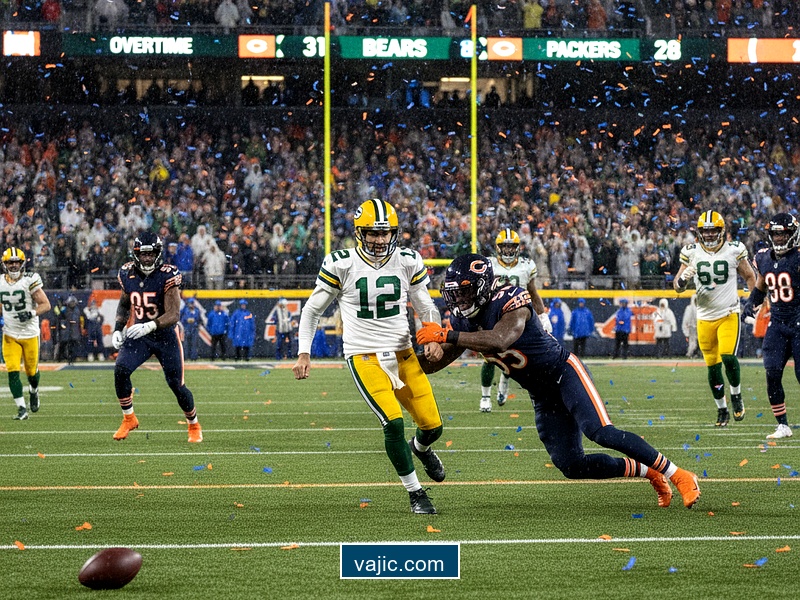
Matt LaFleur’s offensive architecture bent significantly to accommodate Malik Willis, transforming Green Bay’s attack into a heavy RPO-based system that nearly succeeded. However, the game ultimately swung on Chicago’s ability to manipulate leverage in the secondary and Caleb Williams' capacity to extend plays against a tiring pass rush. This wasn't just a win; it was a schematic dismantling of Green Bay’s containment principles in the deepest waters of overtime.
| Metric | Green Bay (Willis) | Chicago (Williams) |
|---|---|---|
| Scheme Identity | Heavy 12 Personnel / RPO | 11 Personnel / Spread Concept |
| Time to Throw (Avg) | 2.45s (Designed Quick) | 3.12s (Creation Phase) |
| 3rd Down Success Rate | 42% (Schemed Open) | 58% (Improvisational) |
| Defensive Pressure Rate | 31% (Simulated Pressures) | 24% (4-Man Rush) |
Why The Numbers Matter
The statistical divergence in "Time to Throw" highlights the fundamental tactical battleground of this matchup. Green Bay operated under strict structural constraints to protect Malik Willis, relying on pre-snap motion and quick-game concepts to neutralize Chicago's pass rush. Conversely, Caleb Williams’ extended time in the pocket was not a product of offensive line dominance, but rather a deliberate tactical choice to stretch Green Bay’s zone coverage horizontally until seams appeared. The Bears accepted negative plays early to generate explosive variance late, a strategy that paid dividends in the extra period.
Deconstructing the Willis System
The narrative suggests Malik Willis simply "played well," but the film reveals a coaching masterclass in constraint-based playcalling. LaFleur essentially deleted the deep drop-back passing game, replacing it with a horizontal stretch philosophy rooted in the run game. By utilizing heavy 12 personnel (one running back, two tight ends), the Packers forced the Bears into base defensive packages, creating advantageous matchups for their perimeter weapons.
On standard downs, Willis was tasked with simple binary reads: key the conflict defender (usually the weakside linebacker) and execute. If the linebacker fills the run gap, throw the slant or the bubble; if he drops into coverage, hand the ball off. This RPO-heavy approach effectively neutralized Chicago's aggressive front four for three quarters. The Bears' defensive line, conditioned to pin their ears back, found themselves frozen by the mesh point, slowing their get-off and buying the Packers' offensive line crucial leverage.
However, this system has a ceiling. Once the field compressed in the red zone and overtime, the lack of vertical threat allowed Chicago’s safeties to flatten their depth. They triggered downhill faster, confident that Willis would not—or could not—exploit the seams behind them. This constriction proved fatal on the final sequences where the windows became nonexistent.
Caleb Williams and the 'Second Reaction' Offense
While Green Bay played within a rigid structure, Chicago thrived in chaos. The "OT magic" attributed to Williams is better understood as the weaponization of the "scramble drill." When a play breaks down, most offenses have generic rules: receivers flow with the quarterback. Chicago, however, has refined this into a specific tactic to stress Green Bay’s zone integrity.
Green Bay utilized a predominantly Cover 3 shell to keep everything in front of them. The weakness of Cover 3 lies in the flats and the deep seams between the cornerback and the safety. Williams repeatedly exploited this by holding the ball. As he broke the pocket, Green Bay’s linebackers were forced to make a decision: maintain depth to protect the intermediate crossers or step up to contain the quarterback run.
"When you break containment against a zone defense, you turn eleven disciplined defenders into eleven individuals staring at the quarterback. That is where the coverage busts happen."
In overtime, Williams manipulated the "Green Dog" blitz rules of the Packers. When Green Bay sent a linebacker to spy or pressure late, it vacated a zone. Williams showed elite processing speed to identify the voided space instantly. His winning plays were not Hail Mary heaves but precise strikes into zones vacated by defenders who were lured out of position by his mobility.
Defensive Adjustments: The Chicago Clamp
The shift that strengthened the Bears' grip on the NFC North occurred on the defensive side of the ball during the fourth quarter and overtime. Early in the game, the Bears respected the threat of the Packers' run game too much, playing single-high safety looks to drop an extra defender in the box. This left their corners on islands, which Willis exploited with quick outs.
The adjustment in the late stages was subtle but decisive. Chicago shifted to a "Quarter-Quarter-Half" look (Cover 6) on critical downs. This hybrid coverage rotated the strength of the secondary toward the Packers' primary receiving threats while keeping a light box. They dared Willis to run the ball into light fronts knowing the clock was the real enemy.
Crucially, PFF grades likely reflect the struggles of the Packers' interior offensive line in pass protection during these moments. By widening their defensive ends to a "Wide 9" alignment, Chicago isolated Green Bay’s tackles, forcing the guards to help outside or leave the B-gaps exposed. This created one-on-one matchups for the interior defensive tackles against Green Bay’s center and guards—matchups Chicago won decisively in overtime. The resulting interior pressure prevented Willis from stepping up, forcing him to drift backward into the waiting arms of the edge rushers.
The Overtime Sequence: A Case Study in Variance
The final sequence exemplified the difference between playing not to lose and playing to win. Green Bay’s defensive coordinator called a conservative game in overtime, relying on a four-man rush and soft zones to force Williams to check down. The logic is sound: force the rookie to string together 12 perfect plays to score.
Chicago countered this by altering route combinations. Instead of standard West Coast spacing, they utilized "Switch" concepts (receivers crossing paths at the line of scrimmage) to create natural rubs and confuse assignment responsibilities in the secondary. Against Green Bay’s man-match zone principles, these switch releases caused momentary hesitation among the defensive backs.
Williams identified the hesitation. On the decisive play, he recognized the safety rotation spinning down late. By holding the safety with his eyes in the middle of the field, he opened the outside lane. It was a high-level manipulation that turned a 50/50 ball into a 70/30 advantage. The result strengthens the Bears' tactical resume heading into the postseason, proving they possess the schematic flexibility to win even when the initial game plan dissolves.