
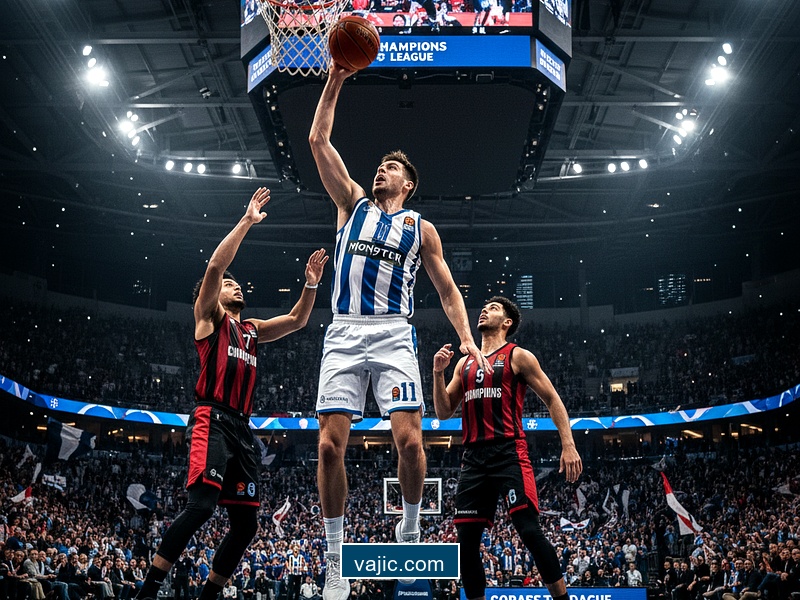
The lights of the Champions League act as a relentless truth serum. There is no hiding in the chaotic, physical brand of international basketball. You either crumble under the weight of expectations, or you carve out your legacy in sweat and iron. For Jack White, a man who has touched the golden trophy of the NBA but spent too much time in the shadows of superstars, Tuesday night was not just a game. It was a declaration of war against obscurity.
The Australian forward didn't just play; he erupted. In a performance that will be circled by scouts from the EuroLeague to the NBA, White posted a double-double so dominant it felt less like a statistic and more like a physical imposition of will. He controlled the airspace, shattered defensive schemes, and reminded every observer that while his stint in the United States might have been quiet, his game screams at a deafening volume.
The Analysis: Beyond the Box Score
To understand the magnitude of White’s performance, one must look past the raw numbers. Twenty-two points and fourteen rebounds constitute a great night for anyone, but the way White achieved them tells the story of a player seeking redemption. This was not a finesse game. He did not float around the perimeter waiting for kick-outs, nor did he stat-pad in garbage time.
White played with a violent desperation. Six offensive rebounds are the metric of pure effort. It signifies six times he was beaten, boxed out, or out of position, and simply decided that he wanted the ball more than the man standing next to him. In the Champions League, where the physicality often resembles rugby more than ballet, White thrived. He utilized his low center of gravity and deceptive wingspan to turn the paint into his personal property. Every missed shot by his teammates became a pass to Jack White.
His scoring was equally pragmatic. He punished smaller defenders in the post and blew past slower centers on the perimeter. He showcased the modern skillset that made him a Duke captain years ago: the ability to be a Swiss Army knife that suddenly transforms into a sledgehammer.
The Shadow of the Ring
The narrative of Jack White is often reduced to a single shiny object: his NBA Championship ring with the Denver Nuggets. It is the ultimate accolade in the sport, yet for a competitor like White, it likely carries a complicated emotional weight. He was on the roster, he practiced with Jokic, he wore the uniform, but he watched the glory from the sidelines.
Being a "human victory cigar" or a bench warmer on a championship team is a strange purgatory for an elite athlete. The world sees you as a winner, but inside, the fire burns to prove you contributed. You want to prove you are not just a passenger on the bus, but a driver.
That shadow followed him out of Denver and into the G-League, and eventually back to the international stage. Critics labeled him a "glue guy"—a euphemism for a player who tries hard but lacks the talent to take over a game. This Champions League performance took a sledgehammer to that label. White didn't glue the team together; he carried them on his back. He stepped out of the shadow of the NBA bench and cast a giant shadow of his own across the court.
The Duke DNA and Australian Grit
We often forget the pedigree Jack White possesses. He captained Duke University under Mike Krzyzewski. You do not earn that role by being passive. You earn it through maniacal discipline and a high basketball IQ. Combine that tactical education with the inherent grittiness of Australian basketball, and you create a prototype perfectly suited for the FIBA game.
In this monster double-double, we saw the synthesis of those two worlds. On one possession, he read the defensive rotation perfectly—the Duke education kicking in—to slip a screen and find open space. On the next, he simply put a shoulder into a defender’s chest and ripped a rebound down with two hands—the Aussie grit taking over.
| Attribute | Impact on Game | Rating |
|---|---|---|
| Motor | Relentless pursuit of 50/50 balls. | Elite |
| Rebounding | Secured extra possessions (6 Off. Reb). | World Class |
| Finishing | Scored through contact in the paint. | High |
A Career at the Crossroads
At 27 years old, White stands at a pivotal intersection. The path of the journeyman is easy to fall into—jumping from league to league, collecting checks, and fading into the statistical averages. But games like this suggest a different trajectory. They suggest a player entering his physical prime who refuses to settle for mediocrity.
This performance in the Champions League serves as a billboard for teams globally. It says that Jack White is not just a role player to round out a rotation. He is a focal point. He is a double-double machine capable of swinging the momentum of high-level games. The "Monster" tag in the headline is not hyperbole; it is a recognition of the terror he instilled in the opposing frontcourt.
The tragedy of sport is often wasted potential. The heroics come when that potent